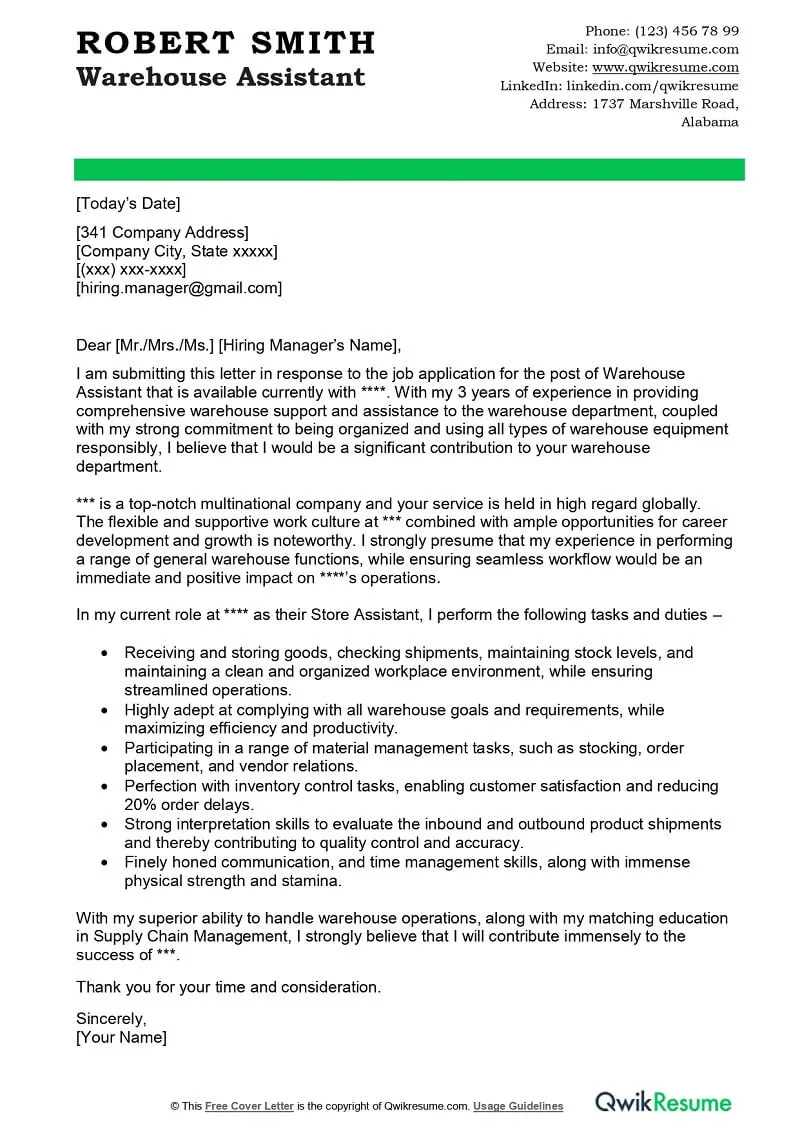
What is a Warehouse Cover Letter?
A warehouse cover letter is a document you submit with your resume when applying for a warehouse job. Its purpose is to introduce yourself to the hiring manager, highlight your relevant skills and experience, and express your interest in the position. Unlike your resume, which provides a concise overview of your qualifications, your cover letter allows you to elaborate on your strengths, explain why you’re a good fit for the role, and demonstrate your enthusiasm for the opportunity. It’s your chance to make a strong first impression and convince the employer to consider you for an interview. Think of it as a personal introduction that complements your resume and helps you stand out from other applicants.
Why is a Cover Letter Important for a Warehouse Job?
While a resume provides factual details, a cover letter allows you to showcase your personality and explain how your skills align with the specific requirements of the warehouse job. It gives you the opportunity to elaborate on your experiences, highlighting how you’ve successfully handled similar responsibilities in the past. This can include detailing instances where you improved efficiency, reduced errors, or contributed to a safer work environment. Moreover, a well-crafted cover letter shows your genuine interest in the position and the company. It demonstrates that you’ve taken the time to understand the role and are motivated to contribute to their success. It is a crucial tool for demonstrating your communication skills.
Key Elements to Include in Your Warehouse Cover Letter

To create a compelling warehouse cover letter, several key elements are essential. These components work together to present you as a qualified and enthusiastic candidate. Ensuring all of these elements are included will significantly improve your chances of making a positive impression on the hiring manager. Each section plays a vital role in showcasing your suitability for the warehouse position.
Your Contact Information
Start your cover letter by providing your contact information at the top. This typically includes your full name, phone number, email address, and optionally, your LinkedIn profile URL. Make sure your email address is professional and that your voicemail greeting is clear. Double-check that the phone number is current and accessible. This is the most fundamental step, but it’s crucial for the hiring manager to be able to reach you easily. Ensure your contact information is accurate so they can contact you for an interview.
Hiring Manager’s Information
If possible, address your cover letter to a specific person. Research the company’s website or LinkedIn to find the hiring manager’s name and title. Addressing the letter directly shows that you’ve taken the time to personalize your application, which can make a positive impression. If you cannot find the name of the hiring manager, you can use a general greeting such as “Dear Hiring Manager” or “Dear [Company Name] Hiring Team.”
Greeting

Use a professional greeting such as “Dear Mr./Ms./Mx. [Last Name]” or “Dear Hiring Manager.” Avoid informal greetings like “Hi” or “Hello.” Ensure that you spell the name correctly. Using the hiring manager’s name is more personal. If you do not know who the hiring manager is then simply use “Dear Hiring Manager.” The greeting sets the tone for the entire letter, so start with a professional and respectful approach.
Opening Paragraph Grab Attention
The opening paragraph is your chance to grab the reader’s attention. State the position you’re applying for and briefly explain why you’re interested in the role and the company. Consider mentioning a specific accomplishment or skill that aligns with the job requirements to show that you’re a strong candidate from the start. Focus on making your introduction concise, compelling, and clearly indicate your enthusiasm for the position. This first paragraph will either make the hiring manager want to continue reading, or not.
Highlighting Your Skills and Experience
In the main body of your cover letter, highlight your relevant skills and experiences. Refer to the job description and identify the key requirements. Provide specific examples of how your skills and experience align with the job. Use the STAR method (Situation, Task, Action, Result) to describe your accomplishments. This helps the hiring manager understand your impact in previous roles. By using clear and concise language, you will demonstrate that you are a strong fit for the position.
Relevant Skills for Warehouse Positions

Warehouse positions require a specific set of skills. List these skills and provide examples of how you have used them in the past. Examples include using forklifts, operating warehouse management systems, inventory management, order fulfillment, and experience with shipping and receiving. Also, mention any experience with safety protocols, teamwork, and physical stamina. Tailor your descriptions to match the specific job description. Be specific about the equipment you can operate. This shows that you understand the core requirements of a warehouse job.
Warehouse Experience Tips
When discussing your warehouse experience, provide specific details about your previous roles. Describe the size and type of warehouse you worked in, and the products you handled. Mention any specializations, such as experience with hazardous materials or temperature-controlled environments. Be clear about your responsibilities. Provide examples of how you worked effectively in a team environment. Also, highlight any training or certifications you have. This information gives the hiring manager a comprehensive view of your capabilities.
Quantify Your Achievements
Whenever possible, quantify your achievements. For example, instead of saying “Improved efficiency,” say “Increased order processing efficiency by 15%.” Use numbers to demonstrate the impact you had on previous employers. This makes your accomplishments more concrete and persuasive. Highlight any time or cost savings, or any positive results you achieved in previous roles. By quantifying your achievements, you showcase your value to the hiring manager. Use action verbs and provide data to show your value to the hiring manager.
Demonstrating Your Value

Focus on demonstrating the value you can bring to the company. Explain how your skills and experience align with the company’s needs and the specific job requirements. Show that you understand the company’s goals and how you can contribute to their success. Highlight any unique skills or experience that make you stand out from other candidates. Tailor your cover letter to the specific requirements of the job to help you clearly demonstrate the value you can offer. Research the company beforehand and tailor your application to their specific needs.
Expressing Enthusiasm
Convey your enthusiasm for the position and the company. Explain why you are interested in working for them and what excites you about the opportunity. Show that you’ve researched the company, understand their mission, and are eager to contribute to their success. Your enthusiasm will make you a memorable candidate. Be sincere and genuine in your expression. A genuine interest in the company will make your application stand out.
Call to Action
End your cover letter with a clear call to action. Indicate your availability for an interview and express your eagerness to discuss your qualifications further. Thank the hiring manager for their time and consideration. Reiterate your interest in the role. Provide your contact information again to make it easy for the hiring manager to reach you. By providing a clear call to action, you make it simple for the hiring manager to take the next step.
Closing and Signature

Use a professional closing such as “Sincerely,” “Respectfully,” or “Best regards.” Type your full name below your closing. If you’re submitting a digital cover letter, you might also include a digital signature. Ensure your signature is clear and professional. This closing should be polite and leave a lasting positive impression. Your goal is to leave the reader with a professional final impression.
Formatting Your Warehouse Cover Letter
Formatting your cover letter correctly is crucial for readability and professionalism. Use a standard, easy-to-read font such as Times New Roman, Arial, or Calibri, with a font size between 10 and 12 points. Use 1-inch margins on all sides of the document. Keep your letter concise. Aim for one page. Use clear headings and bullet points to break up the text and make it easier to read. Proofread your cover letter carefully for any errors in grammar and spelling. Proper formatting ensures your cover letter is professional and easy to read.
Tips for Proofreading and Editing
Before submitting your cover letter, carefully proofread it for any errors. Check for grammar, spelling, and punctuation mistakes. Read your cover letter aloud to catch any awkward phrasing or repetitive language. Have a friend or family member review your cover letter for clarity and accuracy. Use a grammar checker tool to catch any errors you may have missed. Proofreading is a vital step to ensure that your cover letter is polished and professional, making a positive impression on the hiring manager.
Common Mistakes to Avoid

Avoid common mistakes that can damage your chances. Do not use a generic cover letter. Always tailor your letter to the specific job and company. Avoid typos, grammatical errors, and overly long sentences. Do not use jargon or slang. Be positive and professional. Avoid negative language or complaints about previous employers. Do not exaggerate your skills or experience. Be honest and accurate. Ensure you submit your cover letter in a professional format. Avoiding these common mistakes will improve your application.
Warehouse Cover Letter Examples
Reviewing cover letter examples can help you understand how to format and structure your own. Many online resources offer sample cover letters for various warehouse positions. You can find templates and examples that you can adapt to your specific skills and experience. Use these examples as a guide. But always make sure to personalize your cover letter. Tailor your letter to the job and the company to demonstrate your understanding of the role and the company.
Warehouse Worker Cover Letter Example
A warehouse worker cover letter should highlight your experience with receiving, storing, and distributing goods. You should emphasize your ability to operate warehouse equipment. Include your knowledge of inventory management, and your attention to detail. Show your ability to work as part of a team and your commitment to workplace safety. Highlight any certifications you have, such as forklift operation. By providing these details, you can show the hiring manager that you are a well-suited candidate.
Warehouse Associate Cover Letter Example
A warehouse associate cover letter should emphasize your skills in order fulfillment and customer service. Highlight your ability to work in a fast-paced environment and your experience with shipping and receiving. Detail your experience with warehouse management systems. Demonstrate your ability to handle inventory, process orders, and maintain a clean and organized workspace. Mention any experience with quality control and your willingness to take on new tasks. Detail your familiarity with safety protocols and your dedication to ensuring workplace safety.
Warehouse Manager Cover Letter Example
A warehouse manager cover letter should emphasize your leadership skills, your experience in managing warehouse operations, and your ability to improve warehouse efficiency. Focus on your experience with budgeting, inventory control, and performance management. Highlight your knowledge of warehouse management systems and your ability to implement safety protocols. Show your experience in training and managing warehouse teams. Demonstrate your success in reducing costs and improving productivity. Emphasize any achievements related to optimizing warehouse processes or streamlining operations.
Tailoring Your Cover Letter
Tailoring your cover letter to each specific job application is essential. Customize your letter to reflect the requirements of the role and the company’s values. Use keywords from the job description to show you’ve read it carefully. Highlight skills and experiences that are most relevant to the position. Research the company and understand their goals and needs. By customizing your cover letter, you demonstrate your genuine interest and that you’re a strong fit for the specific role.
Researching the Company
Before writing your cover letter, research the company thoroughly. Visit their website, read their mission statement, and learn about their products or services. Understand their values and culture. Check their social media profiles to get a sense of their brand. This research helps you tailor your cover letter to the company’s specific needs and show that you have a genuine interest in working for them. Show that you understand their challenges and how you can contribute.
Matching Skills to Job Descriptions
Carefully review the job description and identify the key skills and qualifications the employer is seeking. Highlight the skills and experiences in your cover letter. Use keywords from the job description. Provide specific examples of how you have demonstrated those skills in the past. Customize your cover letter to match the job requirements. This will show the hiring manager that you have carefully considered the requirements of the role. This will help your cover letter get past the screening process.
Sending Your Cover Letter
When sending your cover letter, ensure it’s in a professional format. Save your cover letter as a PDF to preserve the formatting. Attach your cover letter and resume to your email. Use a clear and professional subject line. Address the email to the hiring manager or the hiring team. Proofread your email before sending it to ensure it is free of errors. Sending a well-formatted, error-free cover letter demonstrates attention to detail.
Best Practices for Submission
Follow the specific instructions provided in the job posting. If the job posting specifies a particular way to submit your application, follow those instructions. If the job posting does not provide instructions, you can use a PDF format for both your resume and cover letter. Include your name and the job title in the file names. If you apply online, ensure the application form is filled out completely and accurately. Following the instructions shows you are capable of following directions.
Follow-Up Strategies
Follow up on your application after a reasonable period, typically a week or two. Send a polite email to the hiring manager to express your continued interest in the position. Briefly reiterate your key qualifications and express your enthusiasm for the opportunity. Thank them for their time. If you haven’t heard back after a second follow-up, consider sending a brief email. Be professional and persistent, but avoid excessive follow-up. Following up demonstrates your interest and initiative.