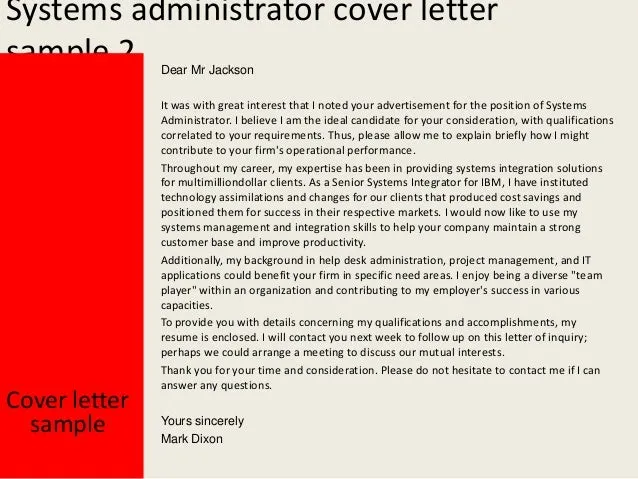
Understanding the Importance of a Sys Admin Cover Letter
In the competitive world of IT, particularly for System Administrators, a well-crafted cover letter can be your golden ticket to landing an interview. It’s more than just a formality; it’s your first opportunity to make a strong impression and distinguish yourself from other applicants. A cover letter acts as a personalized introduction, allowing you to go beyond the bullet points of your resume and showcase your personality, enthusiasm, and specific qualifications that align with the job requirements. It’s where you tell your story, highlighting your relevant experience and illustrating why you’re the ideal candidate. In essence, a cover letter is your personal sales pitch – and it’s crucial to get it right to get hired.
Why a Cover Letter Matters
While your resume provides a snapshot of your skills and experience, a cover letter allows you to provide context. It explains why you’re interested in the specific role and company, demonstrating that you’ve done your homework. A cover letter can also address any potential red flags in your resume, such as gaps in employment or a career change, by explaining the circumstances and framing them positively. Moreover, it allows you to highlight soft skills, such as communication, problem-solving, and teamwork, which are essential in a Sys Admin role but often overlooked in a resume. It’s your opportunity to show that you’re not just qualified but also a good fit for the company culture. A well-written cover letter signifies professionalism, attention to detail, and a genuine interest in the opportunity, all of which are qualities employers seek.
Highlighting Your Skills

Your cover letter is the perfect place to showcase your key technical and soft skills. Instead of just listing your abilities, provide examples of how you’ve applied them in past roles. For instance, instead of stating “Proficient in Windows Server administration”, you could write, “Managed and maintained Windows Server environments, successfully reducing server downtime by 15% through proactive monitoring and patching strategies.” When discussing technical skills, be specific. Mention the technologies you’re familiar with, such as virtualization platforms (VMware, Hyper-V), cloud services (AWS, Azure, GCP), scripting languages (PowerShell, Python), and networking protocols (TCP/IP, DNS, DHCP). Similarly, highlight your soft skills, such as communication, problem-solving, and ability to work under pressure. Use the STAR method (Situation, Task, Action, Result) to describe your accomplishments, making your achievements tangible and impactful. By doing so, you convince the hiring manager that you can deliver results.
Formatting Your Sys Admin Cover Letter
A well-formatted cover letter is just as important as its content. It demonstrates professionalism and attention to detail. Always use a professional font like Arial, Calibri, or Times New Roman in a readable size (11 or 12 points). The letter should be single-spaced with a space between paragraphs. Keep the letter concise, aiming for one page, and use clear headings and subheadings to organize your thoughts and make the letter easy to read. Ensure your contact information is accurate and up-to-date and include the date, the hiring manager’s name (if known), and the company’s address. Proper formatting ensures that the hiring manager can easily absorb the information and appreciate your attention to detail. Remember that presentation matters, and a well-formatted letter showcases your commitment to excellence.
Contact Information
At the top of your cover letter, include your full name, phone number, email address, and your LinkedIn profile URL (if you have one). Make sure your email address sounds professional and that your voicemail message is also professional. This information should be clearly visible and easy to find. Review it carefully to avoid any errors, ensuring the recruiter can easily contact you. Ensure your contact information matches that on your resume to maintain consistency. This section is vital as it provides the means for a potential employer to reach out to you if they are interested in your qualifications and experience.
Greeting and Introduction

Start your cover letter with a professional greeting, such as “Dear Mr./Ms. [Last Name]” if you know the hiring manager’s name. If you don’t know the name, use “Dear Hiring Manager” or “Dear [Company Name] Team.” In the introduction, state the position you’re applying for and how you found the job. Briefly explain why you’re interested in the role and company. Make your introduction engaging and make the hiring manager want to continue reading. Use a confident and enthusiastic tone. Avoid generic opening lines and show that you’ve done some research on the company. This initial section sets the tone for the rest of the letter, so make it count.
Body Paragraphs
The body paragraphs are the core of your cover letter. This is where you showcase your skills, experience, and accomplishments, providing specific examples to support your claims. Use a few well-structured paragraphs to highlight your relevant experience and skills, aligning them with the job description. Explain how your qualifications make you a good fit for the role. Quantify your achievements whenever possible, using numbers and data to demonstrate your impact. Focus on the employer’s needs and what you can offer, rather than simply listing your responsibilities. Each paragraph should build on the previous one, creating a compelling narrative that convinces the reader of your value.
Highlighting Relevant Experience
Select experiences that are most relevant to the specific job you’re applying for. Don’t just list your job duties; describe your accomplishments and the positive outcomes you achieved. For example, instead of saying, “Managed network infrastructure”, try “Successfully managed a network infrastructure that supported over 500 users, resulting in a 99.9% uptime.” When possible, use the STAR method (Situation, Task, Action, Result) to structure your stories, providing context, explaining your responsibilities, detailing your actions, and highlighting the results. Focus on the skills and experiences the employer is looking for, making sure that your experience directly addresses the needs of the company.
Showcasing Technical Skills

System administrators need a wide range of technical skills, and your cover letter is the perfect place to highlight them. Mention the specific technologies you’re proficient in, such as operating systems (Windows, Linux), virtualization platforms (VMware, Hyper-V), cloud services (AWS, Azure, GCP), scripting languages (PowerShell, Python), and network protocols (TCP/IP, DNS, DHCP). Rather than just listing these skills, provide examples of how you’ve used them in previous roles. For example, “Implemented and managed a VMware virtual infrastructure, reducing server costs by 20% and improving resource utilization.” This demonstrates your ability to apply your technical skills to solve real-world problems. Ensure you tailor your skills to match the requirements mentioned in the job description.
Emphasizing Soft Skills
Soft skills are critical for a Sys Admin, and your cover letter is an excellent place to showcase them. Highlight abilities such as communication, problem-solving, teamwork, and time management. Provide examples of how you’ve used these skills to succeed in past roles. For instance, “Collaborated effectively with cross-functional teams to troubleshoot and resolve critical system outages, minimizing downtime and ensuring business continuity.” Or, “Demonstrated strong problem-solving skills by diagnosing and resolving complex network issues within tight deadlines.” Showcasing your soft skills, alongside your technical abilities, gives the hiring manager a well-rounded view of your abilities and confirms your potential to be a valuable asset to the team. This adds significant value to your application.
Expressing Enthusiasm
Let your enthusiasm for the role and company shine through. Explain why you are excited about the opportunity and what attracts you to the company. Mention something specific that interests you about the role or the company’s mission, values, or culture. Demonstrating genuine interest helps you stand out from other applicants. Show that you’ve researched the company and are genuinely excited about the prospect of working there. Avoid generic statements and be authentic in your expression of interest. Enthusiasm often separates the good candidates from the great ones and can make a lasting impression on the hiring manager, making them more likely to remember you.
Closing and Call to Action

In your closing, restate your interest in the position and thank the hiring manager for their time and consideration. Include a clear call to action. Request an interview, expressing your availability and willingness to discuss your qualifications further. For example, “Thank you for your time and consideration. I am eager to learn more about this opportunity and discuss how my skills and experience can benefit [Company Name]. I am available for an interview at your earliest convenience.” Avoid generic phrases and make your closing as personalized as your introduction. This final step reinforces your interest and makes it easy for the hiring manager to move forward with the hiring process. Ensure your closing mirrors your professional tone throughout the rest of the cover letter.
Tailoring Your Cover Letter
A generic cover letter will likely end up in the rejection pile. Customizing your cover letter for each job application is essential. This demonstrates that you’ve taken the time to understand the company’s needs and the specific requirements of the role. Tailoring your letter involves more than just changing the job title. It requires researching the company, identifying their needs, and highlighting how your skills and experience align with those needs. Personalize your cover letter to showcase how you can contribute to their success, making you more attractive as a candidate. This approach shows you are genuinely interested in the company, and not just sending out a blanket application.
Researching the Company
Before you write your cover letter, take the time to research the company. Visit their website, review their social media profiles, and read news articles or press releases about the company. This research will help you understand their mission, values, and culture. Identify their recent projects, challenges, and goals. Understanding the company allows you to tailor your letter to demonstrate how your skills can help them achieve their goals. Knowing their language, current projects, and challenges shows that you have a genuine interest and that you can contribute meaningfully to their success. This research provides you with the essential context to make your cover letter compelling and show the hiring manager that you care.
Customizing for the Specific Role

Carefully review the job description and identify the key requirements and responsibilities. Use the job description as a guide to highlight the skills and experiences that are most relevant to the position. Customize your cover letter to directly address these requirements, providing specific examples of how you have successfully performed similar tasks in previous roles. Use the same keywords and phrases from the job description, where appropriate. This demonstrates that you’ve read and understood the job requirements and that you’re a good fit for the role. Customize the letter to show the hiring manager why you’re the best candidate for this specific job. Making the effort to customize the letter will significantly boost your chances of getting an interview.
Proofreading and Editing
Before submitting your cover letter, thoroughly proofread and edit it. Errors in grammar, spelling, and punctuation can damage your credibility and create a negative impression. Read the letter aloud to catch any awkward phrasing or typos. Ask a friend, colleague, or career advisor to review your letter for clarity, accuracy, and style. Pay attention to sentence structure and word choice. Check the letter for consistency in formatting and tone. Ensure your contact information is correct. A polished cover letter demonstrates your attention to detail and professionalism. Thoroughly proofread and edit to make sure your application gives you the best opportunity to stand out.