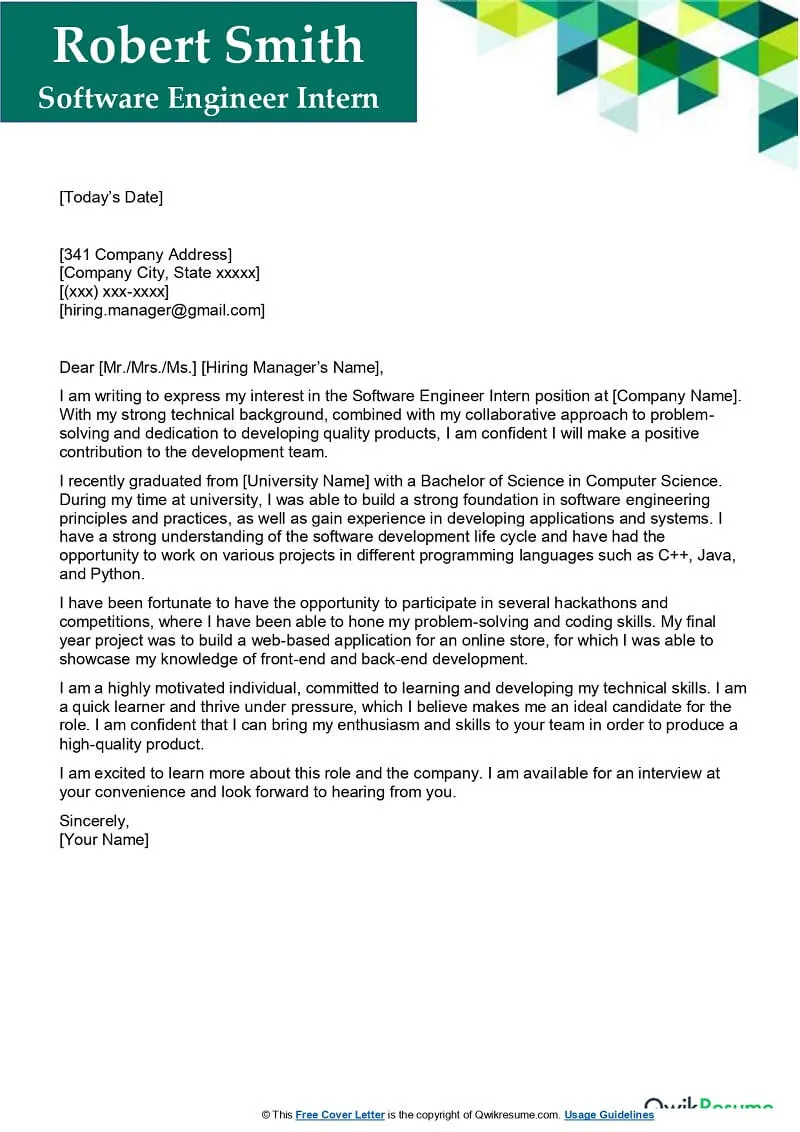
Why You Need a Stellar Software Internship Cover Letter
In the competitive world of software engineering, a well-crafted cover letter can be your golden ticket to landing a coveted internship. It’s more than just a formality; it’s your opportunity to make a strong first impression, highlight your unique skills, and express your genuine enthusiasm for the role and the company. A compelling cover letter allows you to go beyond the bullet points of your resume and tell your story, connecting your experiences and aspirations to the specific requirements and values of the internship. It’s your chance to demonstrate your written communication skills, showcasing your ability to articulate your technical abilities, personal qualities, and career goals. A lackluster cover letter can be easily overlooked, so investing time in crafting a standout one is crucial for setting yourself apart from other applicants and increasing your chances of securing an interview. A cover letter also provides a space to address any potential gaps in your resume, such as explaining a career change or emphasizing a particular skill set that may not be immediately apparent.
Highlighting Your Skills for Software Internship
When highlighting your skills, it’s crucial to strike a balance between technical expertise and soft skills. Technical skills are the foundation of your capabilities as a software engineer, and should be clearly demonstrated in your cover letter. Don’t just list the skills; provide context by mentioning how you’ve applied them in projects or coursework. Soft skills, such as problem-solving, communication, and teamwork, are equally important. They showcase your ability to collaborate, adapt, and contribute effectively within a team. When describing your skills, use concrete examples that demonstrate your ability to apply them in practical situations. Quantify your accomplishments whenever possible to provide tangible evidence of your abilities. For instance, instead of saying “I improved code efficiency,” say “I improved code efficiency by 20% through refactoring.” This kind of specific detail makes your cover letter more compelling and memorable.
Technical Skills to Showcase

Technical skills are the backbone of a successful software engineering internship application. When showcasing your technical prowess, focus on the skills most relevant to the specific internship and the company. Be sure to include programming languages you are proficient in, such as Java, Python, C++, or JavaScript. List any frameworks or libraries you have experience with, like React, Angular, or Django, as well as experience with database technologies like SQL or MongoDB. Include any experience with software development tools, such as Git for version control, and IDEs like Visual Studio Code or IntelliJ IDEA. In addition, mention your familiarity with software development methodologies such as Agile or Scrum. If you have experience with cloud platforms like AWS, Azure, or Google Cloud, it is also worth mentioning. Always provide concrete examples of how you have used these skills in your projects or coursework.
Programming Languages to Include
The programming languages you list on your cover letter are critical. Consider the requirements of the software internship you’re applying for and highlight the languages most relevant to the role. Common and sought-after languages include Python, Java, JavaScript, C++, and C#. If you are proficient in any of these languages, be sure to mention them prominently. However, also mention any other languages you may be familiar with, especially those that are emerging or popular within the industry, such as Go or Rust. Be sure to specify your level of proficiency for each language, from beginner to expert, and give examples of how you have used each language in your projects or coursework. For instance, if you have used Python to build a web application, or Java to develop an Android app, make sure to include these details.
Relevant Software and Tools
Beyond programming languages, it’s important to demonstrate your familiarity with a range of software and tools used in software development. Version control systems like Git are essential for collaborative coding. Proficiency in using IDEs (Integrated Development Environments) such as Visual Studio Code, IntelliJ IDEA, or Eclipse is also a must. Mention your experience with testing frameworks like JUnit, or frameworks for web development like React, Angular, or Vue.js. Including experience with databases like SQL or NoSQL, and familiarity with cloud platforms like AWS, Azure, or Google Cloud, is valuable. If you are knowledgeable in project management software like Jira or Trello, mention it. Include any other relevant software and tools that will allow you to perform well as a software intern.
Emphasizing Your Projects and Experience

Your projects and experience provide concrete evidence of your skills and abilities. When describing your projects, be specific. Provide details about the project’s purpose, your role, and the technologies you used. Don’t just list the technologies; explain how you applied them to solve problems or achieve specific goals. Quantify your accomplishments whenever possible. For instance, state the number of users your application served, the percentage by which you improved performance, or the number of features you implemented. Highlighting the challenges you faced and how you overcame them demonstrates your problem-solving skills and your ability to learn from your mistakes. If you have any relevant work experience, even if it’s not directly related to software engineering, explain how the skills you gained are transferable to the internship role.
Showcasing Personal Projects
Personal projects are a fantastic way to showcase your passion for software engineering and your ability to apply your skills independently. Describe your projects in detail, including the problem you were trying to solve, the technologies you used, and the results you achieved. If your project is available online, provide a link to your GitHub repository or a live demo. This allows the hiring manager to easily assess your code and the functionality of your project. Focus on the challenges you encountered during the project and how you overcame them. This highlights your problem-solving skills and your ability to learn independently. Mention any unique features of your projects, or innovative solutions you developed. Personal projects demonstrate initiative and a proactive approach to learning and applying your skills, which are highly valued in software interns.
Highlighting Relevant Coursework
Your coursework provides a foundation for your technical skills. Highlight the courses that are most relevant to the internship, such as data structures and algorithms, software engineering, or database design. Briefly describe the key projects or assignments you completed in these courses. Mention any specializations or areas of study that align with the internship’s requirements. If you took on any leadership roles in group projects, such as project manager or lead developer, be sure to mention it. This demonstrates your ability to work in a team and take on responsibility. Also, include any academic achievements, such as high grades or honors, that demonstrate your commitment to your studies and your ability to excel in a challenging academic environment. This showcases your ability to grasp and apply complex concepts, and your aptitude for learning new technologies.
Quantifying Your Accomplishments

Quantifying your accomplishments makes your cover letter more impactful and provides concrete evidence of your skills. Use numbers and metrics to demonstrate the results you achieved in your projects and experiences. For example, instead of saying “Improved website performance,” say “Improved website load time by 30% by optimizing image sizes and caching.” If you worked on a project with a team, mention the number of people in the team and your specific contributions. Include the percentage of improvement in any key metrics, such as code efficiency, user engagement, or error reduction. Using numbers helps the hiring manager quickly understand the impact you made and the value you can bring to the internship. This level of detail makes your cover letter more compelling and memorable.
Demonstrating Your Passion and Enthusiasm
Expressing your passion and enthusiasm for software engineering and the company is crucial. Explain why you are interested in software engineering and what excites you about the field. Mention specific technologies or areas of software development that you find particularly fascinating, and explain how you see yourself contributing to the company’s mission. Research the company and its products and services. In your cover letter, mention specific aspects of the company that appeal to you. This shows the hiring manager that you have done your homework and are genuinely interested in the opportunity. Show how your career goals align with the internship and the company’s values. This will demonstrate your commitment and ambition, increasing your chances of getting the internship.
Tailoring Your Letter to the Company
Tailoring your cover letter to each company is essential. Never send a generic cover letter. Before you start writing, research the company’s mission, values, and products. Visit their website, read their blog, and explore their social media presence. Use the company’s name in your cover letter and address it to the specific hiring manager, if possible. This shows that you have put in the effort to understand the company’s needs. Highlight how your skills and experiences align with the specific requirements and values of the internship and the company. Use the same keywords and phrases from the job description. This helps the hiring manager see that you are a good fit for the role. By tailoring your cover letter, you demonstrate your genuine interest in the company and the internship opportunity.
Researching the Company’s Culture

Before you start writing your cover letter, research the company’s culture. Understanding the company’s culture will help you tailor your cover letter and demonstrate that you would be a good fit. Explore the company’s website, and read about their values, mission, and employee testimonials. Check out their social media presence, such as LinkedIn, to get a sense of their work environment and the projects they’re working on. Look for clues about the company culture in the job description. Does it emphasize teamwork, innovation, or a fast-paced environment? Use these insights to tailor your cover letter. For example, if the company values collaboration, highlight your teamwork skills. If they emphasize innovation, showcase your experience with new technologies. By showing that you understand and appreciate the company’s culture, you increase your chances of standing out.
Addressing the Hiring Manager
Addressing the hiring manager by name makes your cover letter more personalized and demonstrates that you’ve put in the extra effort. If you can, find the hiring manager’s name through LinkedIn, the company website, or by contacting the HR department. If you can’t find a specific name, using a professional greeting like “Dear Hiring Manager” is better than a generic “To Whom It May Concern.” When you mention the hiring manager’s name, it shows you are not simply sending a generic cover letter. It’s a sign of professionalism and attention to detail. If you’ve had any prior contact with the hiring manager, like a conversation at a career fair, be sure to mention it. This can create a sense of familiarity and make your application more memorable. Use their name throughout the cover letter, where appropriate, to personalize your message.
Structuring Your Cover Letter for Impact
Structuring your cover letter strategically will make it more readable and impactful. Use a clear, logical format that guides the reader through your qualifications and enthusiasm. Your cover letter should follow a standard business letter format, with a formal salutation, body paragraphs, and a professional closing. Keep your cover letter concise, ideally no longer than one page. This demonstrates respect for the hiring manager’s time. Use a professional font, such as Times New Roman or Arial, and use clear formatting. Proper spacing and a clean layout will make your cover letter more visually appealing. Before submitting, ensure your cover letter is free of grammatical errors and typos. Always proofread, or have someone else review it.
Crafting a Compelling Opening

The opening paragraph of your cover letter is your first and often only chance to grab the hiring manager’s attention. Start with a strong opening that immediately highlights your interest in the internship and the company. Mention the position you are applying for and where you saw the job posting. In the first sentence, clearly state the position you are applying for and how you found out about the opportunity. Briefly mention your most relevant skill or experience that aligns with the internship requirements. This immediately captures the hiring manager’s attention. Express your enthusiasm for the company and the opportunity. Make sure to keep the opening paragraph concise, and set the tone for the rest of your cover letter.
Developing Strong Body Paragraphs
The body paragraphs are where you provide more details about your skills, experience, and qualifications. Each paragraph should focus on a specific aspect of your profile, such as your technical skills, your projects, or your relevant coursework. Use the STAR method (Situation, Task, Action, Result) to describe your accomplishments. In each paragraph, set the scene (situation), explain your responsibility (task), describe the actions you took, and highlight the results you achieved. Provide specific examples and use action verbs to make your accomplishments more compelling. Quantify your accomplishments whenever possible. Use numbers and metrics to demonstrate the impact of your work. Tailor each paragraph to the specific requirements of the internship and the company’s values. Ensure your body paragraphs are well-organized, and use clear transitions between each paragraph.
Writing a Powerful Closing
The closing paragraph of your cover letter is your last opportunity to leave a lasting impression. Reiterate your interest in the internship and the company. Thank the hiring manager for their time and consideration. Clearly state your intention to follow up and how you plan to do so. Include a call to action. Express your enthusiasm for the opportunity to discuss your qualifications further. End with a professional closing, such as “Sincerely” or “Best regards,” followed by your name. Make sure to proofread the entire closing paragraph to ensure there are no errors. A strong closing paragraph reinforces your key qualifications and expresses your genuine enthusiasm for the opportunity.
Proofreading and Editing Your Cover Letter

Proofreading and editing are essential steps in the cover letter writing process. Before submitting your cover letter, carefully proofread it to catch any grammatical errors, typos, or formatting issues. Check the spelling and grammar using a spell-checker. However, always review the suggestions carefully, as spell-checkers may not always catch context errors. Read the cover letter aloud. This helps you to identify awkward phrasing and areas where the writing could be improved. Have someone else review your cover letter. A fresh pair of eyes can often spot errors that you might have missed. Make sure the tone of your cover letter is appropriate for the internship and company. Proofreading ensures that your cover letter is polished and professional, which is essential for making a positive first impression.
Common Cover Letter Mistakes to Avoid
Avoiding common cover letter mistakes can significantly improve your application. One common mistake is sending a generic cover letter that is not tailored to the specific internship or company. Failure to customize your cover letter shows a lack of genuine interest and may lead to your application being overlooked. Grammatical errors and typos are a significant turn-off. Always proofread your cover letter. Another common mistake is simply repeating the information in your resume. Instead, use the cover letter to provide context and expand on your accomplishments and skills. Using jargon and overly technical language can also be a mistake, especially if the hiring manager is not a technical expert. Keep your language clear and concise. Avoid being overly formal or using clichés, as it may come off as insincere. A well-crafted cover letter helps avoid these common mistakes and demonstrates your professionalism.
Formatting Your Cover Letter
The formatting of your cover letter plays a significant role in its overall impact. The format of your cover letter should be professional and easy to read. Choose a clear, professional font, such as Times New Roman or Arial, with a font size between 10 and 12 points. Use standard margins of one inch on all sides. Use clear spacing between paragraphs and sections, to make the letter easy to scan. Include your contact information at the top, including your name, phone number, email address, and LinkedIn profile URL. Make sure your cover letter is consistent with the formatting of your resume. If you are sending your cover letter electronically, save it as a PDF file to preserve the formatting. A well-formatted cover letter demonstrates your attention to detail and professionalism.
Using Action Verbs
Using action verbs in your cover letter makes your accomplishments more compelling. Action verbs bring your experiences to life and demonstrate your skills and abilities. Start each bullet point or sentence describing your achievements with a strong action verb. Examples include: Developed, implemented, designed, created, managed, led, and collaborated. Instead of saying “Responsible for project management,” use “Managed projects effectively, delivering results on time and within budget.” Choose action verbs that are relevant to the software engineering internship and the skills required. Avoid vague verbs and use specific verbs that showcase your abilities. Your cover letter becomes much more engaging, and the hiring manager gets a better understanding of your capabilities.
Seeking Feedback Before Submitting
Seeking feedback on your cover letter can greatly improve its effectiveness. Ask trusted individuals, such as career counselors, professors, or mentors, to review your cover letter. Provide them with a copy of the job description, so they can provide informed feedback. Ask for feedback on the content, structure, and formatting of your cover letter. Ask for feedback on the clarity, tone, and overall impact of your letter. Be open to constructive criticism and willing to make revisions based on the feedback you receive. Revise your cover letter based on the feedback and proofread it carefully before submitting. Seeking feedback is an essential step in ensuring that your cover letter effectively showcases your skills, experience, and enthusiasm for the software engineering internship.