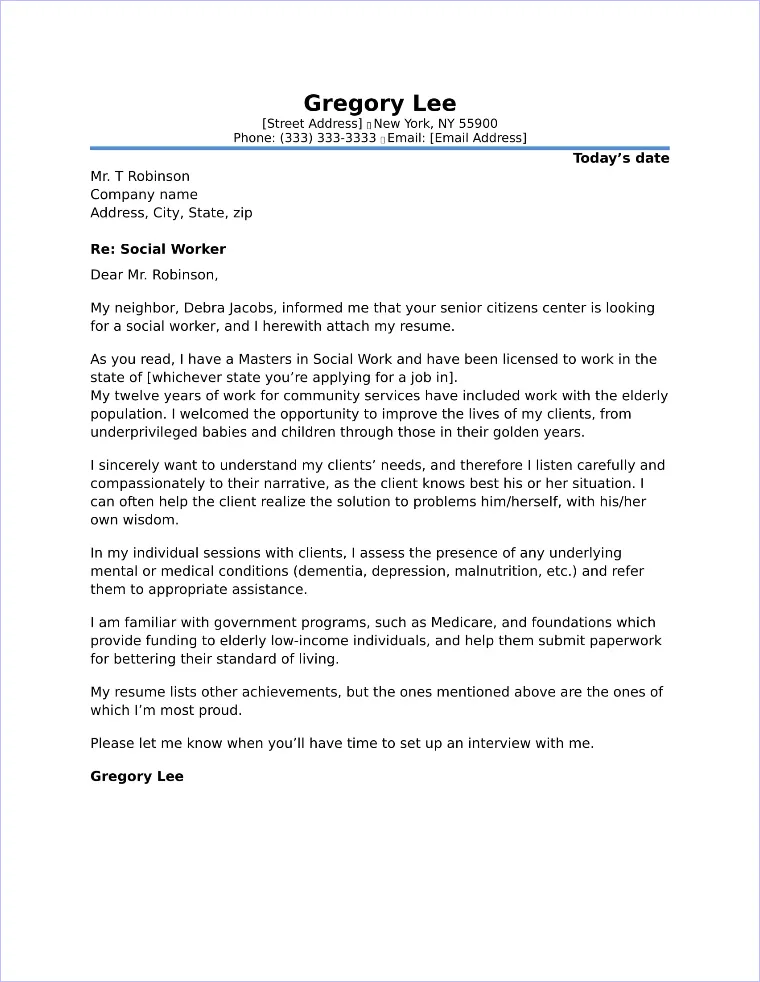
Understanding the Importance of a Social Work Cover Letter
A well-crafted cover letter is your first introduction to a potential employer and is an essential part of your job application in the field of social work. It serves as a crucial opportunity to showcase your personality, passion, and suitability for the role. While your resume provides a detailed overview of your qualifications, the cover letter allows you to tell your story, explain your motivations, and highlight how your skills and experiences align with the specific requirements of the position. In a competitive field like social work, a compelling cover letter can be the deciding factor in securing an interview. It demonstrates your communication skills, attention to detail, and genuine interest in the organization and its mission. Failing to provide a strong cover letter can lead to your application being overlooked, even if you possess the necessary qualifications. This guide provides a comprehensive template and advice to help you create a cover letter that will help you stand out.
Key Components of a Strong Social Work Cover Letter
A strong cover letter includes several key components. Each section must be carefully crafted to present you in the best possible light. The letter should be clear, concise, and tailored to the specific job you are applying for. It’s important to remember that a generic cover letter is unlikely to impress hiring managers, so customization is key. This involves researching the organization, understanding their values, and aligning your experience with their needs. Pay close attention to the specific requirements of the job description, and ensure that your letter addresses each point. Consider the tone of your letter. Social work roles often involve empathy and compassion; your letter should reflect those qualities. Avoid jargon and use clear, professional language. Proofread your letter meticulously before sending it, as errors can undermine your credibility.
Header Section

The header is the first element the hiring manager will see. It sets the tone for the rest of your letter. Keep it clear and professional. The header should contain your contact information and the date, followed by the hiring manager’s contact information. Accuracy is crucial in this section, and even minor errors can give the wrong impression to the hiring manager. Ensure your contact details are up-to-date, and the date reflects the day you are sending the application. The header should be formatted consistently to provide a clean and easy-to-read experience. Use a professional font and maintain a consistent style throughout the document.
Applicant Contact Information
Your contact information should include your full name, phone number, email address, and potentially your LinkedIn profile URL. The goal is to make it easy for the hiring manager to reach you. Be sure to use a professional-sounding email address; avoid using nicknames or informal addresses. Double-check that your phone number is accurate, and your voicemail is set up. Your LinkedIn profile, if included, should be up-to-date and reflect your professional experience. The contact information should be the first thing listed in the header, typically aligned to the left or right. The goal is for this information to be readily available for easy access by the hiring manager.
Date
The date should be included directly below your contact information. It should be the date you are sending your cover letter. Use a standard date format (e.g., Month Day, Year). Ensure this date is accurate, as it indicates when the letter was written. It shows the hiring manager that you’re submitting a current application. The date placement is usually on the left or right side under your contact information. Consistency is key, so maintain the same alignment as your contact information.
Hiring Manager Contact Information

Include the hiring manager’s name, their title, the name of the organization, and the organization’s address. Finding the hiring manager’s name adds a personal touch and shows that you’ve researched the position. If you cannot find the hiring manager’s name, use the title or ‘Hiring Manager.’ Always double-check the spelling of the name and the accuracy of their title. If applying online, ensure the address is correct. This section is typically aligned to the left side of the document, below the date. A well-formatted heading indicates you have taken the time to personalize your application.
Salutation
Start with a formal salutation. Use ‘Dear Mr./Ms./Mx. [Last Name]’ if you know the hiring manager’s name. If you do not know the hiring manager’s name, use a generic salutation like ‘Dear Hiring Manager.’ Avoid outdated salutations such as ‘To Whom It May Concern,’ as this can make your letter appear less personalized. The salutation should be followed by a colon. Maintaining a professional tone from the beginning demonstrates your attention to detail and respect for the hiring process. The salutation is usually aligned to the left side and set apart from the header and body text for clarity. Ensure correct grammar and proper titles for a polished first impression.
Body of the Cover Letter
The body of your cover letter is where you make your case. It should be a few paragraphs long and demonstrate how your skills, experience, and values align with the role and the organization. Each paragraph serves a specific purpose. The first paragraph aims to grab the reader’s attention and express your interest. The second highlights your relevant skills and achievements. The third demonstrates your fit with the organization’s mission and values. Maintain a professional and enthusiastic tone throughout. Avoid overly casual language, and ensure your writing is clear, concise, and free of jargon. This section should be well-structured, easy to read, and demonstrate your written communication skills.
First Paragraph: Grab Their Attention

Start with an attention-grabbing sentence that clearly states the position you’re applying for and where you saw the job posting. Briefly explain why you are interested in the position. Highlight a key skill or experience that makes you suitable for the role. The first paragraph sets the tone for the entire letter, so make a strong first impression. Express genuine enthusiasm for the opportunity and show that you have researched the organization. Keep this paragraph concise and focused. Your goal is to make the hiring manager want to read more. Clearly identify the position and quickly indicate your interest to provide the context for your application.
Highlight Your Passion for Social Work
Show your genuine interest in social work and its values. Explain what motivates you and what makes you passionate about helping others. Briefly describe your understanding of social work principles, such as empathy, advocacy, and social justice. If you have specific experiences or volunteer work that reflect your passion, mention them briefly. This demonstrates your commitment to the field and your alignment with the organization’s mission. Showing your passion early on helps you connect with the hiring manager on a personal level. Relate your motivation back to the specific role requirements, to demonstrate your focused interest in the position.
Emphasize Your Understanding of the Role
Demonstrate your understanding of the job description and the responsibilities involved. Briefly mention the key tasks and expectations of the position. Show that you have researched the organization and understand their services and client population. Use language from the job description to show that you understand what the employer is looking for. Tailor your letter to the specific role; this shows that you are not sending a generic application. Mention relevant experience or skills that make you a good fit for this role. Demonstrate to the hiring manager that you have understood the specific requirements and expectations of the position.
Second Paragraph: Showcase Your Skills and Experience

This is where you highlight your key skills and experiences. Focus on the experiences most relevant to the job description. Mention specific achievements and how you have made a positive impact in your previous roles. Use action verbs to describe your responsibilities and accomplishments. Quantify your achievements whenever possible to showcase your impact. Explain how your skills and experience align with the requirements of the role. Provide examples of how you have successfully handled challenges or achieved goals. Ensure your skills and experiences are aligned with what the organization is looking for.
Quantify Your Achievements
Use numbers and data to demonstrate your achievements. Provide specific examples of your impact. Instead of saying ‘Improved client outcomes,’ say ‘Improved client outcomes by 15% through the implementation of a new intervention.’ Use metrics to showcase your effectiveness and achievements. This allows the hiring manager to easily see the results of your work. Numbers add credibility to your claims and illustrate the value you bring to an organization. Always give context to your numbers to ensure they make sense and are relevant to the role.
Tailor to the Job Description
Carefully review the job description and identify the key skills and qualifications required. Address each requirement in your cover letter. Use keywords from the job description to align your skills and experience. Provide specific examples that demonstrate your abilities and match the needs of the role. Show that you understand what the employer is looking for. Tailor your letter to the specific role, as it proves your attention to detail. This shows the hiring manager you’ve carefully considered their needs.
Third Paragraph: Demonstrate Your Fit

This paragraph is designed to demonstrate how your values align with the organization’s mission. Explain why you are interested in this particular organization. Show that you have researched their work and understand their values. Demonstrate how your personal and professional values align with their goals. Mention any specific programs or services that resonate with you. Convey a genuine interest in working for this organization. Highlight how your unique skills and experiences make you a good fit for the culture. This will help you stand out from the competition.
Address the Employer’s Needs
Focus on what the employer needs and how you can help them achieve their goals. Mention the challenges the organization might be facing. Provide examples of how you have solved similar problems in the past. Show that you are proactive and results-oriented. Demonstrate your ability to contribute to the organization’s mission. This shows the hiring manager that you can add value to their team. Frame your contributions in terms of their positive impact, demonstrating your commitment to client well-being.
Showcase Your Values
Highlight your personal and professional values, such as empathy, compassion, and social justice. Discuss how these values align with the organization’s mission. Provide examples of how you have demonstrated these values in your work or volunteer experiences. Show that you are a person of integrity and commitment. Explain why you want to work for this organization. Your values should be demonstrated in how you have worked with people. Focus on making genuine connections and demonstrating your passion for helping others.
Closing the Cover Letter

End your cover letter with a strong closing. This is your final opportunity to make an impression. Clearly state your interest in the position and your enthusiasm for the opportunity. Include a call to action, such as requesting an interview. Express your gratitude for their time and consideration. Close your letter professionally and follow up with a sign-off.
Call to Action
Clearly state your desire for an interview or the next step in the hiring process. Make it easy for the hiring manager to contact you. Express your availability for an interview and any other follow-up requests. Your call to action should be clear, concise, and confident. This is an important step that signals your interest in the role and shows that you’re ready to take the next step. Close your letter with a proactive call to action.
Closing
Express your gratitude for the hiring manager’s time and consideration. Thank them for considering your application. Show that you appreciate the opportunity to be considered for the role. Keeping your tone positive and professional is important. This demonstrates your respect and consideration for their time. Be polite and concise.
Sign-off
Use a professional sign-off, such as ‘Sincerely,’ ‘Best regards,’ or ‘Thank you.’ Avoid casual sign-offs, such as ‘Cheers’ or ‘Best.’ Ensure your signature is legible if submitting a hard copy. Leave space for your signature if you’re printing and mailing your letter. The sign-off should be aligned on the left side of your document. A professional sign-off leaves a lasting impression.
Proofreading and Editing
Proofreading is a vital step in the cover letter writing process. Carefully check your letter for any errors. Review your letter multiple times and read it aloud to catch any mistakes. Look for grammatical errors, spelling mistakes, and typos. Ensure your sentences are clear, concise, and easy to understand. Consider having a friend or family member proofread your letter. Errors can undermine your credibility and make a negative impression. It is important to ensure accuracy in all aspects of your application.
Formatting Your Cover Letter
Formatting your cover letter is an important element. Use a professional font, such as Times New Roman, Arial, or Calibri, in a readable size (11 or 12 points). Use standard one-inch margins and single-spaced text. Make sure your letter is easy to read. Use bolding and italics sparingly, and only to emphasize key points. Use a clear structure with headings and paragraphs to organize your information. Ensure your formatting is consistent throughout the letter. Use a professional look and format. Use a word processor for easy formatting. Clean formatting improves the letter’s readability. A well-formatted cover letter will demonstrate your professionalism and attention to detail.