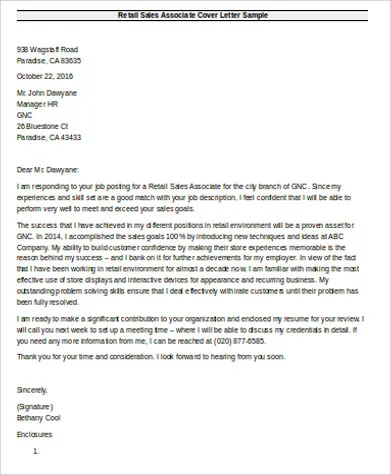
Sales Associate Cover Letter How To Get Hired
Landing a sales associate position requires more than just a resume; a compelling cover letter is your chance to make a strong first impression. It allows you to personalize your application and highlight the skills and experiences that align with the specific job requirements. This guide provides essential cover letter examples for sales associate roles, offering practical advice to help you get hired. A well-crafted cover letter not only introduces you but also demonstrates your understanding of the role, your enthusiasm for the company, and your ability to communicate effectively. Mastering the art of writing a cover letter can significantly increase your chances of securing an interview and ultimately, the job.
Understanding the Importance of a Sales Associate Cover Letter
In today’s competitive job market, a cover letter is a crucial tool that often gets overlooked. For sales associate positions, where interpersonal skills and communication are paramount, a cover letter offers a unique platform to showcase your personality and sales approach. Think of it as your personal sales pitch to the hiring manager, detailing why you are the perfect fit for the role. A strong cover letter can set you apart from other candidates and demonstrate your genuine interest in the company. It provides context to your resume, explaining your career goals and how your experiences align with the company’s needs. It is an opportunity to expand on your achievements, provide specific examples, and highlight skills that may not be immediately obvious from your resume alone.
Why a Cover Letter Matters

A cover letter allows you to go beyond listing your qualifications; it provides an opportunity to articulate your enthusiasm for the role and the company. It demonstrates your ability to write clearly and concisely, a vital skill in any sales-related position. A well-written cover letter showcases your communication skills, attention to detail, and your ability to tailor your message to the specific needs of the employer. By highlighting relevant experiences and skills, you can immediately capture the hiring manager’s attention and increase your chances of receiving an interview. A cover letter makes your application more human, showcasing your personality and your genuine interest in the opportunity, making you more memorable than candidates who only submit a resume.
Highlighting Relevant Skills and Experience
Your cover letter should focus on skills and experiences most relevant to the sales associate role. This includes sales experience, customer service skills, communication abilities, and any experience with sales tools or techniques. If you have achieved specific sales targets or exceeded expectations in previous roles, make sure to quantify your achievements. Use action verbs to describe your accomplishments and use the STAR method (Situation, Task, Action, Result) to structure your examples. Highlighting experiences with customer relationship management (CRM) software, point-of-sale (POS) systems, or any other relevant technology can also be beneficial. Always align your skills and experiences with the job description, showing the hiring manager that you have the specific capabilities they are looking for.
Key Elements of a Successful Sales Associate Cover Letter
Several key elements are essential for a successful sales associate cover letter. These elements include a personalized greeting, a strong introduction, a clear articulation of your skills and experiences, and a compelling closing. Every part of your cover letter should be meticulously crafted to demonstrate your understanding of the role and your enthusiasm for the company. A personalized greeting immediately grabs the hiring manager’s attention, while the introduction sets the tone of your application. Be sure to showcase your achievements, demonstrate your soft skills, and emphasize how you align with the job requirements. The closing should restate your interest and provide contact information, encouraging the hiring manager to reach out for an interview.
Personalized Greeting and Introduction

Start your cover letter with a personalized greeting addressed to the hiring manager or the specific person mentioned in the job posting. This shows that you have taken the time to research the company and are genuinely interested in the role. In your introduction, state the specific position you are applying for and where you found the job posting. Briefly summarize your key qualifications and explain why you are the ideal candidate. Focus on demonstrating your understanding of the company’s needs and how your skills and experiences can contribute to its success. Your introduction should immediately capture the reader’s attention and make them want to learn more about you. If you know someone at the company, mention their name in your introduction to establish a connection.
Showcasing Sales Achievements
Sales achievements are a crucial component of a compelling cover letter. Providing specific examples of your successes and quantifying your accomplishments demonstrates your ability to perform in a sales environment. Use metrics like sales figures, percentage increases, and customer satisfaction scores to show the impact of your work. When showcasing your sales achievements, describe the situation, the task you were given, the actions you took, and the results you achieved (STAR method). For example, if you exceeded your sales targets in a previous role, mention the percentage by which you surpassed the target and any specific strategies you used to achieve it. Include any awards or recognitions you received for sales performance.
Quantifying Accomplishments
Quantifying your accomplishments is essential to demonstrate your value to the hiring manager. Use numbers and percentages to illustrate your impact in previous roles. For example, instead of saying “Increased sales,” say “Increased sales by 20% within six months.” If you improved customer satisfaction, mention the specific percentage increase. If you generated a specific amount of revenue, be sure to provide the figure. Quantifiable results provide concrete evidence of your sales abilities and make a stronger impression than vague statements. Be sure to only include the achievements that are most relevant to the role, demonstrating your focus on the skills that align with the job requirements.
Demonstrating Soft Skills

While sales achievements are important, soft skills are equally valuable. Your cover letter should highlight your communication skills, interpersonal abilities, and your ability to work well with others. Provide specific examples of how you have used these skills to achieve success in previous roles. Describe situations where you successfully resolved customer issues, worked as part of a team to reach sales goals, or adapted your sales approach to meet the needs of different customers. Your cover letter should also showcase your problem-solving skills, your ability to handle rejection, and your persistence in achieving sales targets. Showcasing your soft skills demonstrates that you have the necessary attributes to succeed in a sales environment and interact effectively with customers and colleagues.
Communication and Interpersonal Abilities
Excellent communication and interpersonal abilities are fundamental to success as a sales associate. Showcase your ability to communicate effectively with customers, understand their needs, and build rapport. Provide examples of how you actively listen to customers, respond to their concerns, and tailor your sales approach to match their needs. Highlight your ability to handle difficult customers, resolve conflicts, and maintain a positive attitude. Mention instances where you used persuasive communication to close a sale or build a long-term customer relationship. Use your cover letter to demonstrate your ability to articulate clearly and concisely, both in writing and verbally.
Enthusiasm and Professionalism
Your cover letter should demonstrate your enthusiasm for the role and the company. Express your genuine interest in the position and explain why you are excited about the opportunity. Research the company’s values, mission, and products or services, and align your cover letter to demonstrate your understanding of the company’s goals. Use a professional tone and avoid slang or informal language. Proofread your cover letter carefully to ensure there are no grammatical errors or typos. Make sure your cover letter is well-organized, easy to read, and free of any unprofessional elements. Showcasing enthusiasm and professionalism will leave a positive impression on the hiring manager and increase your chances of getting hired.
Tailoring Your Cover Letter to the Job Description

Customizing your cover letter to match the specific job description is essential. Carefully review the job posting and identify the key requirements, skills, and qualifications the employer is looking for. Your cover letter should then highlight how your skills and experiences align with these requirements. This approach demonstrates your attention to detail and your understanding of the role. Avoid sending a generic cover letter; instead, tailor your cover letter to demonstrate your ability to fulfill the unique responsibilities of the position. This personalized approach shows that you have taken the time to understand the company’s needs and are genuinely interested in the job.
Researching the Company
Before writing your cover letter, research the company to understand its values, mission, and products or services. Visit the company’s website, read its social media profiles, and look for any recent news or announcements. This will help you personalize your cover letter and demonstrate your interest in the company. Mention specific products, services, or initiatives that resonate with you. This research shows that you are proactive and that you have taken the time to understand the company’s culture. Understanding the company’s needs will help you tailor your application to highlight how you can contribute to its success.
Matching Skills to Requirements
Carefully match your skills and experiences to the requirements listed in the job description. Use keywords from the job posting to show that you understand the role and can meet its demands. Prioritize the skills and experiences that are most relevant to the position. If the job description emphasizes customer service, highlight your customer service skills and provide examples of how you have excelled in this area. If the job description emphasizes sales targets, provide quantifiable achievements from your previous sales roles. By tailoring your application to the job requirements, you demonstrate that you have the specific abilities needed to succeed in the position.
Formatting and Proofreading Your Cover Letter

The format and presentation of your cover letter can significantly impact the impression you make. Proper formatting ensures that your letter is easy to read and professional. Proofreading is crucial to eliminate any errors that might detract from your application. A well-formatted and error-free cover letter demonstrates your attention to detail and professionalism. Always review your cover letter before submitting it. Have someone else read it too, as they may spot errors you have missed.
Formatting Tips
Use a professional font like Times New Roman, Arial, or Calibri. Keep the font size between 10 and 12 points. Use standard margins (1 inch on all sides). Use single spacing within paragraphs and double spacing between paragraphs. Ensure that your cover letter is well-organized, with clear headings and subheadings. Keep your cover letter concise, ideally within one page. Use bullet points for lists and quantify your accomplishments wherever possible. Properly formatting your cover letter will make it easier to read and will enhance your overall presentation.
Proofreading and Editing
Proofread your cover letter carefully to catch any typos, grammatical errors, or punctuation mistakes. Errors can undermine your credibility and make a negative impression on the hiring manager. Read your cover letter aloud to identify any awkward phrasing or unclear sentences. Ask a friend or family member to proofread your cover letter as a second set of eyes can often catch errors you might have missed. Ensure that the language used is appropriate for a professional setting. Always edit and revise your cover letter several times.
Writing a Compelling Closing

The closing of your cover letter should restate your interest, express your availability, and thank the hiring manager. A strong closing reinforces your enthusiasm and leaves a positive lasting impression. Make it clear that you are eager to learn more about the role. The closing is your final opportunity to make a strong impression and encourage the hiring manager to contact you for an interview.
Expressing Interest and Availability
In your closing, restate your interest in the position and express your availability for an interview. Indicate your eagerness to discuss your qualifications further and to learn more about the company. Mention your availability for an interview, making it easy for the hiring manager to contact you. You can also briefly reiterate the key skills and experiences that make you an ideal candidate. Keep your closing brief and to the point, but ensure it leaves a positive impression. Make it clear that you look forward to hearing from them soon.
Thanking the Hiring Manager
Always thank the hiring manager for their time and consideration. Express your gratitude for their reviewing your application. This simple gesture demonstrates your professionalism and respect. End your cover letter with a professional closing, such as “Sincerely” or “Best regards,” followed by your name and contact information. Including your phone number and email address makes it easy for the hiring manager to contact you. Your closing should be polite, professional, and reflect your enthusiasm for the opportunity. By following these tips, you can create a cover letter that effectively showcases your skills and significantly improves your chances of landing the sales associate role of your dreams.