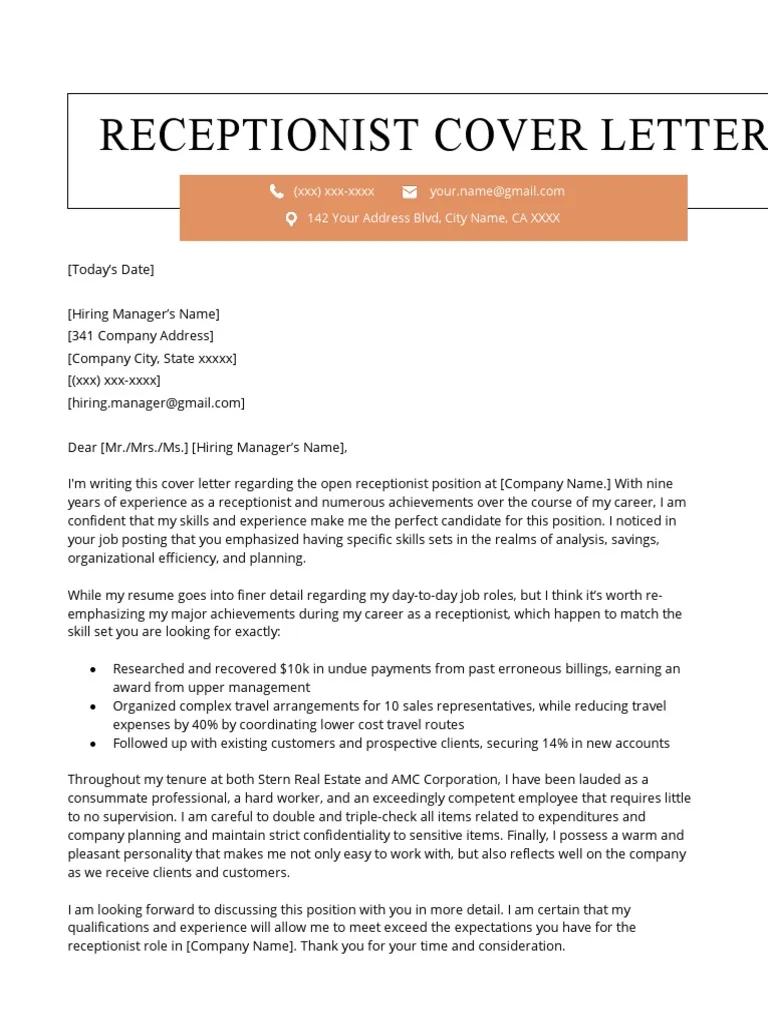
What is a Receptionist Cover Letter?
A receptionist cover letter is a crucial document that accompanies your resume when applying for a receptionist position. It serves as your first introduction to the hiring manager, providing an opportunity to showcase your personality, skills, and enthusiasm for the role. Unlike a resume which lists your experiences and qualifications, a cover letter allows you to explain why you are the perfect fit for the specific company and position. It’s your chance to demonstrate your writing abilities and attention to detail, both essential qualities for a receptionist.
Why is a Cover Letter Important?
In today’s competitive job market, a well-crafted cover letter can significantly increase your chances of landing an interview. It allows you to personalize your application and show genuine interest in the company. Recruiters often use cover letters to assess a candidate’s communication skills, writing proficiency, and attention to detail. A cover letter also provides context to your resume, explaining how your skills and experience align with the job requirements. It’s an opportunity to elaborate on your accomplishments and demonstrate your understanding of the receptionist role and the company’s needs. Many hiring managers expect a cover letter, and not including one could signal a lack of interest or effort on your part.
Essential Components of a Receptionist Cover Letter

A strong receptionist cover letter includes several key components. These elements work together to present you as a qualified and enthusiastic candidate. From the contact details at the top to a compelling call to action at the end, each part plays a vital role in making a positive impression. Understanding these core components is the first step in creating a cover letter that effectively highlights your skills and experience. Properly formatted cover letters are easy to read and shows your professionalism.
Your Contact Information
Begin your cover letter with your contact information. This typically includes your full name, phone number, email address, and optionally, your LinkedIn profile URL. Ensure that your email address is professional and that your voicemail is set up and ready to receive messages. This information should be clearly displayed at the top of the document, making it easy for the hiring manager to contact you if they are interested in your application. Proofread your details carefully to avoid errors that could hinder communication. A well-presented header showcases your professionalism from the start.
The Hiring Manager’s Information
Next, include the hiring manager’s information if you can find it. This shows that you have taken the time to research the company and personalize your application. Include the hiring manager’s name, title, and the company’s address. If the name is not available, you can use a general greeting like “Dear Hiring Manager.” Addressing your letter to a specific person demonstrates your attention to detail and your genuine interest in the role, setting you apart from generic applications. If the name is available, always double-check the spelling and title to ensure accuracy.
Greeting the Hiring Manager

Use a professional and appropriate greeting. The most common and recommended greeting is “Dear [Hiring Manager Name],” using the hiring manager’s name, if known. If the name is not available, you can use “Dear Hiring Manager” or “Dear [Company Name] Hiring Team.” Avoid generic greetings such as “To Whom It May Concern,” which can make your letter feel impersonal. Your greeting sets the tone for the entire cover letter and should be both polite and professional. Always double-check the name and title to show that you value accuracy.
Opening Paragraph Grab Attention
The opening paragraph is your chance to immediately capture the hiring manager’s attention. Start with a strong statement that highlights your enthusiasm for the position and the company. Briefly mention the position you’re applying for and where you saw the job posting. Consider including a sentence or two about why you are excited about the role, and the company. This should be a concise and engaging paragraph that makes the reader want to continue reading. Avoid generic opening lines; instead, tailor your opening to the specific job and company.
Highlighting Relevant Skills
The body of your cover letter is where you showcase your skills and experience. Focus on the skills and experiences that are most relevant to the receptionist position. Use specific examples to illustrate your abilities. This section is your chance to demonstrate how your qualifications match the job requirements. Tailor this part of the letter to the specific job description, highlighting the skills and experiences that the employer has prioritized. Use keywords from the job posting to show the recruiter that you’ve carefully read and understood their needs. The goal is to convince the hiring manager that you have what they are looking for.
Communication Skills

Receptionists must possess excellent communication skills, both verbal and written. In your cover letter, highlight your ability to communicate clearly and effectively. Mention your experience in handling phone calls, emails, and face-to-face interactions. Provide examples of how you’ve successfully communicated with clients or customers. Mention your ability to actively listen, understand, and respond appropriately. Mention any experience with conflict resolution or handling difficult customers. Showcasing these communication skills is vital, as receptionists are often the first point of contact for a company.
Organizational Skills
Receptionists need strong organizational skills to manage schedules, appointments, and office tasks. Highlight your ability to multitask and prioritize tasks efficiently. Mention your experience using calendars, scheduling software, and other organizational tools. Provide examples of how you’ve successfully managed multiple projects or responsibilities simultaneously. Emphasize your attention to detail and your ability to keep things running smoothly. Show your ability to maintain organized records and systems that help the office run effectively and efficiently.
Customer Service Skills
Customer service skills are vital for receptionists. Highlight your ability to provide excellent customer service, create a positive first impression, and handle customer inquiries professionally. Mention your experience in resolving customer issues and ensuring customer satisfaction. Provide examples of how you’ve gone above and beyond to assist customers. Emphasize your friendly and helpful demeanor and your ability to remain calm under pressure. Show your genuine desire to assist others and provide a positive experience.
Quantifying Achievements

Whenever possible, quantify your achievements to demonstrate your impact. Instead of saying you “managed phone calls,” state how many calls you handled daily or the percentage by which you reduced missed calls. Instead of saying you “improved customer service,” specify how you improved customer satisfaction scores. Use numbers, percentages, or specific results to show the value you brought to previous roles. Quantifying your achievements makes your cover letter more compelling and provides concrete evidence of your abilities. Quantifiable results make a stronger case for your application.
Showcasing Experience
Describe your relevant experience in detail. If you have previous receptionist experience, clearly state your responsibilities and accomplishments. Even if you lack direct experience, highlight transferable skills from other roles. For example, if you have experience in customer service or administrative tasks, mention how those skills apply to the receptionist position. Tailor your descriptions to match the job requirements, emphasizing the skills and experience that are most important to the employer. Show your work ethic, your attention to detail, and your enthusiasm for the position. Provide enough information so the hiring manager can assess if you are a good fit.
Tailoring Your Letter
Each cover letter should be customized for the specific job and company. Avoid using a generic template without making adjustments. Carefully read the job description and tailor your letter to match the requirements. Highlight the skills and experience that the employer is looking for. Research the company and show your understanding of their values and mission. Personalize your letter by mentioning something specific about the company or the role that appeals to you. Customizing your letter demonstrates your genuine interest in the role and the company, and shows that you are not sending out mass applications.
Call to Action Closing

The closing paragraph should include a clear call to action. Express your enthusiasm for the position and reiterate your interest in an interview. Include a statement such as, “I am eager to discuss my qualifications further in an interview.” Thank the hiring manager for their time and consideration. Provide your contact information once again, just in case they missed it. Your closing should be concise, professional, and leave a positive impression. Ensure your call to action reinforces your desire for an interview and your commitment to the position.
Proofreading and Editing
Proofreading is essential. Always carefully proofread your cover letter for any grammatical errors, spelling mistakes, or typos. Errors can undermine your credibility and make a negative impression on the hiring manager. Read your letter aloud to catch any awkward phrasing or sentences. Ask a friend, family member, or career counselor to review your letter as well. Consider using grammar and spell-checking tools to ensure your letter is error-free. A well-written and error-free cover letter demonstrates your attention to detail, and professionalism. Make sure that your formatting is consistent throughout the entire document and professional.