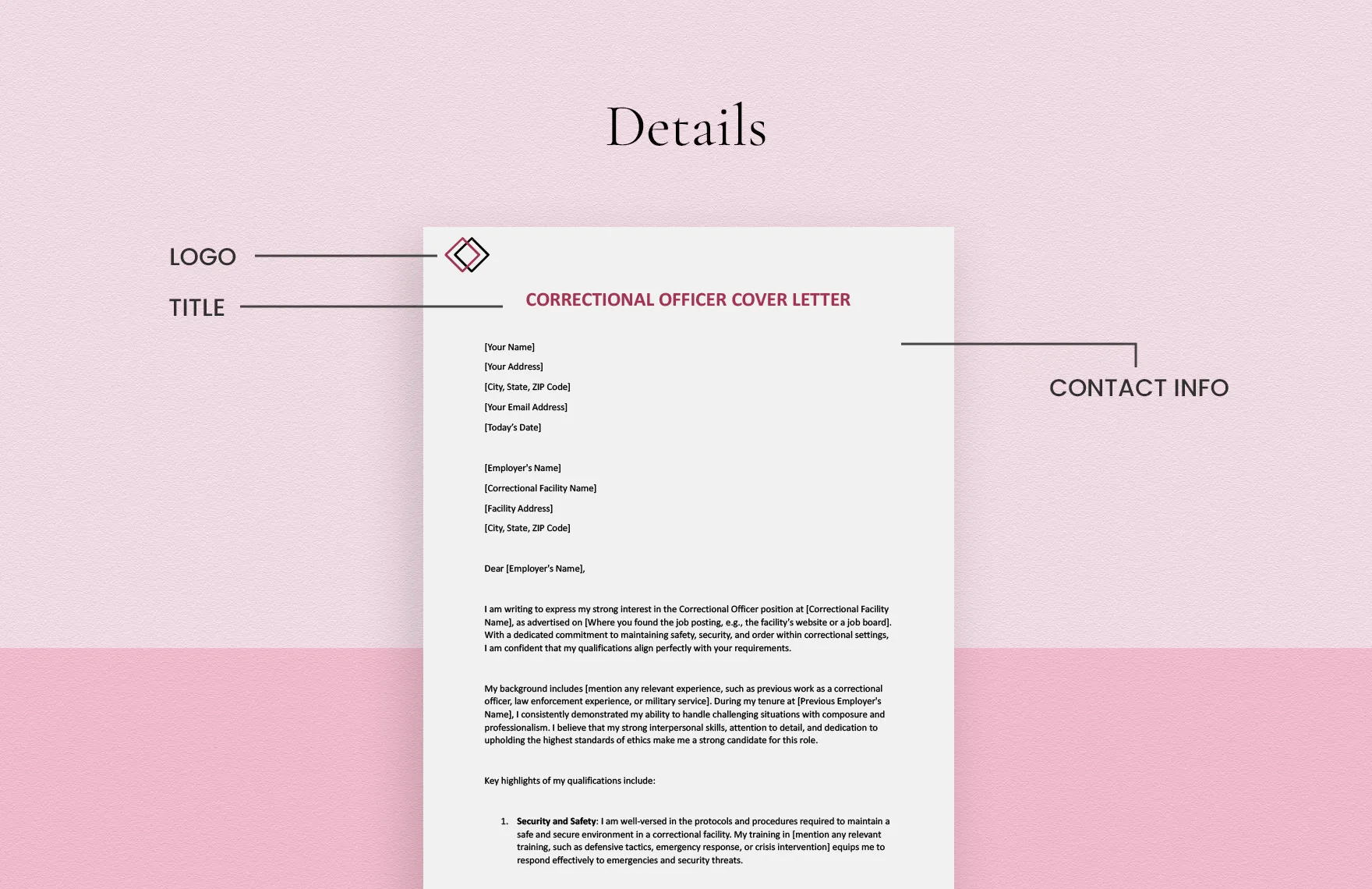
Essential Components of a Parole Officer Cover Letter
A well-crafted parole officer cover letter is your first impression on a potential employer. It’s a crucial document that complements your resume and allows you to showcase your qualifications, skills, and enthusiasm for the position. To write a compelling cover letter, you must understand its key components. This includes proper formatting, highlighting relevant experience, demonstrating soft skills, and tailoring the letter to the specific job requirements. Remember, a cover letter isn’t just a formality; it’s a chance to stand out from other applicants and demonstrate why you are the ideal candidate for the parole officer position. Your goal is to provide a persuasive narrative that compels the hiring manager to learn more about your experience and invite you for an interview. Pay close attention to detail, ensure your writing is clear, and use professional language throughout your letter.
Contact Information and Formatting
Proper formatting and clear contact information are fundamental aspects of any professional cover letter. This section ensures that the hiring manager can easily identify you and reach out regarding an interview. Accurate formatting enhances readability and projects an image of professionalism. A well-organized cover letter reflects your attention to detail and commitment to presenting yourself in the best possible light. Use a standard, easy-to-read font like Times New Roman or Arial, with a font size between 11 and 12 points. Maintain consistent margins (typically one inch) and single-space the body of your letter, with a double space between paragraphs for better readability. Proofread carefully to avoid any typos or grammatical errors, as these can create a negative impression. Following these formatting guidelines ensures your cover letter is both professional and easy to review.
Applicant’s Contact Details

Start your cover letter by including your full name, address, phone number, and professional email address at the top left corner. Ensure your email address is appropriate and professional. Avoid using nicknames or informal language in your email address. Keep your contact information updated and readily accessible. This enables the hiring manager to quickly find your contact information. A well-presented and easily accessible contact section shows that you are organized and prepared. Double-check all details to ensure accuracy. An accurate and easily accessible contact section saves time for the hiring manager, increasing your chances of being contacted for an interview. (Image: applicant-contact-details.webp)
Date and Recipient Information
Directly below your contact information, include the current date. Then, on the left side, address the hiring manager. If possible, find out the name of the hiring manager. A personalized cover letter is always preferred and demonstrates that you’ve taken the time to research the organization. If you can’t find the hiring manager’s name, use a professional salutation like “Dear Hiring Manager.” Including the correct date is essential for demonstrating that your application is current. A properly addressed letter shows respect for the hiring manager and increases your chances of making a positive first impression. This level of detail emphasizes your professionalism and attention to detail.
Professional Salutation
Start your cover letter with a professional salutation. If you know the hiring manager’s name, use “Dear Mr./Ms./Mx. [Last Name].” If the name is unavailable, use “Dear Hiring Manager” or “Dear [Department Name] Hiring Team.” Avoid informal greetings like “Hello” or “Hi.” Maintain a formal and respectful tone throughout your cover letter. It sets the right tone from the start. Using the correct salutation demonstrates your respect and attention to detail. This small detail can significantly impact the overall impression you make, helping you stand out as a qualified candidate. Your choice of salutation should align with the formality of the organization; when in doubt, it is better to lean toward a more formal approach.
Highlighting Relevant Skills and Experience

The core of your cover letter should focus on highlighting your relevant skills and experience. This is where you demonstrate your suitability for the parole officer position. Analyze the job description carefully and identify the key skills and qualifications the employer is seeking. Use your cover letter to provide specific examples of how you have demonstrated these skills in the past. This includes your ability to manage caseloads, conduct investigations, and interact with diverse populations. Be specific about your achievements and quantify your accomplishments whenever possible. Your goal is to provide concrete evidence of your abilities and convince the hiring manager that you are the best candidate. Tailor your response to the specific requirements. (Image: parole-officer-skills.webp)
Emphasizing Qualifications and Experience
Clearly state your qualifications and experience related to the parole officer role. Mention any relevant degrees, certifications, and licenses you possess. Highlight any past experiences, such as law enforcement, social work, or corrections. Frame your accomplishments within the context of the parole officer position. This includes experience in supervising offenders, assessing risks, and ensuring compliance with parole conditions. Providing a summary of your credentials at the beginning of your cover letter helps the hiring manager quickly evaluate your qualifications. This section serves as a concise introduction to your suitability for the role. Be specific about the length of time spent in similar roles and the key responsibilities you held. Remember, your aim is to show, not just tell, the employer that you meet their requirements.
Detailing Relevant Achievements
Go beyond simply listing your responsibilities; detail your achievements. This is your opportunity to showcase your successes and demonstrate the value you would bring to the position. Provide specific examples of instances where you have successfully managed cases, reduced recidivism rates, or resolved critical incidents. Use the STAR method (Situation, Task, Action, Result) to structure your responses. It is a compelling method for demonstrating your achievements. This will make your examples more engaging and impactful. Emphasize your achievements to make a lasting impression. These details provide tangible evidence of your abilities and reinforce your suitability for the parole officer role. (Image: achievements-parole-officer.webp)
Quantifying Accomplishments

Whenever possible, quantify your achievements. Instead of stating that you ‘improved case management’, state that you ‘improved case management by 15%’. Quantifiable results make your achievements more concrete and provide clear evidence of your capabilities. This includes providing measurable outcomes. Quantify the impact you’ve made in your previous roles. This could include the number of cases you handled, the percentage of successful parole completions, or any cost savings you achieved. Using numbers makes your achievements more credible and highlights your ability to deliver results. The more you can quantify your accomplishments, the stronger your cover letter will be.
Showcasing Soft Skills and Personality Traits
The job of a parole officer requires a variety of soft skills and personality traits. These include excellent communication, interpersonal skills, problem-solving abilities, and the capacity to remain calm under pressure. These qualities are essential for building relationships with parolees, collaborating with colleagues, and handling difficult situations. In your cover letter, demonstrate these soft skills by providing examples of how you’ve used them in the past. Share anecdotes or situations that highlight your skills. This makes you more personable and shows that you possess the personality traits that are beneficial in the profession. Emphasizing your soft skills can set you apart from other candidates. (Image: communication-skills.webp)
Demonstrating Communication and Interpersonal Abilities
Communication and interpersonal skills are paramount for a parole officer. You’ll need to communicate effectively with parolees, colleagues, and other stakeholders. Highlight your ability to listen actively, speak clearly, and write professionally. Provide examples of situations where you effectively communicated complex information. Mention your experience in conflict resolution, negotiation, and de-escalation techniques. This shows that you are able to build rapport and handle challenging interactions. These abilities are critical for successfully supervising parolees and maintaining a safe environment. Clearly showcase your effective communication skills to impress the hiring manager. Your ability to articulate ideas and manage conflict can be critical to securing the role.
Expressing Problem-Solving and Analytical Skills

Parole officers must possess strong problem-solving and analytical skills. They must be able to assess risks, identify potential issues, and make sound judgments. In your cover letter, show how you analyze situations, evaluate information, and develop effective solutions. Provide examples of how you have used your analytical skills to improve decision-making or resolve complex issues. Consider including examples of your experience in data analysis, report writing, or other relevant tasks. This demonstrates your critical thinking abilities, a key requirement for the parole officer role. Highlighting your problem-solving skills will position you as a reliable and capable candidate. These capabilities show your competence in the face of the unexpected.
Addressing the Employer’s Needs and Expectations
To write a compelling cover letter, you must address the employer’s needs and expectations. Demonstrate your understanding of the role and the organization. Tailor your letter to the specific job description, emphasizing how your skills and experience align with their requirements. This is where you demonstrate that you’ve done your homework. You must also research the organization. Show how you can contribute to their goals. Tailoring your letter shows the hiring manager that you are genuinely interested in the position and have the skills and knowledge to succeed. Customizing your cover letter is an excellent way to show that you are a serious candidate. This approach will make you stand out in the selection process.
Researching the Organization and Position
Before writing your cover letter, conduct thorough research on the organization and the specific parole officer position. Visit their website, read their mission statement, and learn about their values. This will help you understand their goals and priorities. Review the job description carefully. Identify the key skills and qualifications they are seeking. Tailor your cover letter to address these requirements. Show that you understand the organization’s mission and how you can contribute. This kind of research demonstrates your genuine interest and helps you tailor your application. Demonstrate your dedication. (Image: job-research.webp)
Tailoring the Letter to the Specific Job

Avoid using a generic cover letter. Instead, tailor it to each job application. Carefully review the job description and identify the keywords and requirements. Use those keywords throughout your cover letter, highlighting your relevant skills and experiences. Customize your examples to show how your skills and accomplishments match the specific needs of the employer. This shows that you have the ability to think about the employer’s requirements. It shows a higher level of engagement. Tailoring your letter will dramatically increase your chances of getting an interview. It is important to ensure the cover letter directly addresses each specific job requirement. Take the time to customize the cover letter for each application.
Articulating Career Goals and Aspirations
Conveying your career goals and aspirations helps the hiring manager understand your motivation and commitment to the parole officer profession. Briefly mention your long-term career objectives and how this position aligns with your goals. Show that you have a clear vision for your career. Demonstrate your commitment to professional development and continuous learning. Show your interest in contributing to the organization’s mission. By articulating your goals, you show that you’re not just seeking a job, but that you’re invested in a long-term career. Expressing your ambitions demonstrates your enthusiasm for the role and can significantly enhance your application. Clearly state your career aspirations to show that you are invested.
Concluding with a Strong Call to Action
Your conclusion should be concise and impactful. Restate your interest in the position and summarize your key qualifications. Express your enthusiasm for the opportunity and reiterate your value. End with a strong call to action, requesting an interview and providing your contact information for follow-up. Thank the hiring manager for their time and consideration. This conclusion provides clarity and professionalism. A well-crafted conclusion summarizes your key selling points and motivates the hiring manager to take the next step. A strong conclusion shows you are proactive and serious about the opportunity. (Image: call-to-action.webp)
Expressing Enthusiasm and Gratitude

Reiterate your enthusiasm for the parole officer position. Show your appreciation for the opportunity to be considered. Express your gratitude to the hiring manager for their time and consideration. This leaves a positive impression and shows respect. Use words that convey sincerity and professional excitement. Positive language can reinforce your interest. Ending with enthusiasm and gratitude will boost your chances of receiving positive feedback. This small detail enhances your overall professionalism.
Providing Contact Information for Follow-up
Reiterate your contact information in the concluding section. It helps the hiring manager to reach you. Include your phone number and email address. It allows for easy communication and reduces any potential hurdles. Ensure the information is accurate and up-to-date. This helps to guarantee a seamless process and increases your chances of receiving a response. This simple step helps facilitate a quick response from the hiring manager. Providing clear contact information makes it easier for the organization to reach you. Therefore, providing clear contact information ensures they can reach you.
Proofreading and Editing Your Cover Letter
Proofreading and editing are critical steps. These ensure your cover letter is polished and professional. Errors can undermine your credibility. Always review your cover letter for any typos, grammatical errors, and inconsistencies. Read your cover letter carefully. Consider using a spell-checker and grammar-checker. Ask a friend, family member, or career counselor to proofread your cover letter. A fresh pair of eyes can identify errors that you might have missed. A well-proofread cover letter demonstrates your attention to detail and professionalism. Thorough proofreading and editing ensure a polished final product.