Crafting a Cover Letter for Nurse Practitioner Jobs
As a new graduate Nurse Practitioner (NP), securing your first job can feel overwhelming. A well-crafted cover letter is your key to unlocking that opportunity. It’s your chance to introduce yourself, highlight your skills, and demonstrate your passion for patient care. This guide will walk you through the essential steps of creating a cover letter that grabs attention and increases your chances of landing an interview. Remember, the goal is to stand out from the crowd and showcase why you are the perfect fit for the role. Begin by understanding that your cover letter is more than just a formality; it’s your personal marketing document. It tells your story, connecting your education, skills, and experiences to the specific needs of the employer. Therefore, take your time and tailor each cover letter to the specific job and organization you are applying for. This personalized approach demonstrates your genuine interest and commitment, significantly boosting your chances of success. Pay close attention to detail, ensuring your letter is free of errors and is easy to read and understand.
Highlighting Your Education and Certifications
Your education and certifications are the foundation of your NP career. In your cover letter, clearly state your degree (Master of Science in Nursing, or DNP), the name of your university, and your graduation date. Include any specializations or areas of focus, such as family practice, adult-gerontology, or pediatrics. This information instantly informs the employer about your qualifications. Be precise; accuracy is essential. If you have any relevant certifications, like BLS, ACLS, or specific practice certifications, mention them. These certifications highlight your readiness to practice and can be particularly important for certain roles. Furthermore, provide a brief description of your education and certifications to ensure that the employer gets all necessary information. This is your first opportunity to impress your future employer by detailing what makes you stand out as a top candidate, highlighting relevant information needed to excel.
Details on Your Academic Achievements

Don’t be shy about your academic successes. Did you graduate with honors? Were you on the Dean’s List? Did you receive any scholarships or awards? These achievements demonstrate your dedication, work ethic, and commitment to excellence. Keep it concise, focusing on the most relevant accomplishments. For example, mention if you were a member of a nursing honor society or if you received any clinical excellence awards. These details add credibility and show that you are a high-achieving individual. Academic achievements provide an immediate assessment of your ability to excel and a hint of your expertise within the nursing field. Furthermore, use specific examples to create a picture of your skills and make a statement of why the employer should consider you.
Mentioning Relevant Clinical Rotations
Clinical rotations are where you translate theory into practice. Briefly describe your key clinical experiences, including the setting (e.g., hospital, clinic, private practice), patient population (e.g., adults, children, specific disease states), and the types of procedures or responsibilities you had. If you have multiple rotations, focus on the most relevant ones for the job you’re applying for. Did you have a rotation in family medicine? Highlight it. Did you work in a specific specialty area the employer values? Emphasize it. The goal is to show that you have practical experience and have applied your academic knowledge. Clearly mention the healthcare facilities you trained in and the experiences gained during your rotations. This information provides insight into your exposure to diverse clinical environments. This demonstrates your ability to perform nursing practices in real-world scenarios, making your application more appealing.
Showcasing Your Skills and Competencies
Identify the key skills and competencies that are most relevant to the job description. Then, provide concrete examples to support your claims. For example, if the job requires strong assessment skills, describe a time you accurately assessed a patient’s condition and developed an effective treatment plan. If the job description emphasizes critical thinking, provide a scenario where you had to make a quick decision in a high-pressure situation. The more specific you are, the more credible your claims will be. Use action verbs to describe your skills. Start sentences with words like “Managed,” “Assessed,” “Developed,” “Implemented,” “Collaborated,” and “Educated.” Quantify your achievements whenever possible. Instead of saying, “Improved patient outcomes,” say, “Improved patient outcomes by 15% through effective medication management.” This showcases your ability to make a tangible difference and increases your chances of getting hired.
Emphasizing Patient Care Skills

Patient care is at the heart of nursing. Highlight your ability to build rapport, provide compassionate care, and advocate for patients. Mention your experience in patient education, counseling, and providing emotional support. If you’ve received positive feedback from patients or preceptors, include a brief, impactful quote. Demonstrate your commitment to providing holistic care by addressing the physical, emotional, and social needs of patients. Emphasize your understanding of cultural sensitivity and your ability to care for diverse populations. Show you understand the importance of the patient-provider relationship and how it contributes to positive health outcomes. Explain how you work to establish trust, communicate effectively, and ensure your patients feel heard and respected. Your cover letter is the first opportunity to paint a picture of yourself as a caring and competent NP.
Demonstrating Strong Communication Skills
Effective communication is crucial in healthcare. Highlight your ability to communicate clearly and concisely with patients, families, and colleagues. Provide examples of successful communication in challenging situations, such as explaining complex medical information to patients or mediating conflicts among team members. Mention your experience with electronic health records (EHRs) and any other relevant technology. Show that you can adapt your communication style to different audiences and situations. Also, mention your experiences with interprofessional communication to highlight your ability to work collaboratively. Providing concrete examples of your communication skills is a great way to show how you communicate complex information to diverse groups. Make sure to emphasize how your communication contributed to the well-being of the patient.
Highlighting Leadership and Teamwork Abilities
Even as a new graduate, you’ve likely had opportunities to demonstrate leadership and teamwork. Describe any leadership roles you’ve held, such as a student leader or a volunteer coordinator. Provide examples of how you’ve worked effectively as part of a team to achieve common goals. Emphasize your ability to delegate tasks, provide constructive feedback, and resolve conflicts. Demonstrate your commitment to professional growth and development. Mention any professional organizations you belong to and any continuing education activities you’ve participated in. Illustrate how you contribute to a positive work environment. Your willingness to collaborate, take initiative, and contribute positively makes you an appealing candidate. This showcases your ability to influence others and your ability to work effectively in a team, which are valuable qualities for an NP.
Tailoring Your Cover Letter to the Job Description

This is one of the most important steps. Carefully read the job description and identify the key requirements and preferred qualifications. Then, customize your cover letter to address each of these points. Use the same keywords and phrases that are used in the job description. This helps the hiring manager quickly see that you are a good fit. Show that you understand the specific needs of the employer and how your skills and experience align with those needs. Don’t just list your qualifications; explain how you can use them to contribute to the organization’s goals. Take the time to understand the employer’s needs and demonstrate that you have the skills and motivation to meet them.
Researching the Employer’s Needs
Before you start writing, research the healthcare organization or practice to which you’re applying. What are their values, mission, and priorities? What are their current challenges and goals? Visit their website, read reviews, and check their social media profiles. Demonstrating this knowledge shows that you are genuinely interested in working for them. In your cover letter, mention specific aspects of the organization that appeal to you. Relate these aspects to your skills and career goals. This shows you have taken the time to understand their mission and values and that you genuinely want to contribute to their success. This research will help you tailor your cover letter and highlight the skills and experiences that are most relevant to the organization. If possible, mention their recent achievements, community involvement, or any specific areas of focus.
Matching Your Skills to Job Requirements
Carefully analyze the job description and identify the required skills and qualifications. Create a list of your skills, experiences, and accomplishments that directly align with these requirements. For example, if the job requires experience with electronic medical records (EMR) systems, be sure to highlight your proficiency with the specific EMR system used by the employer. If the job emphasizes a particular patient population, mention your experience working with that population during your clinical rotations. Use the same keywords and phrases from the job description in your cover letter. Explain how your skills and experiences make you a strong candidate for the position. It demonstrates that you’ve carefully considered the requirements of the role and that you’re confident in your ability to succeed.
Structuring Your Cover Letter for Impact

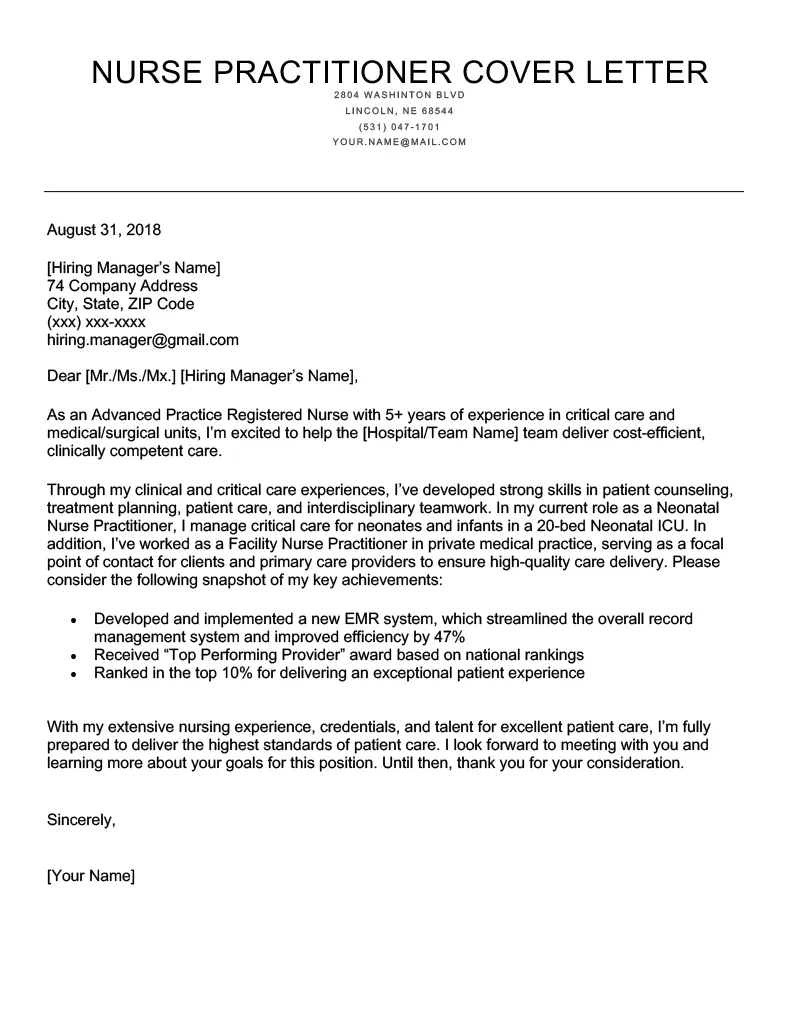
A well-structured cover letter is easy to read and allows the reader to quickly understand your qualifications. Use a clear and professional format. Start with your contact information, the date, and the employer’s contact information. Follow a standard business letter format. Use a professional font and maintain consistent spacing. The letter should be concise and focused. Each paragraph should have a clear purpose. Make sure you are easy to read and understand. Keep it to one page. An effective cover letter is well-organized and presents your information in a logical and compelling manner. This structure makes it easy for the hiring manager to quickly grasp the key points and assess your suitability for the position.
Writing a Compelling Opening Statement
Your opening statement is your first chance to grab the reader’s attention. Start with a strong statement that clearly states the position you are applying for and how you learned about it. Mention the specific job title, and where you saw the advertisement, this shows you pay attention to detail. Briefly state your main qualification and what makes you a good fit for the role. Clearly convey your enthusiasm for the position and the organization. For example, you might state, “I am writing to express my enthusiastic interest in the Nurse Practitioner position at [Hospital Name], as advertised on [Platform]. With my strong clinical skills, dedication to patient care, and passion for [specific area of practice], I am confident I can significantly contribute to your team.” The opening statement sets the tone for the entire letter and determines whether the reader will want to continue reading.
Elaborating on Your Relevant Experiences
After the opening, expand on your key skills and experiences. Use the body of your letter to provide specific examples that demonstrate your qualifications. Break down each skill into a separate paragraph or section. Provide clear examples of how you’ve applied your skills and achieved positive results. Use the STAR method (Situation, Task, Action, Result) to structure your examples. This method is particularly effective for describing your experiences: Start by describing the situation or context. Next, explain the task you were assigned. Then, detail the actions you took. Finally, describe the results of your actions. The STAR method gives structure and demonstrates your ability to be effective.
Creating a Strong Closing Statement

End your cover letter with a strong closing statement that reiterates your interest in the position and expresses your desire to learn more. Thank the hiring manager for their time and consideration. Reiterate your interest in the role and your belief that you are a good fit. Mention your availability for an interview and how you can be reached. A simple and polite closing, like, “Thank you for your time and consideration. I am available for an interview at your earliest convenience and can be reached at [phone number] or [email address]. I look forward to hearing from you soon,” is effective. The closing statement should leave the reader with a positive impression and encourage them to contact you.
Proofreading and Formatting Your Cover Letter
Before submitting your cover letter, take the time to proofread it carefully and ensure it is free of errors. Poor grammar, spelling mistakes, and formatting errors can create a negative impression and undermine your credibility. Your cover letter reflects your attention to detail and professionalism. Take the time to carefully review it. After completing your cover letter, step back and check everything. Make sure the formatting is consistent throughout. Check for errors in grammar, spelling, and punctuation. Double-check all contact information. Consider asking a friend, family member, or career counselor to review your cover letter. A fresh pair of eyes can often catch errors that you might miss. Ensuring your letter is error-free is essential and significantly increases the chances of getting a positive response from the hiring manager.
Checking for Grammar and Spelling Errors
Grammar and spelling errors can instantly damage your credibility. Use a grammar and spelling checker to identify and correct any mistakes. Ensure that you are using correct verb tenses and sentence structure. Proofread the cover letter multiple times, reading it slowly and carefully. Reading it out loud can also help you catch errors. Pay close attention to the proper use of commas, periods, and other punctuation marks. You can also use online tools or resources to check your work and learn to avoid common grammatical mistakes. A well-written, error-free cover letter shows that you are professional and detail-oriented, essential qualities for an NP.
Ensuring a Professional Appearance

Choose a professional font such as Times New Roman, Arial, or Calibri. Use a font size between 10 and 12 points. Make sure your cover letter is easy to read and visually appealing. Use consistent formatting throughout the document, including spacing, margins, and paragraph indentation. Avoid using excessive colors, bolding, or underlining. Ensure that your letter fits on one page. A well-formatted cover letter is essential. By using a professional font, keeping it to one page, and ensuring your layout is clean and readable, you’ll make a positive first impression. A visually appealing cover letter enhances your overall presentation and is more likely to be read and appreciated by the hiring manager.
Showcasing Your Passion and Enthusiasm
Let your personality and enthusiasm shine through. Highlight what motivates you as a nurse practitioner. Demonstrate your passion for patient care and your commitment to making a difference. Illustrate your personal values and what drives you to become a NP. Let the hiring manager see you as a real person who is truly excited about the opportunity. This level of engagement shows you are not just looking for a job but a career. Mention why you are passionate about the specific role, patient population, or specialty. Being enthusiastic and passionate can set you apart from other candidates. Your enthusiasm will make your application memorable and make the hiring manager want to invite you for an interview.