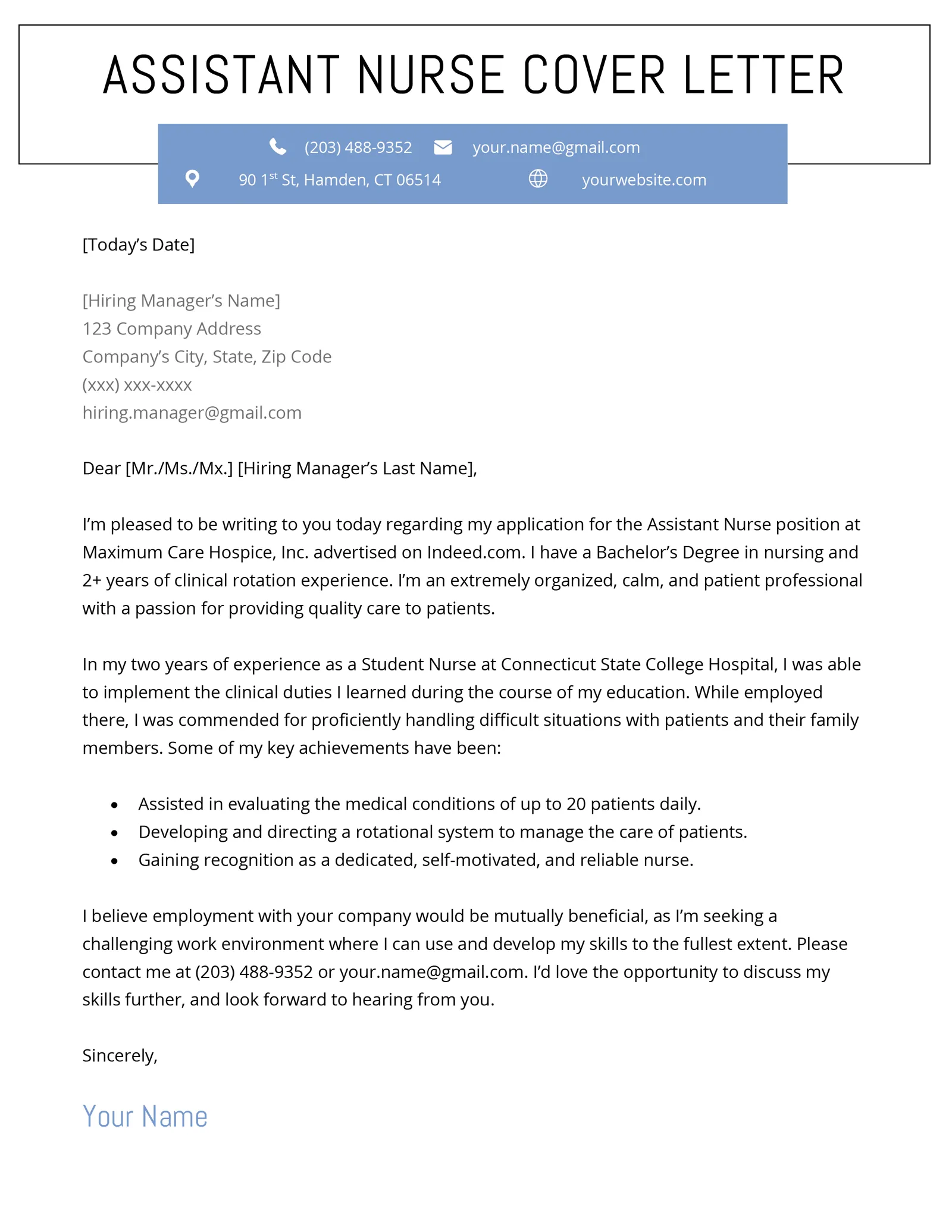
Crafting a Winning Nurse Cover Letter
A well-crafted cover letter is your first impression on a potential employer, serving as a crucial component of your job application package. For nurses, a cover letter provides an opportunity to showcase your passion for patient care, highlight relevant skills, and demonstrate your suitability for the specific position. This guide provides detailed nurse cover letter examples and essential tips to help you create a winning cover letter that sets you apart from other candidates and increases your chances of landing an interview. Understanding the significance of a cover letter and knowing how to effectively structure and tailor it can significantly improve your job search success. The following sections delve into each aspect of writing a compelling cover letter, offering insights, examples, and strategies to help you create a document that grabs attention and compels the reader to learn more about you.
Understanding the Purpose of a Cover Letter
The primary purpose of a cover letter is to introduce yourself, express your interest in the nursing position, and highlight why you are the ideal candidate. Unlike a resume, which provides a factual overview of your experience and qualifications, a cover letter allows you to communicate your personality, enthusiasm, and specific reasons for wanting to work at a particular facility. It’s your chance to explain how your skills and experiences align with the job requirements and the employer’s values. Think of it as your personal sales pitch, designed to persuade the hiring manager that you’re the right fit for the role and the organization. A well-written cover letter complements your resume, providing additional context and detail, making your application more compelling.
Highlighting Your Key Skills and Experience

In your nurse cover letter, focus on the skills and experiences most relevant to the job you’re applying for. Review the job description carefully and identify the key requirements, such as specific medical procedures, patient populations, or software proficiency. Use concrete examples to illustrate your skills. Instead of simply stating that you have experience in wound care, describe a situation where you successfully treated a patient with a complex wound, highlighting the positive outcome. Quantify your achievements whenever possible. For instance, you could mention how you reduced patient readmission rates by a certain percentage or improved patient satisfaction scores. This approach not only showcases your competence but also demonstrates the value you can bring to the employer. Remember to tailor your letter to each job application, emphasizing the skills and experiences that align most closely with the specific position.
Structuring Your Nurse Cover Letter
A well-structured cover letter is easy to read and effectively conveys your key qualifications. There are several crucial components to include in a winning nurse cover letter. Following a clear and concise structure ensures that your letter is professional and impactful, allowing the hiring manager to quickly grasp your qualifications and understand your interest in the position. Each section plays a vital role in highlighting your skills, experiences, and enthusiasm, ultimately increasing your chances of securing an interview and advancing in the job search process. Following a standard format allows you to present your information in a logical and organized manner, demonstrating your professionalism and attention to detail.
Header and Contact Information
Start your cover letter with a professional header that includes your name, address, phone number, and email address. It’s crucial to ensure that the contact information is accurate and up-to-date so that potential employers can easily reach you. Also, include the date and the recipient’s information (name, title, hospital/facility name, and address), if available. This shows that you’ve researched the company and addressed your letter to the appropriate person. A well-formatted header is the first indication of your attention to detail and professionalism, setting a positive tone for the rest of the letter. Double-check the accuracy of all information to avoid any communication issues and make a favorable first impression.
Professional Salutation

Always start your cover letter with a professional salutation, such as “Dear Mr./Ms./Dr. [Last Name]” if you know the hiring manager’s name. If you are unsure of the name, “Dear Hiring Manager” or “Dear [Department Name] Team” are acceptable alternatives. Avoid generic salutations like “To Whom It May Concern,” as these may appear impersonal. A personalized salutation demonstrates that you’ve taken the time to research the organization and its staff, which conveys respect and enthusiasm. A professional salutation sets a positive tone and shows you’re making an effort to create a personal connection with the recipient, which helps increase the likelihood of your application being taken seriously.
Body Paragraphs
The body paragraphs are the core of your cover letter, where you explain your interest in the position, highlight your qualifications, and showcase your personality. The body paragraphs are where you connect your experience to the job requirements. It’s crucial to craft each paragraph thoughtfully to make a lasting impression on the hiring manager. This section should be broken down into multiple paragraphs, each serving a specific purpose: grabbing attention, showcasing achievements, and expressing enthusiasm. Each paragraph provides an opportunity to highlight different aspects of your skills and qualifications. By addressing the key requirements and expressing your passion for nursing, you can increase your chances of creating a strong impression and being considered for an interview.
First Paragraph Grabbing Attention
The first paragraph should immediately grab the reader’s attention and clearly state the position you’re applying for and where you found the job posting. Briefly mention why you’re interested in the role or the organization. Focus on your passion for nursing or what specifically attracted you to the opportunity. You can use a strong opening sentence or a compelling anecdote to capture the hiring manager’s interest. For example, you could start by mentioning a specific experience or accomplishment that aligns with the job requirements. Make sure to keep this paragraph concise and impactful, creating a sense of excitement about your application. Avoid generic opening statements. Strive to make this paragraph memorable and informative. It will immediately set the tone for the rest of the letter.
Second Paragraph Showcasing Achievements

In the second paragraph, provide specific examples of your skills and experiences that align with the job requirements. Highlight your key achievements, quantifying them whenever possible. Instead of just listing your duties, describe what you accomplished. For example, if the job description emphasizes experience with electronic health records (EHRs), you could state how you improved charting accuracy by using a specific system, leading to fewer errors and improved patient safety. Provide evidence of your skills and how they benefited previous employers. The second paragraph is your chance to directly address the employer’s needs by demonstrating your ability to make a tangible contribution to the team. Use the STAR method (Situation, Task, Action, Result) to structure your examples, making them clear and impactful.
Third Paragraph Expressing Enthusiasm
The third paragraph should express your enthusiasm for the position and the organization. Show that you understand the company’s mission and values, and explain why you’re a good fit. This is where you connect your personal career goals with the job’s requirements. Demonstrate your interest in the organization’s culture and the potential opportunities it offers. Conclude by reiterating your interest in the position and expressing your anticipation for the opportunity to discuss your qualifications further in an interview. This paragraph should not only express your enthusiasm but also show that you have done your research. Make sure that you have a genuine connection and that you can describe a positive reason why you want to work there. Show the hiring manager that you are not just looking for a job but that you have a passion for patient care.
Concluding Your Cover Letter
Conclude your cover letter with a professional closing and a call to action. Thank the hiring manager for their time and consideration and reiterate your interest in the position. Include a polite request for an interview. State your availability and how they can contact you. End with a professional closing, such as “Sincerely” or “Respectfully,” followed by your typed name. Review the letter to ensure it’s free from errors, and proofread it carefully. Make sure that your contact information is correct. Following these steps, you can create a cover letter that leaves a lasting impression and greatly increases your chances of getting an interview and securing the job. A well-crafted conclusion demonstrates your professionalism and reinforces your interest in the role, leaving the hiring manager with a positive and memorable impression.
Examples of Effective Nurse Cover Letters

Reviewing nurse cover letter examples can provide valuable insights and help you tailor your letter to the specific job and your unique qualifications. Examples provide a framework for writing a clear, concise, and compelling cover letter. Tailoring the examples to reflect your particular experience, skills, and the specific requirements of the job posting is essential. Consider the following examples for different nursing roles.
Example 1 Registered Nurse (RN)
This section presents a sample cover letter for a Registered Nurse (RN) position. The example highlights skills related to patient care, medication administration, and teamwork, as well as the nurse’s experience in specific settings, such as the ICU or medical-surgical units. The letter will focus on the applicant’s ability to effectively manage patient care and collaborate with multidisciplinary teams, while also quantifying achievements. This example provides a good foundation for any RN seeking to demonstrate his or her professional capabilities. Adapt the content to reflect your own experience, while also showcasing a specific skill set that will align with the requirements of the job, and highlight your achievements.
Example 2 Licensed Practical Nurse (LPN)
This example features a sample cover letter designed for a Licensed Practical Nurse (LPN) position. The LPN cover letter example will emphasize the nurse’s experience in providing direct patient care, assisting with medical procedures, and administering medications. The focus of the example is to showcase the LPN’s ability to communicate with patients and families, while highlighting technical proficiency. The goal is to provide a foundational example that LPNs can customize to highlight their clinical skills, teamwork, and commitment to patient safety. Make sure that the example provided aligns with your qualifications. Tailor the content to the employer’s needs while highlighting your unique set of skills.
Example 3 Nurse Practitioner (NP)

This example presents a sample cover letter for a Nurse Practitioner (NP) position. The letter showcases the advanced practice skills of the NP, including patient assessment, diagnosis, treatment planning, and medication management. The focus is to illustrate the NP’s ability to lead a care team while being able to handle complex medical situations. The example will highlight the NP’s expertise in clinical procedures, patient education, and experience in various healthcare settings. Tailor this example to reflect the specifics of your career and the requirements for the job. Make sure to emphasize skills and qualifications that the potential employer is looking for, while highlighting your achievements.
Customizing Your Cover Letter for Each Application
Customizing your cover letter is essential for creating a document that truly resonates with the hiring manager and demonstrates your genuine interest in the position. Adapting your letter to each application ensures that you address the specific needs and requirements of the job and the organization. Customizing your cover letter demonstrates your attention to detail and your commitment to the application process. There are several key areas to personalize to increase your chances of securing an interview. These include: Researching the employer and tailoring your skills and experience to the job requirements, which shows that you have taken the time to learn about the role and how your experience can benefit the employer.
Researching the Employer
Before writing your cover letter, thoroughly research the employer. Visit their website, read about their mission and values, and learn about their current initiatives. If possible, find out who the hiring manager is and address the letter to them directly. Understanding the employer’s goals will enable you to tailor your letter to align with their needs. This process helps you identify specific skills or experiences the organization values. Refer to the organization’s mission and goals to show that you understand their needs and how you can contribute. This level of personalization demonstrates your genuine interest in the position. It demonstrates that you have done your homework and are eager to be a part of their team.
Tailoring Skills to Job Requirements

Carefully review the job description and identify the key skills and qualifications the employer is seeking. Then, tailor your cover letter to highlight how your experience and skills align with these requirements. Use specific examples from your past experiences to demonstrate your abilities and achievements. Do not simply list your skills; provide concrete examples of how you used those skills to achieve positive results. If the job description requires experience with a specific medical procedure or technology, make sure to emphasize your proficiency and any relevant certifications. Tailoring your letter shows that you understand the role and that you have the skills to excel. Doing so makes your application more relevant and improves the chances that you will make a good first impression on the potential employer. Tailoring your skills provides evidence that you will thrive in this position.
Proofreading and Editing
Proofreading and editing your cover letter is essential to ensure that it is free from errors and polished. Errors in grammar or spelling can immediately undermine your credibility. Always proofread your letter carefully before submitting it. Use a spell checker and a grammar checker, but don’t rely solely on them. Take the time to review your letter multiple times, or ask a friend or colleague to review it as well. A fresh set of eyes can often catch errors you might have missed. Ensure that your letter flows well and that your message is clear and concise. Proofreading and editing demonstrate your attention to detail and professionalism. Proofreading and editing ensures that your letter is the best representation of you and your experience.
Common Mistakes to Avoid
To create a compelling cover letter, it’s essential to avoid common mistakes that can undermine your application and reduce your chances of success. There are many things that should be avoided in your cover letter. Avoiding these pitfalls will dramatically improve your cover letter and make it the best representation of your skills. It will also help increase the chances of the hiring manager taking your application seriously and offering you an interview.
Generic Cover Letters

One of the biggest mistakes is using a generic cover letter that isn’t tailored to the specific job or employer. Generic letters lack the personal touch and fail to demonstrate your genuine interest in the position. Hiring managers can easily spot generic letters, and they are much less likely to consider them seriously. Avoid using templates without making significant changes. Always customize your letter to highlight your relevant skills, experience, and why you are interested in the specific role and organization. Research the organization. Demonstrate that you’ve taken the time to understand the job. Make it clear that you are not just sending the same letter to every job.
Typos and Grammatical Errors
Typos and grammatical errors can severely damage your credibility and demonstrate a lack of attention to detail. Always proofread your cover letter multiple times and use spell-check and grammar-check tools. However, these tools aren’t foolproof. Ask a friend, colleague, or career counselor to review your letter to catch any mistakes you might have missed. Pay close attention to sentence structure, punctuation, and word usage. Ensure the letter is well-organized and easy to read. A polished cover letter that is free from errors demonstrates professionalism and a commitment to quality.
Failing to Quantify Achievements
Many applicants fail to quantify their achievements. Instead of merely stating your responsibilities, use numbers and data to illustrate the impact of your work. For example, instead of saying, “Managed patient records,” state, “Managed patient records for 50 patients daily, ensuring 100% accuracy and compliance.” Quantifying your accomplishments makes your cover letter more compelling and allows the hiring manager to easily assess your contributions. Whenever possible, include statistics, percentages, and specific examples to demonstrate your skills and achievements. Use the STAR method (Situation, Task, Action, Result) to structure your accomplishments and show your value.
Conclusion
Writing a strong cover letter is crucial for landing a nursing job. By understanding the purpose of the cover letter, structuring it effectively, and customizing it for each application, you can create a compelling document that highlights your skills and qualifications. Remember to emphasize your achievements, express your enthusiasm, and proofread carefully. The use of nurse cover letter examples can guide you, but make sure to tailor the examples to your experience. Avoid common mistakes like using generic letters or neglecting to quantify your achievements. By following the guidelines provided, you can significantly improve your chances of getting an interview and securing your dream nursing position. A well-crafted cover letter is a powerful tool that can help you stand out and impress potential employers.