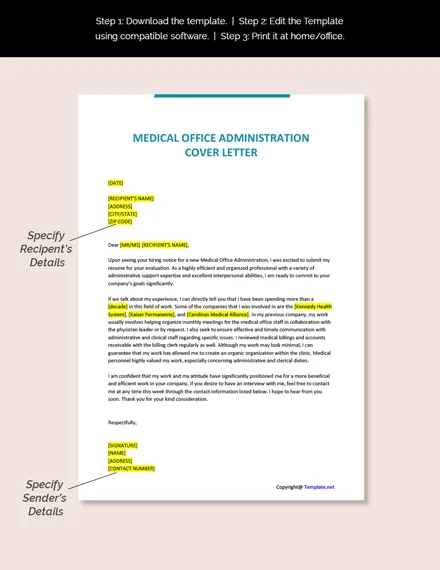
What Is a Medical Office Cover Letter
A medical office cover letter is a crucial document accompanying your resume when applying for jobs in the healthcare sector. It serves as your first introduction to a potential employer, providing an opportunity to showcase your personality, skills, and enthusiasm for the position. Unlike a resume, which is a factual summary of your experience, a cover letter allows you to explain why you’re the perfect fit for the specific medical office and role. A well-crafted cover letter can significantly increase your chances of landing an interview and ultimately, securing your desired job. It is your chance to shine and make a positive first impression.
Key Components of a Medical Office Cover Letter
Contact Information

Professional Header
Begin with a professional header that includes your name, address, phone number, and email address. Ensure that your email address is professional and suitable for business correspondence. This section allows the employer to easily contact you. A clean and well-formatted header sets a professional tone for the entire letter.
Applicant’s Name and Contact Info
Make sure to include your full name and contact information, including your phone number and email address, at the top of the letter. It’s essential that this information is accurate and up-to-date to ensure the hiring manager can easily reach you.
Date

Include the current date beneath your contact information. This helps the employer know when the letter was written.
Hiring Manager’s Name and Title
Address your letter to the hiring manager, if possible. Research the practice or clinic to find the name and title of the person responsible for hiring. If you cannot find a specific name, use a professional greeting like “Dear Hiring Manager.” Proper addressing demonstrates initiative and attention to detail.
Greeting
Start your cover letter with a formal greeting such as “Dear Mr./Ms./Mx. [Last Name]” or “Dear Hiring Manager.” Avoid informal greetings like “To Whom It May Concern.” Always address the reader respectfully and professionally.
Body Paragraphs

First Paragraph
State the Position
In the first paragraph, clearly state the position you are applying for and how you found the job posting. Be specific and mention where you saw the advertisement (e.g., Indeed, company website). Briefly express your interest in the role and the organization. This immediately informs the reader of your purpose.
Briefly Summarize Experience

Provide a concise summary of your relevant experience. Highlight the key aspects of your background that align with the job requirements. Focus on the most important skills and experiences that make you a suitable candidate for the position.
Second Paragraph
Highlight Relevant Skills
In the second paragraph, elaborate on the skills and qualifications that make you a strong candidate. Identify the key skills mentioned in the job description and provide examples of how you have demonstrated those skills in previous roles. Focus on skills like patient communication, medical record management, and knowledge of medical terminology.
Quantify Achievements

Quantify your achievements whenever possible. Use numbers and data to showcase your accomplishments. For example, mention how you improved patient satisfaction scores, reduced administrative errors, or streamlined office processes. Providing tangible evidence of your successes is a powerful way to impress a potential employer.
Third Paragraph
Express Enthusiasm and Fit
In the third paragraph, express your enthusiasm for the position and the organization. Explain why you are interested in working for this particular medical office. Research the clinic’s mission, values, and services, and explain how your goals align with theirs. Showing genuine interest makes you a more compelling candidate.
Call to Action

Conclude your cover letter with a clear call to action. State that you are eager to learn more about the opportunity and are available for an interview. Thank the hiring manager for their time and consideration. This demonstrates your proactive approach and desire for the role.
Closing and Signature
Use a professional closing such as “Sincerely,” “Respectfully,” or “Best regards.” Leave space for your handwritten signature, followed by your typed name. Always proofread your cover letter for any typos or grammatical errors before submitting it.
Formatting and Design Tips
Font and Readability
Choose a professional and easy-to-read font, such as Times New Roman, Arial, or Calibri. Use a font size between 10 and 12 points. Ensure that the font is consistent throughout the document for a polished appearance. Readability is key to making a positive impression.
White Space
Use ample white space to make your cover letter visually appealing and easy to read. Use single-spacing within paragraphs and double-spacing between paragraphs. Maintain consistent margins (usually 1 inch on all sides). White space helps the reader focus on the content and prevents the letter from appearing cluttered.
Proofreading and Editing
Proofread your cover letter meticulously for any typos, grammatical errors, or formatting inconsistencies. Ask a friend or family member to review your letter as well. Errors can undermine your professionalism and may lead to your application being overlooked. Take the time to ensure your cover letter is flawless.
Medical Office Cover Letter Examples
Example 1 Medical Assistant
A cover letter for a medical assistant position should highlight your skills in patient care, clinical procedures, and administrative tasks. Include details about your experience with taking patient histories, assisting with examinations, and performing basic lab tests. Mention any certifications you hold, such as Certified Medical Assistant (CMA), and your proficiency in electronic health records (EHR) systems.
Example 2 Medical Receptionist
A medical receptionist cover letter should emphasize your communication, organizational, and customer service skills. Highlight your experience in scheduling appointments, answering phones, greeting patients, and managing patient records. Showcase your ability to handle insurance verification, billing inquiries, and maintain a welcoming environment. Mention any experience with specific medical office software.
Example 3 Office Manager
An office manager cover letter should demonstrate your leadership, administrative, and financial management skills. Highlight your experience in supervising staff, managing budgets, and ensuring the smooth operation of the medical office. Include details about your experience with billing, coding, and insurance claims. Show your proficiency in office management software and your ability to maintain compliance with healthcare regulations.
Common Mistakes to Avoid
Generic Content
Avoid using a generic cover letter that could be sent to any employer. Tailor each cover letter to the specific job and medical office you are applying to. Customize the content to match the requirements of the position and the values of the organization. Generic letters show a lack of effort and make you appear less interested.
Typos and Grammatical Errors
Typos and grammatical errors can damage your credibility and professionalism. Always proofread your cover letter carefully before submitting it. Use spell check and grammar check tools, and have someone else review your letter for any errors. Attention to detail is crucial.
Ignoring the Job Description
Carefully read the job description and address the key requirements in your cover letter. Highlight the skills and experiences that match the qualifications listed. Failing to address the requirements makes it difficult for the employer to see how you fit the role.
Too Much Information
Keep your cover letter concise and focused. Avoid including irrelevant information or rehashing your entire resume. Focus on the most important skills and experiences that demonstrate your suitability for the role. A well-written cover letter should be no more than one page in length.
Tailoring Your Cover Letter
To tailor your cover letter, research the medical office and the position. Identify the key skills, experiences, and qualifications that the employer is seeking. Then, customize your letter to highlight how your background aligns with their needs. Use keywords from the job description to demonstrate your understanding of the role.
Keywords
Incorporate relevant keywords from the job description throughout your cover letter. This helps the hiring manager quickly see that you have the required skills and experience. However, do not overuse keywords. Ensure that they are used naturally and in context to make your letter readable and engaging.
Research the Practice/Clinic
Research the medical practice or clinic to understand its mission, values, and services. Demonstrate your interest in the organization by mentioning specific aspects that resonate with you. This shows that you have taken the time to learn about the company and are genuinely interested in joining their team.
Follow-up After Submission
After submitting your cover letter and resume, follow up with the hiring manager within a week to reiterate your interest in the position. You can send a brief email thanking them for their time and asking about the status of your application. This demonstrates your enthusiasm and professionalism. Make sure the email is brief, professional, and free of any errors.
In conclusion, a well-crafted cover letter is essential for securing a job in a medical office. By following these guidelines, you can create a compelling cover letter that showcases your skills, experience, and enthusiasm. Remember to tailor your letter to each specific job application, and always proofread carefully. Good luck with your job search!