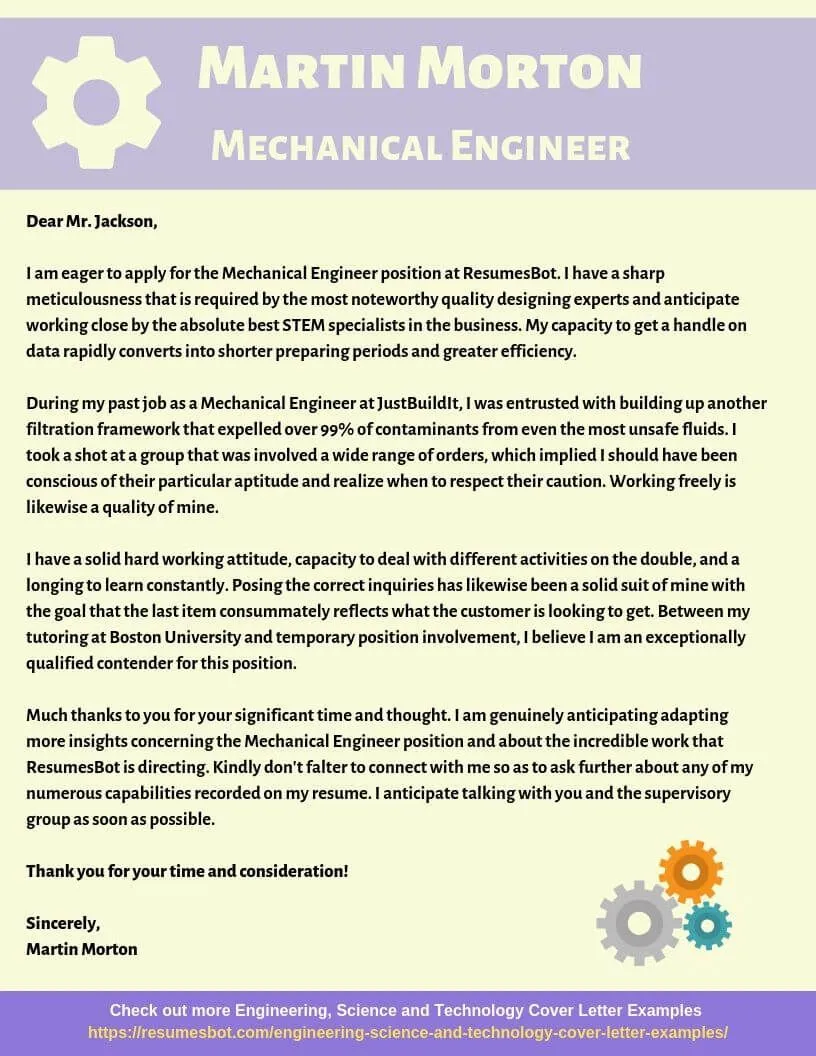
Why Cover Letters Are Crucial for Mechanical Engineers
In the competitive field of mechanical engineering, a well-crafted cover letter can be your key to unlocking new opportunities. It’s often the first impression you make on a potential employer, offering a chance to showcase your personality, passion, and suitability for a specific role. A cover letter is not merely a formality; it’s a vital tool that allows you to expand on your resume, provide context to your experiences, and demonstrate your genuine interest in the company and the position. It’s where you can articulate your career goals, highlight relevant skills, and show how your unique qualifications align with the employer’s needs. A strong cover letter sets you apart from other applicants, proving you’re not just qualified on paper, but also a great fit for the company culture.
Key Components of a Strong Mechanical Engineer Cover Letter
Creating a compelling cover letter involves several key components working in harmony to tell your story effectively. Begin with your contact information and the date, followed by the hiring manager’s details. A professional greeting sets the tone, while the opening statement should immediately grab the reader’s attention. Throughout the body, highlight your relevant skills and experience, including quantifiable achievements to demonstrate your impact. Tailor the letter to the specific job description, showcasing projects and technical expertise, and mentioning relevant software and tools. Express your enthusiasm and genuine interest in the role and the company. Conclude with a clear call to action, inviting the reader to review your resume and contact you for an interview. Each part plays a crucial role in ensuring your cover letter is informative, engaging, and persuasive.
Your Contact Information and Date

At the top of your cover letter, start with your contact information, including your full name, phone number, email address, and optionally, your LinkedIn profile URL. Immediately below, include the date you’re sending the letter. This section provides the hiring manager with the necessary details to reach you and ensures the document is properly dated for record-keeping purposes. Ensure the information is accurate and up-to-date, reflecting your current professional identity. Correct formatting and presentation here are essential for a professional look and easy reference.
The Hiring Manager’s Information
Always address your cover letter to a specific person, if possible. Research the company to find the hiring manager’s name and title. If you cannot find a specific name, use a professional greeting like “Dear Hiring Manager.” Include the hiring manager’s title, the company’s name, and the company’s address. Personalizing your cover letter demonstrates that you’ve taken the time to research the company and are genuinely interested in the opportunity. Addressing the letter to a specific person can significantly increase your chances of getting it read and considered seriously.
Greeting and Opening Statement
Start with a professional greeting, such as “Dear Mr./Ms. [Last Name],” or “Dear Hiring Manager,” if you don’t have a specific name. The opening statement should immediately capture the reader’s attention. Briefly mention the position you are applying for and where you found the job posting. Then, use this opportunity to express your interest in the role and the company. State your enthusiasm for the opportunity and provide a brief overview of why you are a good fit. The opening paragraph is critical as it sets the stage for the rest of your letter and influences the hiring manager’s initial impression. For instance, you might start by stating your excitement about the opportunity and mentioning a key skill or experience that aligns with the job requirements.
Highlighting Your Skills and Experience

The core of your cover letter is showcasing your skills and experience. Focus on the skills and experiences most relevant to the job description. Provide specific examples from your past roles and projects to demonstrate your capabilities. Emphasize your technical expertise, problem-solving abilities, and any other skills listed in the job requirements. It’s not just about listing your skills; it’s about illustrating how you’ve applied them successfully in previous situations. Use action verbs and quantify your achievements whenever possible to make your accomplishments more impactful. For instance, instead of simply stating that you managed a project, describe how you managed the project to deliver it on time and within budget.
Quantifiable Achievements
Quantifying your achievements is crucial for making a strong impression. Whenever possible, use numbers and data to demonstrate the impact of your work. Instead of saying you improved efficiency, state that you increased efficiency by a certain percentage. This provides tangible evidence of your capabilities and the value you bring to the table. For example, you could highlight how you reduced production costs, improved product performance, or increased customer satisfaction. Quantifiable achievements provide concrete evidence of your skills and make your cover letter more compelling. Make sure your achievements are relevant to the job description and the company’s objectives.
Tailoring Your Letter to the Job Description
Customizing your cover letter to match the specific job description is essential. Carefully review the job posting and identify the key requirements and keywords. Use these keywords throughout your cover letter to demonstrate that you possess the desired skills and experience. Highlight how your qualifications align with the employer’s needs. Tailoring your letter shows that you have taken the time to understand the role and that you’re genuinely interested in the position. Addressing the specific requirements of the job description ensures that your cover letter resonates with the hiring manager and increases your chances of getting an interview.
Showcasing Projects and Technical Expertise

Provide details about relevant projects you’ve worked on, highlighting your technical expertise. Describe your role in each project, the challenges you faced, and the solutions you implemented. Emphasize the technical skills and knowledge you used. For instance, you could describe your experience with CAD software, FEA analysis, or other relevant technologies. Showcasing your technical expertise through specific project examples gives the hiring manager a clearer picture of your capabilities and what you can bring to their team. It’s important to provide enough detail to demonstrate your understanding and skills while keeping the descriptions concise and focused.
Mentioning Relevant Software and Tools
Mechanical engineers often use a variety of software and tools. Make sure to list the specific software and tools you are proficient in, such as CAD software (SolidWorks, AutoCAD, etc.), simulation tools (ANSYS, COMSOL), and programming languages (MATLAB, Python). Mention your experience with these tools, demonstrating your ability to use them effectively in your work. If the job description specifies certain software, be sure to mention your experience with those specific tools. This demonstrates that you have the practical skills necessary to perform the job and can hit the ground running.
Expressing Your Enthusiasm and Interest
Demonstrate your genuine enthusiasm and interest in the role and the company. Explain why you are excited about the opportunity and what attracts you to the company. Research the company’s mission, values, and recent projects. Express your interest in contributing to their goals and describe how your skills and experience align with their needs. Mentioning specific aspects of the company that resonate with you, such as their innovative approach or their commitment to sustainability, can make your cover letter more persuasive. Your enthusiasm and passion for the role can leave a lasting positive impression on the hiring manager, differentiating you from other candidates.
The Closing and Call to Action

End your cover letter with a strong closing and a clear call to action. Thank the hiring manager for their time and consideration. Reiterate your interest in the role and express your eagerness to discuss your qualifications further in an interview. State that you have attached your resume for their review and are available at their earliest convenience. Provide your contact information again, if needed, to make it easy for them to reach you. The closing should be professional and leave the hiring manager with a positive impression. End with a polite closing such as “Sincerely” or “Best regards” and your full name.
Example 1 Entry-Level Mechanical Engineer
An entry-level cover letter should highlight your academic achievements, internships, and any projects you worked on during your studies. Focus on the skills you have gained through your education, such as problem-solving, analytical skills, and knowledge of engineering principles. Mention any relevant coursework, such as thermodynamics, fluid mechanics, or machine design. Provide examples of projects where you applied these principles and any results achieved. If you have any internships or co-op experiences, describe your responsibilities and what you learned. Highlight your eagerness to learn and contribute to the company. An entry-level mechanical engineer’s cover letter demonstrates a strong foundation and a desire to begin your career.
Skills and Experience for Entry-Level
For entry-level positions, emphasize your educational background, including your degree, GPA, and relevant coursework. Highlight any hands-on experience, such as lab work, design projects, or participation in engineering clubs. Mention any software you have used, such as CAD, simulation, or analysis tools. Provide examples of projects you worked on during your studies, such as designing a new product or improving an existing system. Focus on transferable skills such as teamwork, communication, and problem-solving. Show that you are a fast learner and are eager to contribute to the company. An entry-level cover letter should showcase your potential and enthusiasm for a successful career.
Example 2 Experienced Mechanical Engineer

An experienced mechanical engineer cover letter should focus on your professional achievements and the impact you’ve made in previous roles. Quantify your accomplishments whenever possible, such as cost savings, efficiency improvements, or product enhancements. Highlight your technical expertise and leadership abilities. Describe your experience with project management, team leadership, and mentoring. Tailor your cover letter to the specific job requirements and showcase how your experience aligns with their needs. Mention any certifications or professional licenses you hold. An experienced engineer’s cover letter demonstrates value and the capacity to drive results.
Highlighting Achievements for Experienced Engineers
When highlighting your achievements, use quantifiable results. Provide specific examples of how you improved efficiency, reduced costs, or enhanced product performance. For instance, you could mention how you reduced manufacturing costs by a certain percentage or improved product reliability, leading to a reduction in warranty claims. Describe projects you led or contributed to, highlighting your role and your key accomplishments. Quantify your contributions and use data to back up your claims. Mention any awards or recognition you’ve received. By quantifying your achievements, you provide concrete evidence of your ability to drive results and make a significant impact in the new role.
Example 3 Mechanical Design Engineer
A cover letter for a mechanical design engineer should emphasize your design skills and experience with relevant software. Highlight your ability to create designs, perform calculations, and create prototypes. Mention your experience with CAD software (such as SolidWorks, AutoCAD, or Inventor), FEA analysis, and other design tools. Describe projects where you have designed new products or improved existing ones. Emphasize your creativity, problem-solving skills, and attention to detail. If you have experience with 3D printing or other rapid prototyping technologies, make sure to mention them. A mechanical design engineer’s cover letter should showcase your design abilities and expertise in the field.
Focusing on Design and Innovation

Focus your cover letter on your design skills and ability to innovate. Describe your experience with creating designs, performing simulations, and building prototypes. Mention any innovative designs or solutions you’ve developed. Emphasize your creativity, problem-solving skills, and attention to detail. Provide examples of projects where you developed new products or improved existing designs. Show that you are passionate about innovation and staying at the forefront of design trends. Tailor your letter to showcase your understanding of design principles and the latest technologies, demonstrating your ability to create effective and innovative solutions.
Example 4 Project Engineer Mechanical
A cover letter for a project engineer should highlight your project management skills and ability to lead teams. Describe your experience with managing projects from start to finish, including planning, budgeting, scheduling, and resource allocation. Mention your experience with project management methodologies, such as Agile or Waterfall. Highlight your communication skills, ability to work with cross-functional teams, and leadership qualities. Showcase your ability to deliver projects on time and within budget. If you have experience with risk management, procurement, or vendor management, make sure to mention it. A project engineer’s cover letter should emphasize project management capabilities and your successful track record.
Showcasing Project Management Skills
Emphasize your project management skills, including your experience with planning, budgeting, scheduling, and resource allocation. Describe your role in managing projects from start to finish. Highlight your communication and leadership skills and your ability to work effectively with cross-functional teams. Mention any project management methodologies you have experience with, such as Agile or Waterfall. Describe your successes in delivering projects on time and within budget. Provide examples of projects where you successfully managed risks, resolved issues, and ensured project success. A project engineer’s cover letter should demonstrate your ability to lead and manage projects from start to finish.
Example 5 Mechanical Engineer with Specialization
If you have a specialization, such as robotics, HVAC, or aerospace engineering, tailor your cover letter to highlight your expertise in that area. Emphasize your knowledge of the specific technologies, tools, and regulations related to your specialization. Mention any relevant certifications or licenses. Provide examples of projects where you have applied your specialized skills. Show that you are passionate about your specialization and that you stay up-to-date with the latest developments in your field. A cover letter highlighting your specialization can make you stand out from other candidates and increase your chances of landing the job.
Highlighting a Specialization
Focus on your specialized skills and experience. If your specialization is in robotics, mention your experience with robot design, programming, and integration. If you specialize in HVAC, highlight your knowledge of HVAC systems, energy efficiency, and building codes. Provide examples of projects where you have applied your specialized skills and expertise. Highlight any relevant certifications or licenses. Show your passion for your specialization and your commitment to staying current with industry trends. Tailor your cover letter to show how your specialized skills align with the job requirements and what unique value you bring.
In conclusion, a well-crafted cover letter is essential for mechanical engineers seeking new opportunities. By highlighting your skills, experience, and achievements, and tailoring your letter to each specific job, you can make a strong impression on potential employers. Follow these examples and guidelines to create a compelling cover letter that sets you apart from the competition and helps you land your dream job. Always remember to proofread carefully before submitting your application. Good luck!