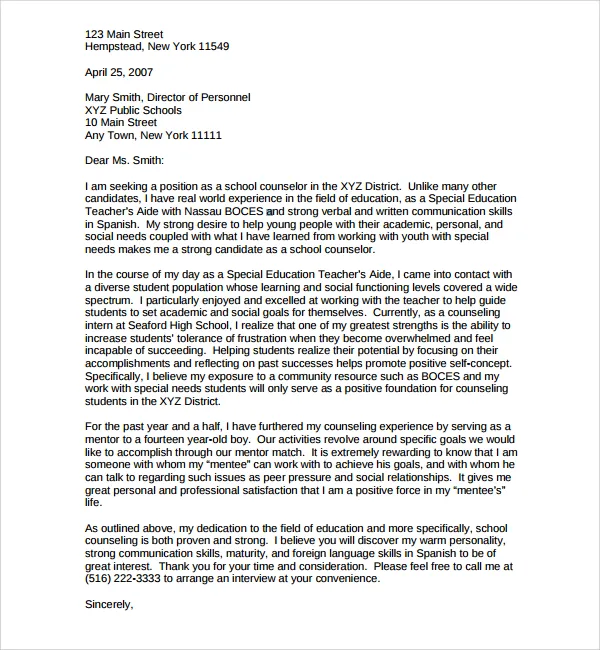
The Importance of an Admissions Counselor Cover Letter
Your admissions counselor cover letter is the initial introduction to your potential employer, and it is a crucial part of the application process. It offers a detailed view of your qualifications, experience, and suitability for the role, going beyond what is stated in your resume. A strong, tailored cover letter can mean the difference between getting an interview or having your application overlooked. It provides you with an opportunity to express your interest in the position and showcase your understanding of the admissions process. It tells your story and highlights the key qualifications that align with the job requirements, giving you an advantage over other candidates.
Understanding the Admissions Counselor Role
Before beginning to craft your cover letter, it’s essential to fully understand the role of an admissions counselor. This understanding allows you to tailor your letter to highlight the experiences and skills most relevant to the position. The admissions counselor role is more than just reviewing applications; it is about providing support, guidance, and information to prospective students. They are responsible for representing the institution to potential applicants and helping them through the complex application process. Showing that you understand the nuances of this responsibility and that you are ready to fulfill it is essential to a successful application.
Key Responsibilities of an Admissions Counselor

An admissions counselor’s work is multifaceted, covering a broad range of duties. They review applications, conduct interviews, and participate in recruitment events to attract prospective students. Admissions counselors evaluate transcripts, test scores, and essays. They also engage with a diverse student population. They represent the institution at college fairs and high school visits, and they provide support throughout the enrollment process to ensure that new students transition smoothly. By demonstrating experience with these responsibilities, your cover letter will be more effective and relevant.
Crafting a Compelling Cover Letter
To craft a compelling cover letter, you must grab the reader’s attention and clearly showcase your qualifications, along with your understanding of the role and the institution. You should be able to highlight your skills, experience, and achievements while keeping the letter clear, concise, and tailored to the specific job and the requirements of the institution. The following sections will help you to create a cover letter that stands out among many applications.
Header and Contact Information
Begin your cover letter with a professional header that includes your full name, address, phone number, and email address. It is essential that your contact information is accurate and up-to-date. Including the date and the recipient’s details (name, title, institution, and address) is also crucial for a professional look. This attention to detail demonstrates your professionalism and enables the hiring manager to contact you easily. Proofreading your header to avoid any errors will positively impact the hiring manager.
Formatting Your Cover Letter

How you format your cover letter is just as important as what you write. A clean and easy-to-read font such as Times New Roman, Arial, or Calibri should be used and the font size should be between 10 and 12 points. Single-space within paragraphs and double-space between paragraphs. Your cover letter should ideally be one page, with clear headings, bullet points, and ample white space to make it easy to scan. A well-formatted cover letter demonstrates your attention to detail and your ability to communicate professionally.
Greeting and Addressing the Hiring Manager
Avoid generic greetings like “To Whom It May Concern.” Whenever possible, address the hiring manager by name. If you can find the hiring manager’s name on LinkedIn, on the institution’s website, or in the job posting, use it. It shows that you have taken the time to do your research and are interested in the position. If you cannot find a specific name, then “Dear Hiring Committee” is acceptable. Personalizing your greeting can distinguish your cover letter and application from others.
Writing a Strong Opening Paragraph
The opening paragraph is your chance to grab the reader’s attention. State the position you are applying for and how you found the job posting. Briefly mention why you are interested in the role and what makes you a good fit. This paragraph sets the tone for the rest of your letter. Write a strong opening paragraph that is concise, enthusiastic, and clearly states your intention to apply for the position. It should also give the reader a reason to continue reading your letter.
Highlighting Relevant Skills and Experiences

Focus on your relevant skills and experiences when highlighting them in the main body of your cover letter. Emphasize how your previous positions have prepared you for the admissions counselor role. Use specific examples to illustrate your capabilities. Make sure you align your skills with the job description; this shows that your letter is directly relevant to the role. Provide evidence of your achievements and skills through real-life examples rather than just stating them.
Showcasing Your Qualifications
When showcasing your qualifications, highlight those most relevant to the job. Focus on your experience in student recruitment, application review, counseling, and communication. If you have experience with any CRM systems or any other software used in admissions, make sure you mention it. Use strong action verbs to describe your accomplishments and responsibilities, such as “managed”, “coordinated”, or “implemented.” This will make your letter more impactful and dynamic.
Quantifying Achievements and Results
Quantify your achievements whenever you can. Rather than stating “I improved student enrollment,” say “I increased student enrollment by 15%.” Use numbers to demonstrate the impact of your work. Quantifying your achievements makes your claims more credible and provides concrete evidence of your abilities. Use percentages, numbers, or metrics to provide tangible results. This lets the hiring manager see the value you can bring to the role.
Demonstrating Passion for the Role

Show your sincere passion for the admissions counselor role and the institution. Admissions counselors work with prospective students. Your cover letter should reflect your enthusiasm and your dedication to helping students succeed. Include the reasons for your interest in this specific institution and what attracts you to it. This demonstrates a deeper level of engagement and will make your application more memorable.
Expressing Your Enthusiasm
Express your enthusiasm for the position and the institution. Explain what motivates you to work in admissions. This could be a personal connection to the institution, a passion for helping students, or an appreciation for the institution’s mission and values. Let your passion shine through your writing. Show your enthusiasm in your accomplishments and aspirations. This will make you stand out from the crowd.
Tailoring Your Letter to the Institution
Every institution has its unique characteristics. Tailor your cover letter to reflect the specific mission, values, and culture of the college or university you are applying to. Research the institution thoroughly before writing your letter. Show that you understand its goals and how your skills align with its needs. Personalizing your letter demonstrates your genuine interest and shows that you have taken the time to learn about the institution. It can significantly impact the hiring manager.
Researching the Institution’s Mission and Values

Thoroughly research the institution’s mission and values before writing your cover letter. You can visit their website, read their mission statement, and learn about their programs and culture. Identify how your skills and experiences align with their goals and values. Referencing these goals and values in your cover letter shows that you are applying to their institution for a specific reason. This demonstrates initiative and interest in the position.
Incorporating Institutional Culture
Incorporate the institution’s culture into your cover letter. Mention the specific programs, initiatives, or values that appeal to you. If the institution emphasizes diversity, equity, and inclusion, highlight your related experience. If they value innovation or community involvement, show how your background aligns with these priorities. Customizing your letter to reflect the institution’s culture makes it clear that you are not just a good fit for the job, but that you will contribute positively to the team and the campus community.
Writing a Powerful Closing Paragraph
Your closing paragraph should summarize your key qualifications and reiterate your interest in the position. It should express your gratitude for the opportunity and include a clear call to action. The closing paragraph is your last chance to make a positive impression; therefore, it should be memorable. End your letter with confidence, reiterating your enthusiasm and desire to contribute to the institution’s success.
Expressing Gratitude and a Call to Action

Thank the hiring manager for their time and consideration. Reiterate your interest in the position and indicate your willingness to discuss your qualifications further in an interview. Provide your contact information again, and state clearly how the hiring manager can reach you. A well-executed call to action will encourage the hiring manager to take the next step, such as contacting you for an interview. Always include a professional closing, such as “Sincerely” or “Respectfully,” followed by your full name.
Proofreading and Editing Your Cover Letter
Before submitting your cover letter, proofread it meticulously. Errors can be a big disadvantage no matter how impressive your qualifications are. Take the time to ensure your cover letter is error-free. This attention to detail will reflect well on you and your professionalism. Proofreading demonstrates your respect for the hiring manager and shows your commitment to quality.
Checking for Grammatical Errors and Typos
Carefully check your cover letter for any grammatical errors or typos. Use spell-check and grammar-check tools, but don’t rely on them completely. Read your letter aloud to catch any mistakes or awkward phrasing. It’s also useful to have someone else proofread your letter because another set of eyes can find errors you may have missed. Ensure that all names, titles, and dates are accurate. Correct grammar and spelling demonstrate professionalism and attention to detail.
Ensuring Clarity and Conciseness
Ensure your cover letter is clear and concise. Avoid jargon and overly complicated language. Use simple, direct sentences and paragraphs. Make sure your main points are easy to understand. Your cover letter should present your capabilities in a straightforward manner. Avoid overwhelming the hiring manager with too much information. Get straight to the point and demonstrate the benefits you can bring to the role. Clarity allows your best qualities to shine through.
Seeking Feedback from Others
Ask a trusted friend, mentor, or career counselor to review your cover letter. Their feedback can provide valuable insights and help you identify areas for improvement. They may catch errors you missed or offer suggestions to strengthen your letter. A fresh perspective can make a big difference. Their insights will help polish your writing and make it more effective. Use their feedback to create the best possible cover letter.