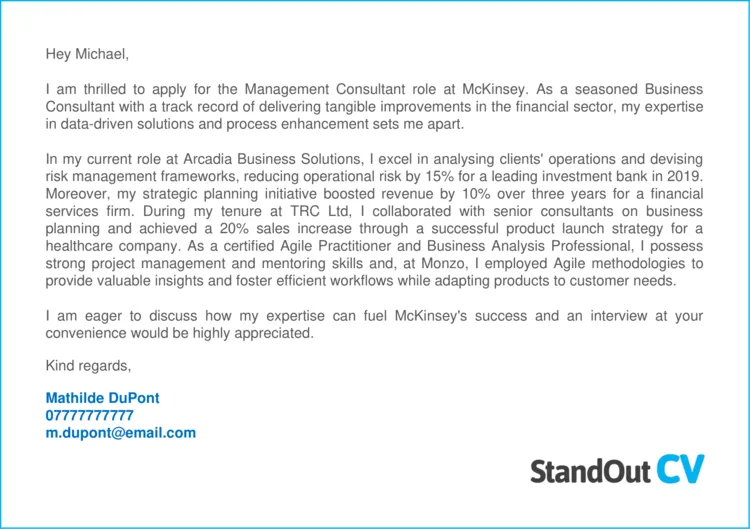
The Importance of a McKinsey Cover Letter
Applying to McKinsey & Company is a significant goal for many, and a well-crafted cover letter is crucial for making a strong first impression. It’s your chance to demonstrate why you’re a compelling candidate, showcasing not just your skills and experiences but also your understanding of McKinsey and its values. A cover letter allows you to go beyond the confines of your resume and provide context, elaborate on achievements, and express your genuine interest in the firm. A great cover letter can be the deciding factor in whether you get an interview, and a poorly written one can immediately disqualify you, so investing time and effort into this document is essential.
Why Cover Letters Matter for McKinsey
McKinsey receives applications from exceptionally talented individuals worldwide, making the competition fierce. Your cover letter is your opportunity to stand out from the crowd. It allows you to personalize your application, showing that you’ve invested time in understanding McKinsey’s culture and what they are looking for in a candidate. It also provides a platform to connect your experiences and skills to the specific requirements of the role. A strong cover letter can demonstrate your communication skills, attention to detail, and ability to articulate your value proposition, all critical qualities for a consultant.
What Recruiters Look For

McKinsey recruiters are looking for more than just a list of accomplishments; they want to see how you think, your ability to solve complex problems, and your potential to thrive in a fast-paced, collaborative environment. They assess your ability to communicate clearly and concisely, your understanding of McKinsey’s core values (such as leadership, problem-solving, and teamwork), and your genuine interest in the firm. The cover letter should showcase your analytical skills, demonstrate your impact in previous roles, and reveal your passion for consulting. Recruiters are looking for individuals who not only possess the necessary skills but also align with the firm’s culture.
Essential Components of a McKinsey Cover Letter
Contact Information and Greeting
Begin your cover letter with your full name, address, phone number, and email address. If possible, address the letter to a specific person (e.g., the hiring manager or a recruiter) rather than using a generic greeting. This demonstrates that you’ve done your research and are genuinely interested in the firm. Ensure you spell their name correctly, as this demonstrates attention to detail. A personalized greeting shows you’ve gone the extra mile and understand who will be reading your letter.
Personalized Introduction

In the opening paragraph, state the position you’re applying for and briefly explain why you’re interested in McKinsey. Mention something specific that attracted you to the firm, whether it’s a particular project, the company culture, or its commitment to certain industries. This opening paragraph should immediately capture the reader’s attention and demonstrate your genuine interest. Keep it concise and to the point, focusing on the ‘why’ behind your application. Avoid generic statements; make it clear why you’re choosing McKinsey over other consulting firms.
Highlighting Achievements and Skills
The body of your cover letter is where you highlight your relevant achievements and skills. Choose a few key experiences from your resume that align with the requirements of the consulting role. Instead of simply listing your responsibilities, focus on your accomplishments. Quantify your achievements whenever possible and explain the impact you made in each role. Use the STAR method (Situation, Task, Action, Result) to provide context and demonstrate your problem-solving abilities. Focus on examples that show analytical thinking, leadership, and teamwork.
Quantifying Your Accomplishments
One of the most important aspects of showcasing your achievements is quantifying your results. Whenever possible, use numbers to demonstrate the impact of your work. For example, instead of saying you ‘improved sales,’ say you ‘increased sales by 15% within one quarter.’ Use metrics, data, and specific outcomes to show how your actions led to positive results. This makes your accomplishments more credible and provides a clear picture of your value. Quantifying your accomplishments helps potential employers understand your contributions more effectively and the benefits you bring to the table.
Demonstrating Alignment with McKinsey Values

McKinsey values are at the core of its culture, and your cover letter should reflect your understanding and embodiment of these values. Examples of these are leadership, integrity, problem-solving, and collaboration. Show how your past experiences align with these values. For example, if you led a team, discuss how you motivated them and achieved a common goal, highlighting your leadership skills. If you faced a challenging problem, explain your analytical approach and how you arrived at a successful solution. By explicitly connecting your experiences to McKinsey’s values, you show that you’re a great cultural fit.
Expressing Enthusiasm and Fit
Show your genuine enthusiasm for working at McKinsey. Explain what interests you most about the firm, whether it’s the type of work, the industries they serve, or their global presence. Illustrate your understanding of McKinsey’s culture and values, and explain why you believe you would thrive in their environment. Refer to specific projects or initiatives that resonate with you. This conveys that you’ve done your research and have a genuine interest in becoming a part of the McKinsey team. This also allows the recruiter to see that you are not just sending out generic applications.
Closing and Call to Action
In your closing paragraph, summarize your key qualifications and reiterate your interest in the position. Thank the reader for their time and consideration. Include a clear call to action, such as expressing your availability for an interview and providing your contact information. Keep your closing concise and professional. This ensures you end your cover letter on a positive note and leave a lasting impression.
Key Strategies for a Strong McKinsey Cover Letter

Researching McKinsey and Tailoring Your Letter
Thoroughly research McKinsey before you start writing. Visit their website, read about their projects, and understand their values and culture. Tailor your cover letter to the specific position and the firm’s needs. Demonstrate that you understand McKinsey’s work and its focus on making a difference. Mention specific projects, initiatives, or values that resonate with you. Showing that you understand McKinsey’s business and what they do will set you apart. This customization demonstrates that you’ve taken the time to understand the firm and are not just sending a generic application.
Show, Don’t Tell
Instead of simply stating that you possess certain skills, use examples from your past experiences to demonstrate those skills. For example, instead of saying you are a good leader, describe a situation where you led a team to achieve a significant goal. Use the STAR method (Situation, Task, Action, Result) to provide context and demonstrate your abilities. This approach is much more effective than making general statements. Provide specific examples from your past that showcase your abilities and contributions.
Focusing on Impact and Results

Concentrate on the impact of your actions and the results you achieved in your previous roles. Quantify your accomplishments whenever possible using metrics and data. This will help the recruiter understand the value you brought to those roles. Emphasize the positive outcomes you achieved, such as increased revenue, improved efficiency, or successful project completion. Show how your skills and experiences can translate to success in a consulting role at McKinsey.
Proofreading and Editing
Proofread your cover letter carefully for any grammatical errors, typos, or inconsistencies. A polished and error-free cover letter reflects your attention to detail and professionalism. Ask a friend or career advisor to review your letter and provide feedback. Ensure the language is clear, concise, and persuasive. Pay close attention to the formatting, ensuring that it is neat, easy to read, and well-organized. A cover letter is a reflection of your writing and communication abilities, so make sure it is flawless.
Common Mistakes to Avoid
Generic Cover Letters

Avoid using a generic cover letter that could be sent to any company. Tailor your letter to McKinsey by demonstrating your understanding of the firm’s values, culture, and projects. Show genuine interest and provide specific examples of how your skills and experiences align with McKinsey’s needs. Generic letters are easily spotted and immediately disqualify you. Ensure your letter reflects that you have researched McKinsey and understand what they do and value.
Lack of Specificity
Don’t be vague. Instead of making general statements about your skills and achievements, provide specific examples and quantify your accomplishments. Use data, metrics, and specific outcomes to illustrate your impact. Back up your claims with evidence and provide context for your experiences. The more specific your examples are, the more compelling your cover letter will be. Avoid generic phrases; instead, provide specific examples of your past accomplishments.
Typos and Grammatical Errors
Typos and grammatical errors can be very damaging to your application. They demonstrate a lack of attention to detail and can give the impression that you are not serious about the role. Proofread your cover letter carefully, and ask someone else to review it. Ensure your formatting is consistent and that the language is clear and concise. Errors can undermine your credibility and reduce your chances of getting an interview. Always double-check for any spelling or grammatical errors.
Formatting and Presentation
Your cover letter should be well-formatted and easy to read. Use a professional font, such as Times New Roman or Arial, and ensure the font size is appropriate (11 or 12 points). Use clear and concise language. Ensure your letter is visually appealing with adequate white space and logical paragraphing. A well-formatted cover letter demonstrates your attention to detail and professionalism. Proper formatting ensures that the recruiter can easily read and comprehend the content, making a positive impression.