Understand the Purpose of Your Cover Letter
A law enforcement cover letter is more than just a formality; it’s your first opportunity to make a strong impression on a potential employer. It serves as an introduction, allowing you to showcase your personality, skills, and experiences in a way that a resume alone cannot. In a competitive field like law enforcement, a well-crafted cover letter can be the deciding factor in securing an interview, setting you apart from other qualified candidates. The cover letter provides a platform to tell your story, explaining why you are the ideal candidate and aligning your aspirations with the values of the department.
Why a Law Enforcement Cover Letter Is Crucial
The importance of a cover letter in the law enforcement sector cannot be overstated. It’s your chance to demonstrate your genuine interest in the specific department and convey your passion for public service. Recruiters and hiring managers often use the cover letter to assess your writing skills, attention to detail, and ability to communicate effectively – all critical qualities for law enforcement officers. It also helps you tailor your application to a specific role or department, making your candidacy appear more focused and personalized, proving that you took the time to get to know their organization. This personalization is often critical to securing an interview.
How a Cover Letter Highlights Your Skills

A cover letter allows you to elaborate on the skills and experiences listed in your resume. It provides the space to highlight specific achievements, explain how your skills align with the requirements of the job, and provide context for your qualifications. You can use the cover letter to describe how you’ve demonstrated leadership, teamwork, problem-solving, and other essential skills relevant to law enforcement. By providing concrete examples, you make your application more compelling and demonstrate the value you can bring to the department. This will make a stronger impression on hiring managers, showcasing your key skills.
Key Components of a Winning Law Enforcement Cover Letter
Your Contact Information and Date
Begin your cover letter by providing your full name, address, phone number, and email address at the top. Include the date beneath your contact information. This ensures the hiring manager can easily reach you. Make sure the email address and phone number is professional and frequently checked. Keep the layout clean and organized, using a clear and readable font.
Proper Formatting and Professionalism

Maintain a professional format throughout your cover letter. Use a standard font like Times New Roman, Arial, or Calibri in a readable size (11 or 12 points). Ensure your letter is single-spaced with a space between paragraphs. Use left-aligned text and avoid unnecessary colors, graphics, or unusual fonts. The overall appearance should convey professionalism and attention to detail.
Addressing the Hiring Manager
Whenever possible, address your cover letter to a specific person, such as the hiring manager or the chief of police. Research the department’s website or contact them to find out the correct name and title. If you cannot find a specific name, use a professional salutation like “Dear Hiring Manager” or “Dear [Department Name] Recruitment Team”. Avoid generic greetings such as “To Whom It May Concern”.
Researching the Department and Tailoring Your Letter
Before writing your cover letter, thoroughly research the law enforcement department you are applying to. Understand their mission, values, recent initiatives, and the specific requirements for the position. Tailor your cover letter to match the department’s needs and highlight how your skills and experience align with their goals. This personalization shows that you are genuinely interested in the specific department and understand what they are looking for in a candidate.
Crafting a Compelling Opening

Your opening paragraph is crucial for capturing the reader’s attention. State the position you are applying for and how you learned about it. Immediately convey your enthusiasm for the role and the department. Briefly mention your key qualifications or a notable achievement that aligns with the department’s values. Consider starting with a strong statement that demonstrates your passion for law enforcement and your commitment to the community.
Showcasing Your Relevant Skills and Experience
In the body of your cover letter, provide specific examples of your skills and experiences that are relevant to law enforcement. Focus on qualities such as leadership, communication, problem-solving, teamwork, integrity, and decision-making abilities. Relate these skills to the job requirements, highlighting how you have demonstrated these skills in previous roles or situations. Use the STAR method (Situation, Task, Action, Result) to provide context and demonstrate your achievements.
Highlighting Relevant Skills from Experience
Provide specific examples from your previous experiences to demonstrate your relevant skills. If you have experience in a customer service role, describe how you handled difficult situations and maintained composure. If you have leadership experience, explain how you motivated a team and achieved a specific goal. Use concrete examples to showcase your abilities and illustrate how you can bring value to the law enforcement department.
Quantifying Achievements and Using Action Verbs

Whenever possible, quantify your achievements. Instead of saying “Improved customer satisfaction,” state “Improved customer satisfaction by 15% through implementing a new training program.” Use action verbs to describe your accomplishments. Words like “led,” “managed,” “developed,” “implemented,” “resolved,” and “achieved” make your cover letter more dynamic and emphasize your contributions. This will create a more impactful impression.
Demonstrating Your Understanding of Law Enforcement
Demonstrate your knowledge of law enforcement principles and practices. Show that you understand the importance of community policing, ethics, and the law. Discuss your commitment to upholding the law and serving the community. Mention any relevant coursework, training, or certifications you have completed that relate to law enforcement. Showing your understanding of the field demonstrates your dedication.
Expressing Your Enthusiasm and Suitability
Clearly express your enthusiasm for the specific law enforcement department and the role you are applying for. Explain why you are drawn to this particular department and how your values align with theirs. Show that you have researched the department and understand its mission, vision, and values. Highlight what makes you a good fit for their team, emphasizing your dedication to public service and commitment to excellence. Make your application specific to that department, showing that you want to work there.
Ending with a Strong Call to Action

Conclude your cover letter with a strong call to action. Express your interest in an interview and reiterate your enthusiasm for the position. Thank the hiring manager for their time and consideration. Provide your contact information again and state your availability for an interview. Consider ending with a confident statement that underscores your commitment to the department’s goals and values. For example: “I am eager for the opportunity to discuss how my skills and experience can contribute to the [Department Name] mission.”
Proofreading and Editing Your Cover Letter
Ensuring Accuracy and Clarity
Thoroughly proofread your cover letter for any grammatical errors, spelling mistakes, or typos. Ensure that your writing is clear, concise, and easy to understand. Use proper punctuation and sentence structure. A polished cover letter demonstrates attention to detail and professionalism, which are essential qualities for law enforcement. Read your cover letter aloud to catch any awkward phrasing or inconsistencies. Poor formatting makes it more likely that your application will be discarded.
Seeking Feedback and Refining Your Letter

Ask trusted friends, family members, or career advisors to review your cover letter. Request feedback on the clarity, content, and overall effectiveness of your letter. Consider their suggestions and revise your letter accordingly. A fresh pair of eyes can help you identify areas for improvement that you might have missed. Be open to constructive criticism and use it to refine your cover letter to make it as strong as possible.
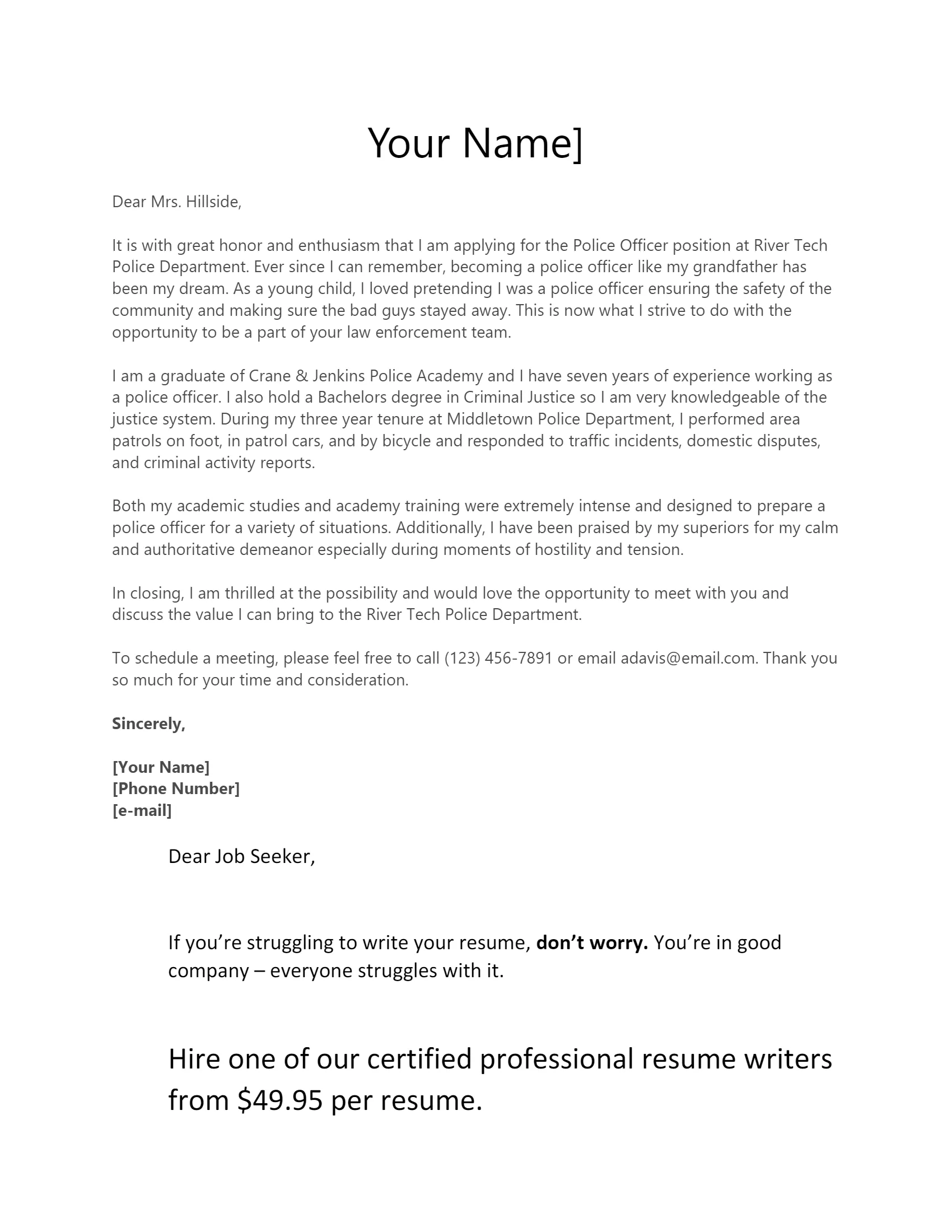
Example Law Enforcement Cover Letter
Below is a sample cover letter for a law enforcement position. Remember to customize this template with your own information and tailor it to the specific department and position you are applying for.
[Your Name] [Your Address] [Your Phone Number] [Your Email Address]
[Date]
[Hiring Manager Name (if known), or “Hiring Manager”] [Department Name] [Department Address]
Dear [Mr./Ms./Mx. Last Name or Hiring Manager],
I am writing to express my keen interest in the Police Officer position with the [Department Name], as advertised on [Platform where you saw the advertisement]. As a highly motivated and dedicated individual with a strong commitment to community service and upholding the law, I am confident that my skills and experience align well with the requirements of this role.
[Body Paragraphs – customize with your skills and experience, using examples and action verbs. Highlight any relevant training, education, and achievements. Show your understanding of the department’s values and mission. For example: “During my time as a volunteer firefighter, I developed critical thinking and quick decision-making skills. I also developed the ability to remain calm under pressure and work cooperatively with a team.”]
I am particularly drawn to the [Department Name] due to [Specific reason, e.g., its commitment to community policing, its reputation for excellence, etc.]. I am impressed by [Mention a specific initiative or program of the department] and believe my values align perfectly with your mission.
I am eager for the opportunity to discuss my qualifications in detail. Thank you for your time and consideration. I have attached my resume for your review.
Sincerely, [Your Signature (if printed)] [Your Typed Name]
Tips for Making Your Cover Letter Stand Out
Keywords to Include in Your Cover Letter
Use relevant keywords from the job description throughout your cover letter. Incorporate words like “leadership,” “communication,” “problem-solving,” “teamwork,” “integrity,” “community service,” and specific skills mentioned in the job posting. This helps demonstrate that you meet the requirements of the position and makes your cover letter more likely to be noticed by applicant tracking systems. Focus on the most essential aspects, while avoiding the excessive use of irrelevant words.
Adapting Your Cover Letter for Different Departments
Tailor your cover letter to each specific department you apply to. Research each department’s mission, values, and any specific requirements for the position. Adjust your cover letter to match these needs and highlight how your skills and experience align with their goals. This shows that you are genuinely interested in the specific department and demonstrates that you took the time to understand their organization.
Common Mistakes to Avoid in Your Cover Letter
Avoid common pitfalls that can undermine your application. Refrain from using generic cover letters that aren’t tailored to the specific job or department. Do not include irrelevant information or anything negative about previous employers. Make sure you avoid spelling or grammatical errors. Avoid making unsupported claims without providing evidence. Never misrepresent facts or be dishonest.