Understanding the McKinsey Cover Letter
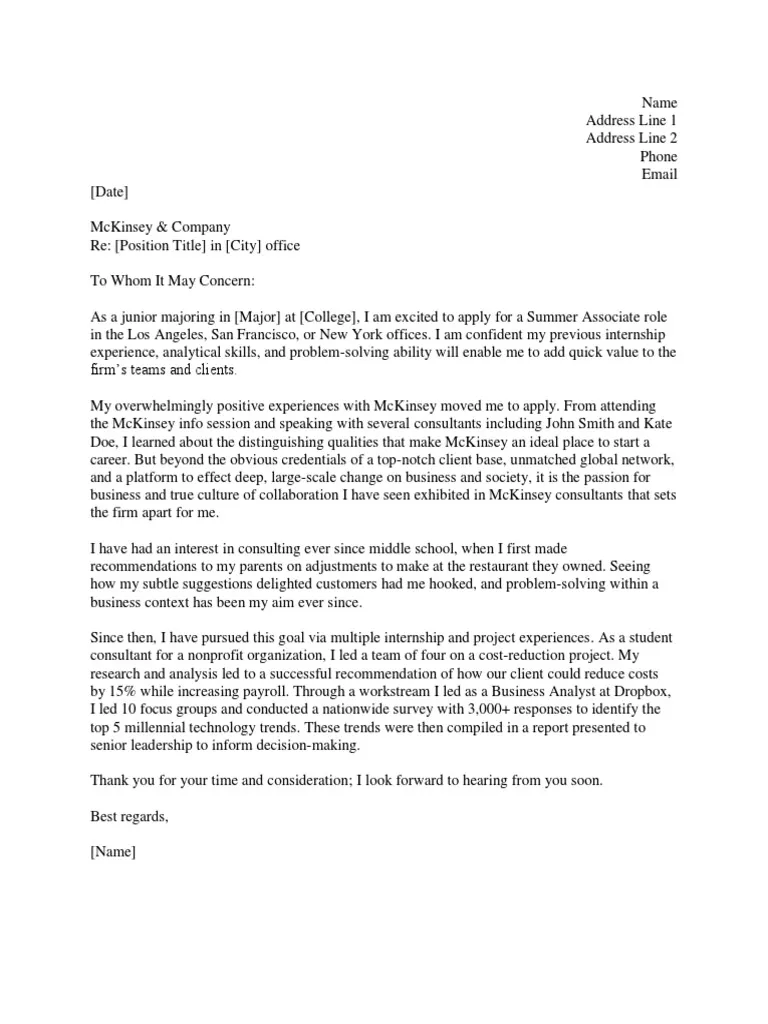
The McKinsey cover letter is a crucial component of your application. It serves as your first introduction to the firm and provides you with an opportunity to showcase your personality, skills, and experiences beyond what is presented in your resume. Unlike a resume, which primarily lists facts, your cover letter allows you to tell your story, highlighting why you’re a perfect fit for McKinsey and demonstrating your understanding of their values and approach. A well-crafted cover letter is not merely a formality; it’s a powerful tool that can significantly increase your chances of securing an interview and ultimately, a position at McKinsey. It gives you the space to demonstrate your thought process, communication skills, and genuine interest in the company. Crafting a strong letter requires careful attention to detail, thorough research, and a clear understanding of what McKinsey seeks in its candidates.
Why a Strong Cover Letter Matters
A compelling cover letter is indispensable for several reasons. First, it demonstrates your genuine interest in McKinsey. A generic letter will be easily dismissed, while a tailored letter showcasing your understanding of McKinsey’s work and values will immediately grab the attention of the hiring managers. Second, it provides context to your resume. It allows you to elaborate on your experiences, connect your skills to McKinsey’s needs, and highlight achievements that might not be fully evident in your resume. Third, it reflects your communication skills. The clarity, conciseness, and persuasiveness of your writing are assessed, as these qualities are vital for a consultant. Finally, a strong cover letter sets you apart from the competition. McKinsey receives thousands of applications, and a well-written letter is your chance to make a lasting impression and show why you should be considered. A weak cover letter can instantly disqualify you, regardless of your other qualifications; therefore, dedicating time to refine your letter is a smart investment.
Key Components of a McKinsey Cover Letter

A strong McKinsey cover letter is composed of several key elements, each playing a critical role in effectively conveying your value proposition. The letter should start with a professional header containing your contact information. Follow this with a compelling opening paragraph that immediately captures the reader’s attention and clearly states your purpose. The body of the letter should highlight your achievements and quantify them with data whenever possible. You need to showcase relevant skills, demonstrate your problem-solving abilities, and illustrate your leadership experiences. The middle section is where you discuss your understanding of McKinsey’s values and tailor your letter to the specific needs of the firm. The closing paragraph should reiterate your interest, summarize your key strengths, and express your enthusiasm for the opportunity. Each component of the letter should be carefully crafted to create a cohesive narrative that sells your candidacy effectively.
Formatting Your McKinsey Cover Letter
Proper formatting is essential for a professional and readable cover letter. Begin with a clear and concise header, including your full name, contact information (phone number and email address), and the date. Use a standard business letter format, including the recipient’s name and title, the company address, and a formal salutation (e.g., “Dear Mr./Ms. [Last Name]”). Maintain a professional font like Times New Roman, Arial, or Calibri, and use a font size of 11 or 12 points for readability. Keep the letter concise, ideally within one page. Use clear paragraphs and headings to break up the text and make it easy to scan. Be sure to maintain consistent spacing throughout the document. Before submission, carefully proofread for any grammatical errors, typos, or formatting inconsistencies. A well-formatted cover letter demonstrates your attention to detail and professionalism, which are highly valued at McKinsey.
Header and Contact Information
The header of your cover letter is the first thing the hiring manager sees, so it is important to make a professional impression. Start with your full name, ensuring that it is clearly visible and easy to read. Below your name, include your contact information, such as your phone number and a professional email address. Be sure to avoid using an informal email address; it is best to create one specifically for professional communication. On the same line as the date, include the recipient’s name and title, the company name, and the full address of the McKinsey office you are applying to. Ensure that all this information is accurate and formatted consistently. A clean and well-organized header sets a professional tone and makes it easier for the recipient to contact you.
The Opening Paragraph

Your opening paragraph is your opportunity to immediately grab the reader’s attention. Start by stating the purpose of your letter clearly and concisely. Mention the specific position or role you are applying for, and indicate where you saw the job posting. Follow with a compelling hook that demonstrates your enthusiasm for McKinsey and its work. This could be a brief mention of a recent McKinsey publication you read, a project you are particularly interested in, or an experience that highlights your relevant skills. Avoid generic introductions that start with phrases like “I am writing to express my interest.” Instead, focus on showcasing your knowledge of McKinsey and what makes you stand out. The goal is to create an immediate positive impression and encourage the reader to continue.
Highlighting Your Achievements
The body of your cover letter should highlight your achievements, demonstrating your value to McKinsey. Focus on quantifiable accomplishments rather than simply listing your responsibilities. Use the STAR method (Situation, Task, Action, Result) to structure your examples and provide context. Clearly describe the situation you were in, the task you undertook, the actions you took to address the task, and the measurable results you achieved. Quantify your achievements with data whenever possible. For example, instead of saying “Improved sales,” say “Increased sales by 15% in six months.” Provide specific examples of your successes, such as projects you led, problems you solved, or initiatives you spearheaded. Tailor these examples to align with the skills and qualities McKinsey values in its candidates.
Quantifying Your Accomplishments
Quantifying your accomplishments is a critical step in making your cover letter impactful. McKinsey consultants are data-driven, and they appreciate candidates who can present their achievements in a similar manner. Whenever possible, use numbers, percentages, and specific metrics to demonstrate the impact of your work. For example, instead of saying “Managed a team,” you could say “Managed a team of 10 people, resulting in a 20% increase in project efficiency.” Instead of saying “Improved customer satisfaction,” you might state “Increased customer satisfaction scores from 70% to 90% in one year.” By quantifying your accomplishments, you provide concrete evidence of your capabilities and demonstrate your ability to achieve tangible results. This not only strengthens your application but also shows your understanding of the importance of data analysis and performance metrics.
Demonstrating Relevant Skills

Demonstrating relevant skills is essential to showcase your fit for McKinsey. Identify the key skills that are emphasized in the job description and align them with your experiences. Highlight skills such as analytical thinking, problem-solving, communication, leadership, and teamwork. Provide specific examples of how you have utilized these skills in your previous roles or projects. For example, if the job description emphasizes analytical thinking, you could describe a situation where you used data analysis to solve a complex problem. If communication is a key skill, discuss how you effectively presented findings to stakeholders. The goal is to show, rather than just tell, the hiring managers that you possess the skills they are seeking. Tailor your skill demonstration to reflect the requirements of the specific role you are applying for and McKinsey’s overall expectations.
Showcasing Problem-Solving Abilities
McKinsey values candidates who are adept at problem-solving. In your cover letter, provide concrete examples of situations where you successfully identified, analyzed, and solved complex problems. Use the STAR method to structure your responses, clearly explaining the challenge, the steps you took to address it, and the positive outcome. Focus on showcasing your ability to think critically, analyze data, and develop innovative solutions. Highlight your approach to problem-solving, including any tools or methodologies you employed. This could involve case studies, project examples, or instances where you overcame obstacles to achieve specific goals. By demonstrating your problem-solving abilities, you illustrate your readiness to tackle the challenges that consultants face daily. Provide specific examples of how you’ve approached different situations. The key is to show how you dissect a problem and develop a solution.
Illustrating Leadership Experiences
Leadership is a core competency that McKinsey seeks in its consultants. Your cover letter should highlight instances where you have demonstrated leadership skills, even if your experience is not in a formal leadership role. Describe situations where you have taken initiative, motivated others, or led a team to achieve a common goal. Provide specific examples of the actions you took to inspire and guide others, resolve conflicts, and make effective decisions. Quantify the impact of your leadership whenever possible. Show how your actions resulted in tangible improvements, such as increased productivity, improved team morale, or successful project outcomes. Illustrating your leadership experience, even in informal settings, proves your capacity to take initiative and influence others, making you a more compelling candidate.
Expressing Your Interest in McKinsey

It is important to articulate your genuine interest in McKinsey and what draws you to the firm. Mention specific aspects of McKinsey’s work, culture, or values that resonate with you. Avoid generic statements; instead, demonstrate that you have researched the firm and understand its mission and values. This could include mentioning a specific project you are interested in, a consultant whose work you admire, or McKinsey’s commitment to a particular industry or cause. Explain what motivates you to want to work at McKinsey. Your enthusiasm should be evident throughout your cover letter. Your interest can make all the difference. The more you show that you understand and connect with their mission, the better.
Researching McKinsey’s Values
Thorough research into McKinsey’s values is vital for aligning your cover letter effectively. Understand the firm’s core principles, such as integrity, client service, and professional development. Explore McKinsey’s website, read case studies, and review publications by McKinsey consultants. Identify how your own values align with those of McKinsey. For example, if McKinsey values teamwork, emphasize your collaborative experiences. If McKinsey values innovation, highlight your experience with problem-solving and your creative approaches. By demonstrating that you understand and share McKinsey’s values, you show that you are a good cultural fit and are more likely to thrive at the firm. This helps in building a strong case that you understand the company’s mission and that you can adopt and practice their values.
Tailoring Your Letter to McKinsey
Tailoring your cover letter to McKinsey is not just about mentioning the firm’s name; it’s about creating a highly personalized document that resonates with their specific needs and values. Tailor your letter to the specific office you are applying to and the role you are seeking. Research the office’s recent projects, focus areas, and any unique characteristics. Highlight the skills and experiences that are most relevant to the job description and the firm’s current priorities. Show that you have a deep understanding of McKinsey’s work and approach. Customize each application. Generic cover letters do not work. The more effort you put into tailoring it, the more likely you are to make a good impression.
The Closing Paragraph

Your closing paragraph should be a concise and impactful summary of your key strengths and your enthusiasm for the opportunity. Reiterate your interest in the role and express your excitement about the possibility of contributing to McKinsey. Reiterate your key strengths in a few concise sentences. State that you are available for an interview and provide any necessary contact information. End with a professional closing, such as “Sincerely,” or “Best regards.” Always thank the reader for their time and consideration. A strong closing paragraph leaves a lasting impression and encourages the reader to take the next step in the application process.
Proofreading and Editing
Proofreading and editing are essential steps to ensure your cover letter is polished and error-free. Before submitting your cover letter, carefully proofread it for any grammatical errors, typos, spelling mistakes, or formatting inconsistencies. Read your letter aloud to catch any awkward phrasing or unclear sentences. Ask a friend, mentor, or career advisor to review your letter and provide feedback. They may notice errors that you have overlooked. Check for consistency in font, spacing, and formatting throughout the document. Ensure that the tone of your letter is professional and aligns with McKinsey’s standards. A well-edited cover letter demonstrates your attention to detail and your commitment to presenting your best self to McKinsey. Attention to detail is a key attribute for a consultant. Do not skip this important step.
Common Mistakes to Avoid
Avoid common mistakes that can weaken your cover letter. Do not use generic or overly enthusiastic language. Avoid clichés and be authentic in your expression. Avoid simply restating your resume. Instead, provide additional context and insights into your experiences. Refrain from including irrelevant information that does not directly relate to McKinsey or the role. Ensure that you do not exceed the one-page limit. Avoid errors. Make sure there are no typos, grammatical errors, or formatting inconsistencies. Do not use an unprofessional email address or tone. By avoiding these common pitfalls, you increase the chances of making a positive impression on the hiring managers at McKinsey.
Using the Right Tone

The tone of your cover letter should be professional, enthusiastic, and confident. Write in a clear and concise manner, avoiding jargon or overly complex language. Express your genuine interest in McKinsey and the role, but avoid sounding overly flattering or desperate. Demonstrate your confidence in your skills and experiences. Use a positive and engaging tone that reflects your personality and your passion for consulting. Maintain a professional tone throughout the letter. Ensure that your writing style aligns with McKinsey’s culture and values, which emphasize excellence, collaboration, and intellectual curiosity. Reflect your understanding of the company and why you will make a good contribution.
Submitting Your Cover Letter
After thoroughly reviewing and editing your cover letter, it is time to submit it. Before submitting, double-check that you have followed all application instructions. Ensure that the cover letter is attached correctly and is in the required format (usually a PDF). Verify that all the information is accurate. Include the correct recipient and company details. Submit your application before the deadline. After submitting, keep a copy of your cover letter and track your application status. If you haven’t heard back within a reasonable time, follow up with the recruiter. By following these steps, you will increase your chances of making a positive impression on McKinsey’s hiring managers.