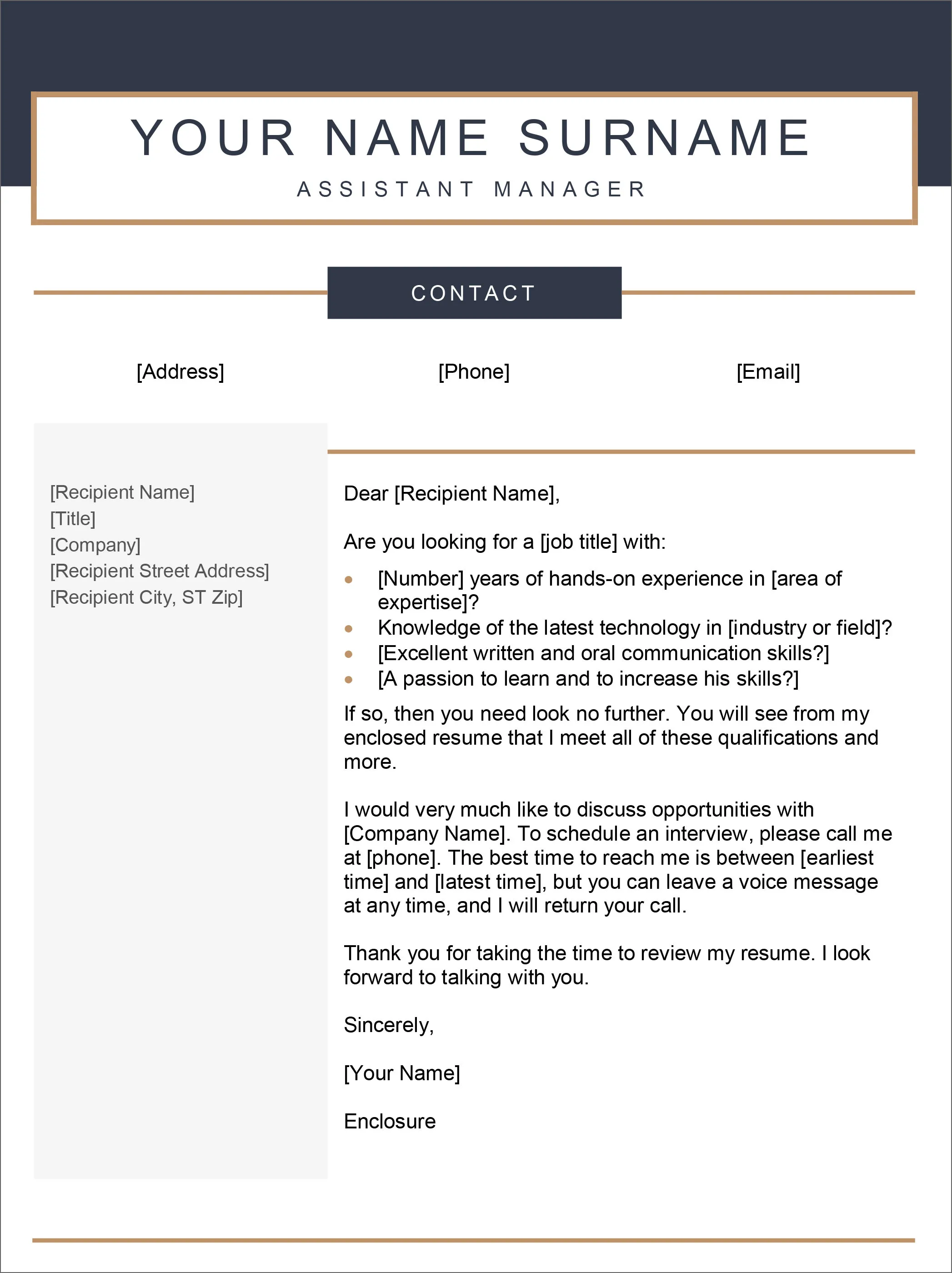
What Is a Cover Letter?
A cover letter is a crucial document accompanying your resume when applying for a job. It serves as your first introduction to a potential employer, allowing you to highlight your key skills, experiences, and why you are a perfect fit for the position. Unlike your resume, which provides a factual overview, a cover letter gives you the opportunity to express your personality, demonstrate your enthusiasm, and showcase your communication skills. It’s your chance to make a strong first impression and encourage the hiring manager to delve deeper into your qualifications.
Why Use a Cover Letter Template
Using a cover letter template offers several advantages in your job search. Firstly, it saves you valuable time by providing a pre-formatted structure. You don’t have to start from scratch; instead, you can focus on tailoring the content to match the specific job requirements and your unique qualifications. Secondly, templates ensure a professional and polished appearance, enhancing the credibility of your application. They guide you on what information to include and how to organize it effectively. Thirdly, templates often come in various styles, allowing you to choose one that aligns with your personality and the industry standards, making your application more appealing to the reader. By using a well-designed template, you present yourself in the best possible light.
Benefits of Using Free Cover Letter Templates

Free cover letter templates offer exceptional value to job seekers. They provide a cost-effective way to access professionally designed formats without any financial burden. These templates are readily available online, offering a wide range of styles and layouts to suit diverse job applications. They help you maintain consistency in your application materials, ensuring that your cover letter complements your resume and reflects a cohesive professional image. Using free templates streamlines the application process, allowing you to quickly generate tailored cover letters for multiple job applications. The accessibility of these templates empowers you to create compelling cover letters, thus increasing your chances of getting noticed by potential employers and securing interviews.
Finding the Right Free Cover Letter Template
Finding the right free cover letter template is crucial for making a strong impression. Consider the industry and the job you’re applying for; some templates suit certain fields better than others. Look for templates that are easily customizable, allowing you to modify the text, fonts, and layout to match your needs. Ensure the template has a clean, professional design that is easy to read and visually appealing. Prioritize templates from reputable sources, as they are more likely to adhere to professional formatting standards. Explore various websites and resources to compare different templates and choose one that best reflects your skills and the job requirements. Selecting the appropriate template sets the stage for a successful cover letter and a positive impression on the hiring manager.
Types of Free Cover Letter Templates
There are various types of free cover letter templates available to suit different job application needs. Understanding the differences between them can help you choose the most effective option. Common types include standard, modern, creative, and minimalist templates, each with its unique style and purpose. Standard templates typically follow a traditional format, ideal for conservative industries or roles. Modern templates incorporate contemporary design elements, making them suitable for creative or tech-focused positions. Creative templates showcase more design flair, suitable for roles where originality is valued. Minimalist templates focus on clean lines and simplicity, perfect for emphasizing your content. Choosing the correct template is essential to align with the job and create a document that effectively presents your qualifications and personal brand.
Template 1: The Standard Cover Letter

The Standard Cover Letter template is a classic and reliable choice for many job applications. It follows a traditional format, with a clear and concise structure. This template typically includes sections for your contact information, the date, the recipient’s information, a formal salutation, a brief introduction, a body that highlights your skills and experience, a closing paragraph summarizing your interest, and a professional closing. It’s ideal for industries that value formality and professionalism, such as finance, law, and government. The Standard Cover Letter template ensures that your message is clear and easily understood, making a strong impression in conventional settings.
Template 2: The Modern Cover Letter
The Modern Cover Letter template incorporates contemporary design elements to create a visually appealing and engaging document. It often includes features like a clean layout, use of white space, subtle color accents, and modern fonts. This template is suitable for industries and roles that embrace innovation and creativity, such as marketing, design, and technology. The Modern Cover Letter template showcases your ability to stay current with design trends while maintaining a professional tone. It’s designed to capture the reader’s attention and highlight your skills in a dynamic and visually interesting way, which makes it a great choice for making a memorable impression in a competitive job market.
Template 3: The Creative Cover Letter
The Creative Cover Letter template is designed to showcase your personality and artistic flair. It features bold designs, unique layouts, and a strong visual impact. This template is ideal for fields where creativity is highly valued, such as graphic design, advertising, and the arts. The Creative Cover Letter template allows you to demonstrate your design skills and make your application stand out. It can incorporate elements like custom graphics, unusual typography, and innovative formatting to capture the reader’s attention. When using this template, ensure it aligns with the company’s brand and the job requirements, presenting yourself as a bold and imaginative candidate.
Template 4: The Minimalist Cover Letter

The Minimalist Cover Letter template is characterized by its clean, uncluttered design, focusing on clarity and readability. This template uses a simple layout, ample white space, and a limited color palette to create a professional and sophisticated look. This template is suitable for any industry, particularly those where precision and attention to detail are essential, such as engineering, consulting, and academic positions. The Minimalist Cover Letter template emphasizes your key qualifications and experience without distractions. By focusing on content and a streamlined design, this template ensures your message is easily understood, leaving a lasting impression of competence and professionalism.
Customizing Your Free Cover Letter Template
Customizing your free cover letter template is essential to make it unique to you and the specific job you’re applying for. After selecting a template, take the time to personalize it with your own details and experiences. Modify the text to reflect your skills, accomplishments, and why you’re interested in the role. Tailor the content to address the specific requirements outlined in the job description, highlighting the most relevant skills. Consider adjusting the template’s layout, such as font choices and spacing, to enhance readability and maintain a professional appearance. Always review your customized cover letter to ensure that it aligns with your personal brand and the target company, presenting your application as compelling and memorable.
Key Elements to Customize
When customizing your cover letter template, focus on several key elements to make it stand out. First, personalize the introduction by mentioning the specific job and expressing your enthusiasm for the company. Next, highlight your most relevant skills and experiences that align with the job requirements, using action verbs to describe your accomplishments. Tailor your content to the specific needs of the employer. Quantify your achievements with numbers or data whenever possible to demonstrate your impact. Ensure the closing paragraph summarizes your interest and reiterates your value proposition. By incorporating these elements, you create a customized cover letter that resonates with the hiring manager and increases your chances of getting an interview.
Personalizing the Template for Your Skills

Personalizing the template to reflect your specific skills is crucial for highlighting your qualifications. Identify the key skills and experiences the job description emphasizes, and then tailor your cover letter to directly address them. Use keywords and phrases from the job posting to show that you meet the requirements. In each section, use specific examples of your accomplishments and how you’ve applied those skills in the past. If the job description emphasizes teamwork, include examples where you’ve collaborated effectively. If the job requires analytical skills, provide instances where you’ve solved problems using data. Personalizing the template allows you to make a direct connection between your abilities and the job requirements, making a strong case for why you should be hired.
Formatting Your Printable Cover Letter
Proper formatting is essential to create a professional and readable printable cover letter. Choose a clear and easy-to-read font, such as Arial, Calibri, or Times New Roman, with a font size between 10 and 12 points. Ensure consistent spacing throughout the document, including single or 1.15 line spacing and standard margins (1 inch on all sides). Use headings and bullet points to break up large blocks of text and make it easier for the reader to scan the content. Keep paragraphs concise and focused, each containing only a few sentences. Align the text to the left, avoiding full justification, which can create uneven spacing. Proper formatting enhances readability and shows attention to detail.
Ensuring Readability and Professionalism
Ensuring readability and professionalism is crucial for your cover letter’s impact. Use clear and concise language, avoiding jargon or overly complex sentences. Keep the tone professional and positive throughout the document. Make sure your sentences flow logically, creating a cohesive narrative. Structure your letter with a clear introduction, body, and conclusion, each serving a specific purpose. Proofread carefully for grammatical errors, spelling mistakes, and punctuation issues, as these can detract from your credibility. Use active voice to make your sentences more engaging and direct. Prioritize a clean and uncluttered layout that is easy for the hiring manager to read, showing your attention to detail and professionalism.
Proofreading and Editing Your Cover Letter

Proofreading and editing your cover letter is a critical step that ensures your application is polished and error-free. Start by carefully checking your grammar, spelling, and punctuation. Use a spell-checker, but also read the document closely, as these tools may miss contextual errors. Check the formatting and layout to ensure consistency and professionalism. Make sure all contact information is correct and up-to-date. Review the content for clarity and conciseness; eliminate any unnecessary words or phrases. Consider having a trusted friend or colleague review your cover letter for feedback, as a fresh pair of eyes can often spot errors you might have missed. Thorough proofreading and editing will significantly increase your credibility and showcase your attention to detail.
Tips for Printing Your Cover Letter
Following these tips for printing your cover letter helps ensure a professional presentation. First, save your cover letter as a PDF to preserve its formatting and ensure it appears correctly on any device. Print on high-quality paper, preferably 24-32 lb bond paper, to convey a sense of professionalism. Check the printer settings to ensure the document prints without any cropping or distortion, and that the ink is of high quality. Proofread the printed copy to check for any unexpected formatting issues. Consider the method of delivery; if mailing, print a hard copy to include with your resume. Always keep a digital copy of your final, printed cover letter for your records and future reference.
Choosing the Right Paper
Choosing the right paper enhances the professionalism and presentation of your cover letter. Opt for high-quality paper, ideally 24-32 lb bond, as it feels more substantial and prevents ink bleed-through. Select a paper color that complements your brand and feels appropriate for the industry, typically white or off-white. Ensure the paper is smooth and has a matte finish, which projects a professional image. Avoid using textured or colored paper unless it is consistent with the company’s branding. Ensure the paper size is standard (8.5 x 11 inches) for compatibility with standard printers and professional appearance. The right paper elevates the overall impression of your cover letter, indicating your attention to detail and commitment to quality.
Printing and Sending Your Cover Letter

Printing and sending your cover letter requires careful attention to detail. Ensure that you have a crisp, clean print of your cover letter on appropriate paper. If sending a hard copy, carefully fold the cover letter to fit neatly inside the envelope with your resume. Use a professional envelope and clearly address it to the hiring manager or the appropriate contact person. If submitting digitally, always save your cover letter as a PDF to preserve the formatting. When emailing, use a clear and professional subject line, and attach both your cover letter and resume as PDF files. Proofread both the printed and digital versions to ensure they are free of errors and reflect a professional image, making a positive first impression.