Why Cover Letters Matter for Entry-Level Jobs
In the competitive world of entry-level job applications, a well-crafted cover letter can be your secret weapon. While a resume provides a snapshot of your experience, a cover letter allows you to tell a story. It’s your chance to demonstrate your personality, enthusiasm, and genuine interest in the role and the company. For entry-level positions, where experience may be limited, a cover letter can highlight transferable skills, relevant coursework, volunteer work, and any other experiences that showcase your potential. A strong cover letter can also help you stand out from other candidates who might have similar qualifications.
Understanding the Purpose of a Cover Letter
The primary purpose of a cover letter is to introduce yourself to a potential employer and express your interest in a specific job. It should complement your resume by providing context and expanding on your qualifications. Think of it as your personal introduction. A good cover letter should clearly state the position you are applying for, explain why you are a good fit for the role and the company, and encourage the hiring manager to review your resume. It’s also an opportunity to address any gaps in your experience or explain why you’re transitioning careers.
Key Elements to Include in Your Entry-Level Cover Letter

A compelling cover letter is a careful blend of information and personality. There are several essential components that every entry-level cover letter should include. By incorporating these elements, you increase your chances of capturing the attention of the hiring manager and making a positive impression. These elements will help you to show you are a good fit, and help the employer get to know you.
Header and Contact Information
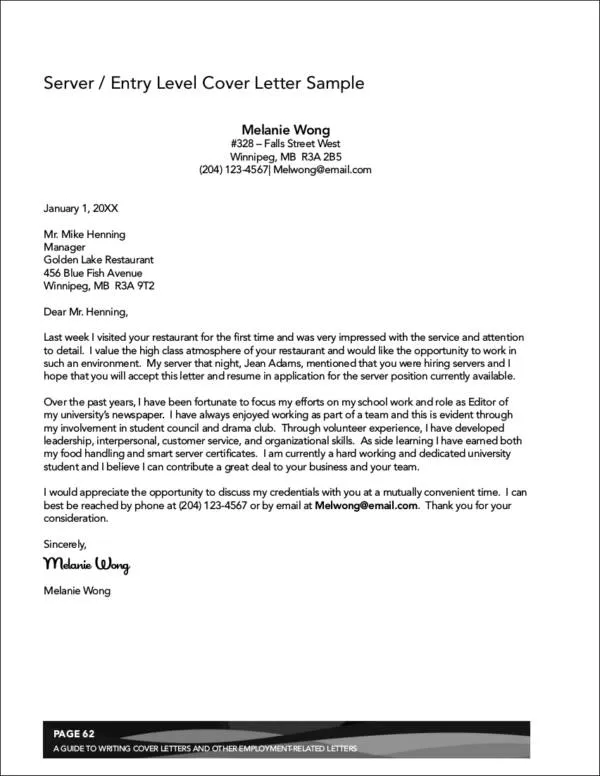
Start with a professional header that includes your full name, address, phone number, and email address. Make sure your email address sounds professional. Include the date and the hiring manager’s name and title, if you know it, along with the company’s address. If you can’t find the hiring manager’s name, research the company website or use a general title like “Hiring Manager”.
Greeting the Hiring Manager
Addressing the hiring manager by name shows you’ve done your research and are genuinely interested in the role. Use “Dear Mr./Ms./Mx. Last Name” or “Dear Hiring Manager” if you are unable to find a specific name. Avoid generic greetings such as “To Whom It May Concern.” This is your first opportunity to make a good impression, so make sure it is personal and professional. See image: greeting-the-hiring-manager.webp
Opening Paragraph: Grab Their Attention

Your opening paragraph is your hook. It should immediately capture the reader’s attention and clearly state the position you are applying for. Briefly mention where you found the job posting and express your enthusiasm for the opportunity. A compelling opening sentence can highlight your understanding of the company and the role or mention a specific skill that aligns with the job requirements. This is where you set the tone and make the hiring manager want to read further.
Body Paragraphs: Showcase Your Value
The body of your cover letter is where you demonstrate your qualifications and explain why you’re a good fit for the role. Focus on the most relevant skills and experiences mentioned in the job description and provide specific examples of how you have used those skills. Use the STAR method (Situation, Task, Action, Result) to describe your accomplishments and quantify them whenever possible. Show, don’t just tell, by giving concrete examples. See image: body-paragraphs.webp
Highlighting Relevant Skills and Experience
Even if you lack extensive professional experience, you can still highlight relevant skills and experiences from internships, volunteer work, projects, coursework, and extracurricular activities. Identify transferable skills such as communication, problem-solving, teamwork, and time management. Explain how your experiences have equipped you with these skills. Customize your cover letter to align with the specific requirements of each job you apply for. See image: cover-letter-tips.webp
Quantifying Achievements (Even Without Experience)
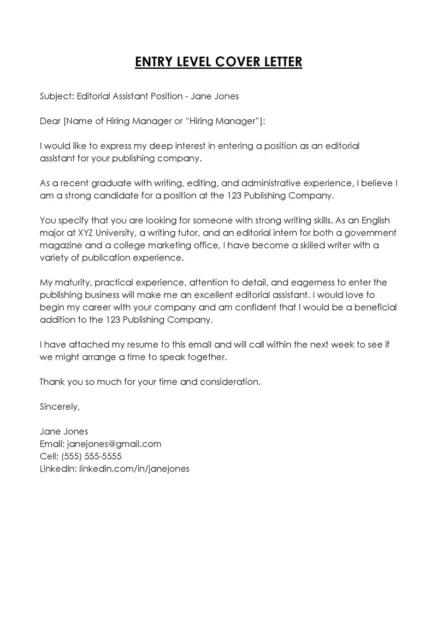
While quantifying achievements might seem difficult for entry-level candidates, it is still possible. Whenever possible, use numbers to demonstrate your accomplishments. For example, if you were a volunteer, mention the number of hours you contributed or the number of people you assisted. If you completed a project, describe the outcome or the impact it had. Use metrics to show the value you brought to previous experiences. This adds credibility to your claims. See image: achievements-cover-letter.webp
Tailoring Your Cover Letter to Each Job
Avoid sending a generic cover letter. Tailoring your cover letter to each job application is critical. Review the job description carefully and identify the key skills and qualifications the employer is looking for. Use these keywords and phrases in your cover letter to demonstrate that you have the right skills. Research the company to understand its values, culture, and mission, and explain why you are a good fit. This shows that you are genuinely interested in the position and have taken the time to learn about the company.
Closing Paragraph: Call to Action
Your closing paragraph should reiterate your interest in the position and thank the hiring manager for their time and consideration. Include a clear call to action, such as expressing your eagerness to discuss your qualifications further and inviting them to contact you for an interview. End with a professional closing such as “Sincerely” or “Best regards,” followed by your name.
Common Mistakes to Avoid

Several mistakes can undermine the effectiveness of your cover letter. Here are some common pitfalls to avoid: Generic cover letters that are not tailored to the specific job, typos and grammatical errors, using overly casual language, failing to highlight relevant skills and experiences, and simply repeating information from your resume. In addition, avoid exaggerating or lying about your qualifications. Always keep your cover letter concise and to the point. Keep it to one page.
Example 1 A Recent Graduate
Dear [Hiring Manager Name], I am writing to express my keen interest in the [Job Title] position at [Company Name], as advertised on [Platform]. As a recent graduate with a degree in [Your Degree] and a strong foundation in [Relevant Skills], I am eager to apply my skills and contribute to [Company Name]’s mission. During my studies, I successfully completed several projects involving [Specific Skills], including [brief description]. I am confident that my skills align well with the requirements. I am excited about the opportunity to learn and grow within your team.
Example 2 Career Changer
Dear [Hiring Manager Name], I am writing to express my strong interest in the [Job Title] position, as advertised on [Platform]. With a background in [Previous Field] and a passion for [New Field], I am eager to transition my skills to a new challenge. My experience in [Previous Role] has equipped me with valuable skills, including [transferable skills]. In my previous role, I achieved [Quantifiable result]. I am excited to leverage my skills and contribute to [Company Name]’s success.
Example 3 Student Seeking Internship

Dear [Hiring Manager Name], I am writing to express my interest in the [Internship Title] at [Company Name]. As a student in [Your Major] at [Your University], I am eager to gain practical experience in [Industry]. I am particularly drawn to [Company Name]’s [Company Value/Mission] and believe my skills in [Relevant Skills] would be a valuable asset. In my coursework, I have focused on [Specific skill]. I am enthusiastic about the chance to contribute to your team.
Formatting and Presentation Tips
Your cover letter should be easy to read and visually appealing. Use a professional font such as Times New Roman, Arial, or Calibri, and keep the font size between 10 and 12 points. Use a clear, concise layout with adequate white space between paragraphs to enhance readability. Use bullet points to highlight key achievements or skills. See image: cover-letter-formatting.webp
Proofreading and Editing Your Cover Letter
Before submitting your cover letter, carefully proofread it for any errors in grammar, spelling, and punctuation. These errors can create a negative impression. Ask a friend, career counselor, or family member to review your cover letter. Ensure that it flows logically, and that your tone is professional. Make sure your contact information is up-to-date. See image: proofreading-cover-letter.webp
The Importance of a Strong First Impression

Your cover letter is your first impression, so make it count. By following these tips and examples, you can write a compelling cover letter that showcases your skills, enthusiasm, and genuine interest in the role. Tailor each cover letter to the specific job, highlighting relevant skills and experiences. A well-written cover letter can significantly increase your chances of securing an interview and landing your dream job. Remember to stay positive, enthusiastic, and confident in your abilities.