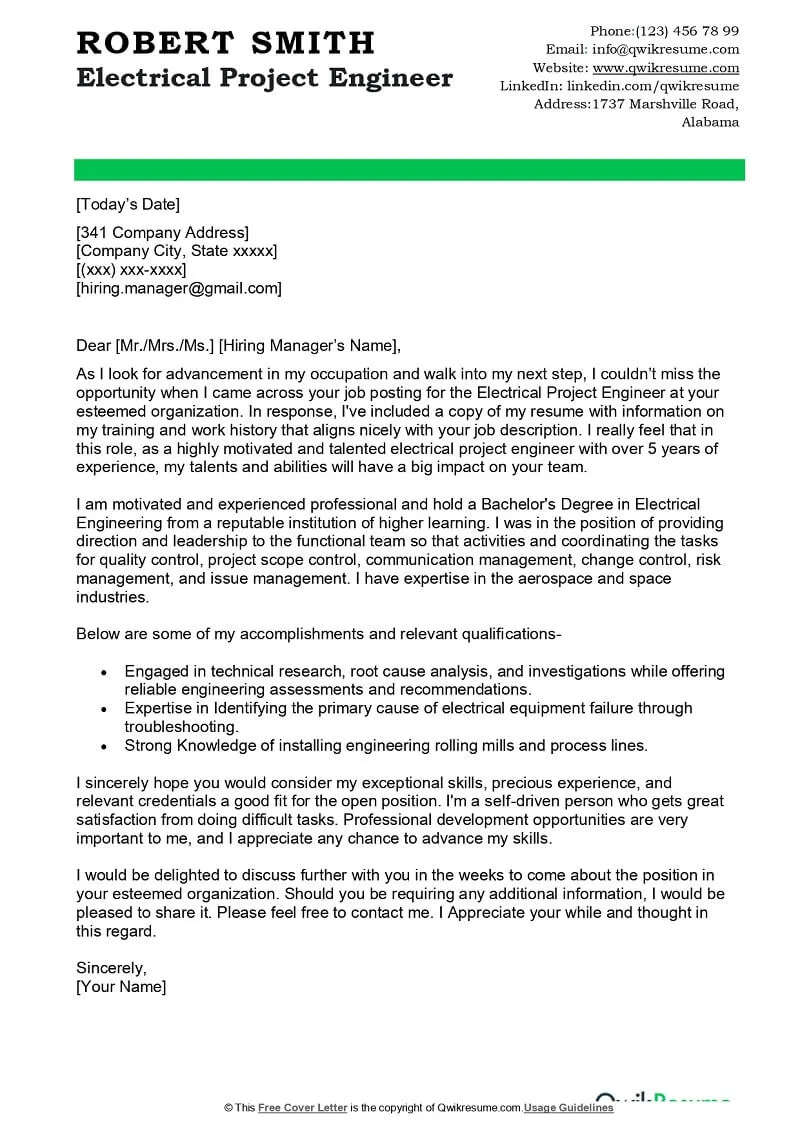
What is an Electrical Engineer Cover Letter
An electrical engineer cover letter is a crucial document that accompanies your resume when applying for electrical engineering positions. It serves as your first introduction to a potential employer, allowing you to highlight your skills, experiences, and qualifications in a personalized and engaging manner. Unlike a resume, which provides a concise overview of your professional history, a cover letter enables you to elaborate on specific achievements, explain your career goals, and demonstrate your enthusiasm for the role and the company. Think of it as your personal sales pitch, designed to convince the hiring manager that you are the ideal candidate for the job.
Why Cover Letters Are Important for Electrical Engineers
In the competitive field of electrical engineering, a well-crafted cover letter can significantly improve your chances of landing an interview. It provides an opportunity to showcase your communication skills, technical expertise, and problem-solving abilities, which are essential for success in this profession. Furthermore, a cover letter allows you to demonstrate your understanding of the specific job requirements and how your skills align with them. This demonstrates that you have taken the time to research the role and the company, showing genuine interest and initiative. A strong cover letter can differentiate you from other applicants, especially if you have limited work experience, by emphasizing your potential and eagerness to learn.
Key Components of a Successful Cover Letter

A compelling cover letter for an electrical engineer should include several key components. These elements work together to create a persuasive and professional document that captures the attention of the hiring manager. Starting with a professional header containing your contact information and the date, the letter should then address the hiring manager directly with a personalized greeting. The body of the letter should highlight your most relevant skills, quantify your achievements with data-driven examples, and tailor your experience to match the specific requirements of the job description. Conclude with a strong closing that expresses your interest in the position and encourages the reader to review your resume and contact you for an interview.
Header Section and Contact Information
The header of your electrical engineer cover letter is the first thing the hiring manager will see, so it is crucial to create a professional impression. Begin by including your full name, professional title (e.g., Electrical Engineer, Junior Engineer), and contact information, including your phone number, email address, and LinkedIn profile URL. Ensure that your email address sounds professional; avoid using nicknames or casual language. Below your contact information, include the date and the hiring manager’s name and title, along with the company’s name and address. Using the hiring manager’s name shows you have taken the time to personalize the letter, making a positive initial impact. This structured format ensures easy access to your contact details, making it simple for the employer to reach you.
Greeting and Professional Tone
The greeting sets the tone for your entire cover letter, so it is important to use a professional and respectful approach. If possible, address the hiring manager by name. Researching the company website or LinkedIn can help you find the name of the person responsible for hiring. Use a formal salutation, such as “Dear Mr./Ms./Dr. [Last Name],” to show respect and attention to detail. If you are unable to find the hiring manager’s name, use a general greeting like “Dear Hiring Manager” or “Dear [Company Name] Hiring Team.” Maintain a professional tone throughout your letter, using formal language, avoiding slang or colloquialisms, and proofreading carefully to eliminate any grammatical errors. This conveys professionalism and respect, leaving a positive first impression.
Body Section Highlighting Skills

The body of your cover letter is where you highlight your skills and experiences relevant to the electrical engineering position. Start with a brief introductory paragraph stating your purpose for writing and expressing your interest in the specific role. Then, provide a few concise paragraphs, each addressing a specific skill or area of expertise. Focus on the skills that align with the job description, such as circuit design, power systems, control systems, or embedded systems. Use strong action verbs to describe your accomplishments and responsibilities, such as “designed,” “implemented,” “analyzed,” or “managed.” For example, you could write, “Designed and implemented a new power distribution system, resulting in a 15% reduction in energy consumption.” Show how your skills and experiences match the job’s requirements and what you can bring to the role.
Quantifiable Achievements and Project Experience
To make your cover letter stand out, it is crucial to include quantifiable achievements and project experiences. Instead of simply listing your responsibilities, use data and statistics to demonstrate the impact of your work. For instance, if you improved the efficiency of a system, state the percentage increase. If you reduced costs, specify the amount saved. If you managed a project, provide details about its scope, budget, and timeline. Showcase any relevant projects you have worked on, particularly those that align with the job requirements. Briefly describe your role in each project, highlighting the challenges you faced, the solutions you implemented, and the positive outcomes you achieved. This provides concrete evidence of your skills and abilities, making your cover letter more compelling.
Tailoring the Cover Letter to the Job Description
Each cover letter should be tailored to the specific job description for which you are applying. Read the job description carefully to identify the key skills, qualifications, and experiences the employer is seeking. Then, customize your cover letter to address these requirements directly. Highlight the relevant skills and experiences you possess and provide examples of how you have demonstrated these in the past. Use the same keywords and terminology used in the job description to show that you understand the role and the company’s needs. By tailoring your cover letter, you demonstrate to the hiring manager that you have taken the time to understand the position and are a strong fit for the role, increasing your chances of getting an interview.
Closing Section Expressing Interest

The closing section of your cover letter should reiterate your interest in the position and express your enthusiasm for the opportunity. Briefly summarize your key qualifications and reiterate how your skills and experiences align with the job requirements. Then, state your desire for an interview and make it easy for the employer to contact you. Include a call to action, such as “I am eager to discuss my qualifications further in an interview” or “Thank you for considering my application; I look forward to hearing from you soon.” End the letter with a professional closing, such as “Sincerely” or “Respectfully,” followed by your typed name. Proofread the entire letter one final time to ensure that everything is correct before submitting it.
Reviewing and Proofreading the Cover Letter
Before submitting your cover letter, it is essential to review and proofread it carefully. Errors in grammar, spelling, and punctuation can damage your credibility and create a negative impression. Read your cover letter multiple times, paying close attention to detail. Consider asking a friend, family member, or career counselor to review it as well. They may be able to catch errors that you have missed. Check that the formatting is consistent and that the language is clear, concise, and professional. Ensure that your contact information is accurate and up-to-date. By taking the time to review and proofread your cover letter, you ensure that it presents you in the best possible light and increases your chances of securing an interview for your desired electrical engineering position.