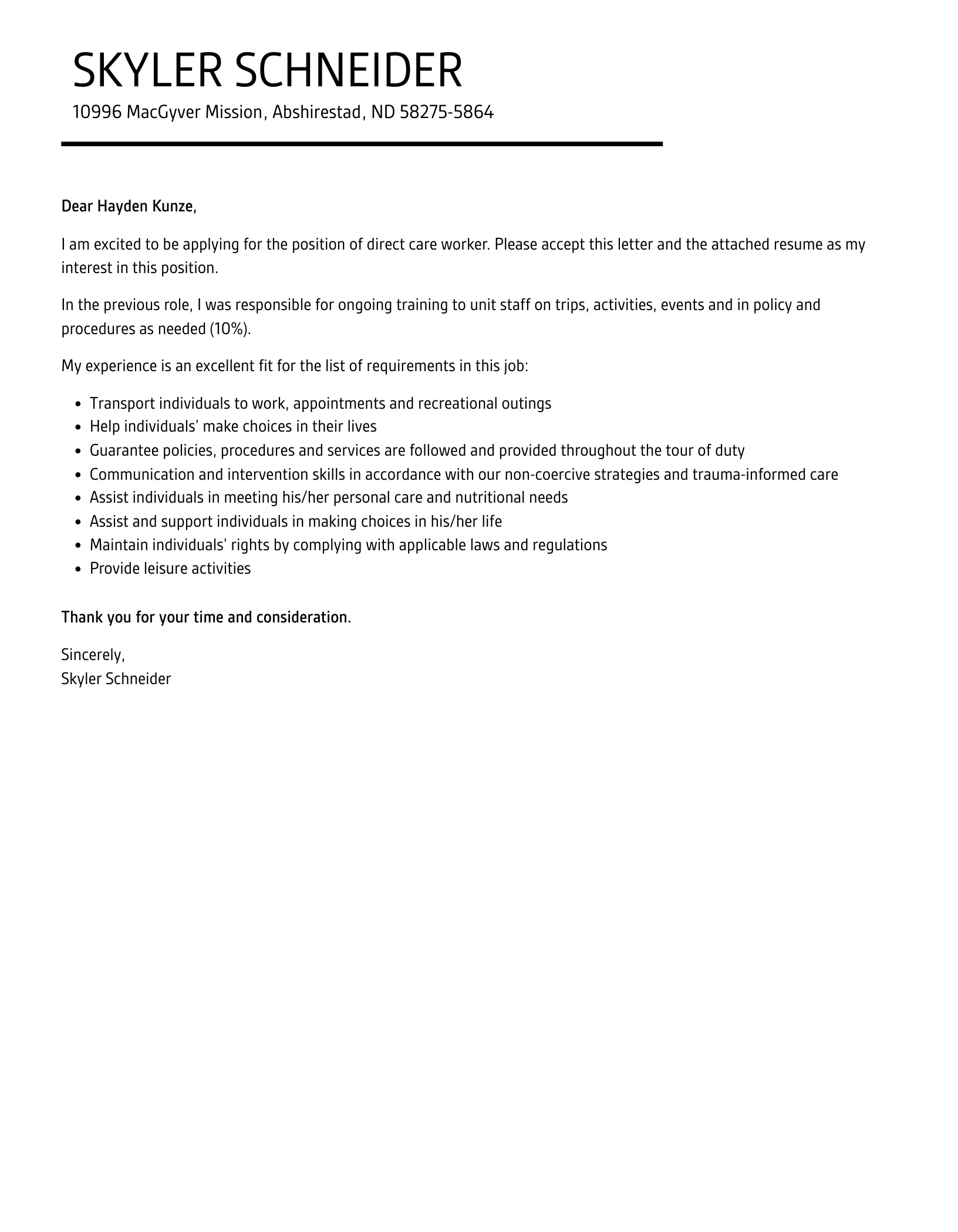
Why a Strong Direct Care Worker Cover Letter Matters
A well-crafted cover letter is your first opportunity to make a positive impression on a potential employer. For a direct care worker, a cover letter is especially crucial. It’s your chance to go beyond the resume and showcase your personality, passion for caregiving, and the specific skills and experiences that make you the ideal candidate. It provides context to your resume, allowing you to highlight key achievements and explain any gaps in your employment history. A strong cover letter demonstrates your professionalism, attention to detail, and genuine interest in the role and the organization. It’s your personal introduction, setting the tone for your application and potentially influencing the hiring manager’s decision to call you for an interview. In a competitive job market, a compelling cover letter can set you apart from other applicants.
Highlighting Your Skills for Direct Care Roles
Direct care work demands a unique blend of technical skills, personal qualities, and a deep sense of empathy. Your cover letter should focus on highlighting the skills most relevant to the specific job description. Carefully review the requirements listed in the job posting and tailor your letter to address them directly. Think about how your previous experiences, whether paid or volunteer, have equipped you with the necessary skills to succeed in this role. Use specific examples to demonstrate your abilities. Instead of simply stating that you are a good communicator, describe a situation where you successfully communicated with a patient, their family, or other healthcare professionals to provide the best possible care. The goal is to convince the hiring manager that you possess the qualities needed to excel as a direct care worker and make a positive impact on the lives of those you serve.
Relevant Skills to Showcase

When writing your cover letter, emphasize skills and qualities that are essential for success in direct care. These include but are not limited to those listed in the following sections. Remember to always back up your claims with specific examples from your previous experiences. Think about how you have demonstrated these skills in the past and how they align with the requirements of the job you are applying for. Use action verbs to describe your accomplishments and quantify your achievements whenever possible. Consider your achievements to showcase your abilities for direct care roles.
Empathy and Compassion
Empathy and compassion are at the heart of direct care work. In your cover letter, demonstrate your ability to understand and share the feelings of others. Describe situations where you provided emotional support to a patient or resident, actively listening to their concerns and providing comfort. Highlight your ability to approach each individual with dignity and respect, tailoring your care to their unique needs and preferences. Share an experience where you went above and beyond to meet the emotional needs of a patient or client, demonstrating your commitment to providing holistic care. Express your genuine desire to make a positive difference in the lives of those you care for and your understanding of the challenges they may face. Showing that you are emphatic to those you care for can increase your odds of getting the job.
Communication and Interpersonal Skills
Effective communication is critical in direct care. Your cover letter should highlight your ability to communicate clearly, respectfully, and empathetically with patients, residents, families, and other healthcare professionals. Provide examples of how you have successfully communicated complex information in a way that is easy to understand. Describe situations where you resolved conflicts, mediated disputes, or built strong relationships with individuals from diverse backgrounds. Showcase your active listening skills and your ability to adapt your communication style to meet the needs of different individuals. Mention your experience with non-verbal communication and your ability to recognize and respond to subtle cues. If you are fluent in more than one language, mention that to increase your chances of getting the job.
Patience and Adaptability

Direct care work can be challenging, and it requires patience, flexibility, and adaptability. In your cover letter, demonstrate your ability to remain calm and composed in stressful situations. Describe instances where you successfully managed difficult behaviors or adapted to unexpected changes in a patient’s condition or care plan. Highlight your ability to prioritize tasks, manage your time effectively, and remain focused on providing quality care, even under pressure. Showcase your resilience and your willingness to learn and grow. Mention any experience you have working with individuals with specific needs, such as those with dementia, developmental disabilities, or mental health issues. Emphasize your capacity to embrace change and adjust your approach as needed, ensuring the best possible care for each individual.
Organization and Time Management
Direct care workers are responsible for a wide range of tasks, and strong organizational and time management skills are essential. In your cover letter, highlight your ability to manage multiple responsibilities simultaneously. Describe how you prioritize tasks, create schedules, and ensure that all necessary care is provided in a timely manner. Provide examples of how you effectively documented patient information, maintained accurate records, and communicated effectively with the care team. Showcase your ability to anticipate needs, proactively address potential issues, and work efficiently. Mention any experience you have with electronic health records or other care management software. Emphasize your commitment to maintaining a safe, clean, and organized environment for patients and residents. Highlight your ability to stay organized and to follow instructions is a must to be a direct care worker.
Crafting a Compelling Direct Care Worker Cover Letter
Now, let’s focus on the structure and content of your cover letter. Each element plays a crucial role in conveying your qualifications and demonstrating your interest in the position. By following the steps below, you can craft a cover letter that effectively highlights your strengths and makes a lasting impression on the hiring manager. Remember, tailoring your cover letter to each specific job application is essential to showcase your skills and experience in the best possible light.
Header and Contact Information

Start your cover letter with a professional header that includes your full name, address, phone number, and email address. Ensure your contact information is current and easy to read. Consider using a professional email address rather than a casual one. If the job posting specifies a particular contact person, include their name, title, and the company’s address as well. This demonstrates your attention to detail and your commitment to following instructions. The header sets the tone for the rest of your letter, so make sure it is neat, clean, and easy to understand.
Addressing the Hiring Manager
Always address your cover letter to a specific person, if possible. Research the hiring manager’s name and title. If you are unable to find a specific name, use a professional salutation such as “Dear Hiring Manager.” Avoid generic greetings like “To Whom It May Concern.” Personalizing your letter shows that you have taken the time to research the company and the position. This immediately sets you apart from other applicants who might be using a generic cover letter. In the body of your cover letter, make a direct reference to the job and mention how your skills and experience align with the requirements of the position. For example, you can mention why you are interested to work with them.
Opening Paragraph — Grabbing Attention
The opening paragraph is your first opportunity to capture the hiring manager’s attention. Make it count. Clearly state the position you are applying for and how you learned about it. Then, immediately highlight your key qualifications and why you are a good fit for the role. Consider starting with a brief, impactful statement that showcases your passion for direct care work or a relevant achievement. For example, you might begin with a sentence that summarizes your years of experience in direct care, or a specific skill, or a relevant certification that makes you stand out. The first few sentences should be concise, compelling, and focused on showcasing your value to the organization.
Body Paragraphs — Showcasing Your Experience

The body paragraphs are where you expand on your qualifications and demonstrate your ability to succeed in the role. Use this section to provide specific examples of your skills, experiences, and achievements. Each paragraph should focus on a particular aspect of your qualifications, such as your ability to provide personal care, your experience with specific medical conditions, or your communication skills. Use the STAR method (Situation, Task, Action, Result) to structure your examples. Describe the situation you were in, the task you were assigned, the actions you took, and the positive results you achieved. Quantify your achievements whenever possible. Use numbers to demonstrate the impact of your work.
Quantifying Achievements with Numbers
Whenever possible, use numbers to quantify your achievements and demonstrate the impact of your work. Numbers add credibility and make your accomplishments more tangible. For example, instead of saying “I provided excellent care,” you might say “I consistently administered medication to 10 patients per day, ensuring 100% compliance.” Instead of saying “I improved patient satisfaction,” you might say “I increased patient satisfaction scores by 15% within six months.” Use metrics like these to show the true value of your experiences to employers. This makes it much easier for hiring managers to grasp the significance of your accomplishments. Providing data gives your cover letter additional weight.
Highlighting Relevant Certifications and Training
Direct care roles often require specific certifications and training. Be sure to highlight any relevant credentials you possess, such as CNA (Certified Nursing Assistant), CPR certification, First Aid training, or any specialized training related to the population you will be caring for. Include the name of the certification, the issuing organization, and the date of completion. If you have any additional training or professional development experiences, such as workshops or seminars, be sure to mention them. Including these details in your cover letter will show the employer your commitment to the industry and your willingness to develop your skills to better serve your patients. Certifications are also something you can include on your resume.
Closing Paragraph — Call to Action

Your closing paragraph should reiterate your interest in the position and express your eagerness to learn more. Thank the hiring manager for their time and consideration. Clearly state your availability for an interview and provide your contact information again. Make it easy for the hiring manager to take the next step by including a clear call to action. This might include stating that you look forward to discussing your qualifications further or that you are available for an interview at their earliest convenience. Reiterate your enthusiasm for the role and your commitment to providing quality care. Consider ending with a positive statement that summarizes your value to the organization.
Proofreading and Formatting Your Cover Letter
Before submitting your cover letter, proofread it carefully for any errors in grammar, spelling, and punctuation. Errors can undermine your credibility and make a negative impression on the hiring manager. Read your letter aloud to catch any awkward phrasing or unclear sentences. Have someone else review it as well; a fresh pair of eyes can often spot mistakes that you might miss. Ensure your cover letter is well-formatted and easy to read. Use a professional font, such as Times New Roman or Arial, and maintain consistent formatting throughout the document. Use clear headings and subheadings to organize your content and make it easier for the reader to scan. Keep your paragraphs concise and to the point. A well-formatted and error-free cover letter demonstrates your attention to detail and professionalism. If you’re unsure about proper formatting, look at examples online.
Common Mistakes to Avoid in Your Cover Letter
Several common mistakes can hurt your chances of getting an interview. Avoid generic language and clichés. Tailor your cover letter to each job and avoid using a generic template that you send to multiple employers. Do not include irrelevant information. Make sure everything you write is directly relevant to the job description. Do not be overly focused on what you want from the job; instead, focus on what you can offer to the employer. Avoid using negative language or complaining about previous employers or experiences. Focus on your positive qualities and accomplishments. Always proofread your cover letter carefully to avoid any spelling or grammatical errors. Ensure that your contact information is correct. Following these steps will help ensure that you can get the job.
Tailoring Your Cover Letter to Each Job

One of the most important things you can do is tailor your cover letter to each job you apply for. This means carefully reviewing the job description and identifying the key skills, experiences, and qualifications the employer is seeking. Then, customize your cover letter to highlight how your qualifications align with their specific needs. Use the same keywords and phrases as in the job description. Provide specific examples that demonstrate your abilities and address the employer’s requirements directly. Tailoring your cover letter shows that you are genuinely interested in the position and have taken the time to understand the role and the organization. It significantly increases your chances of making a positive impression and getting an interview. The more you tailor it, the better.
Examples of Strong Direct Care Worker Cover Letters
Reviewing examples of strong cover letters can provide valuable insights into how to structure and write your own. Search online for examples of direct care worker cover letters. Pay attention to how the writers highlight their skills, experiences, and accomplishments. Note how they tailor their letters to the specific job descriptions. Use these examples as a guide, but be sure to write your own cover letter in your own voice. Let your personality and passion for caregiving shine through. Modify them to fit your own experience. Consider the examples to be your own reference guide. This can provide you with a template of how to write your own cover letter.