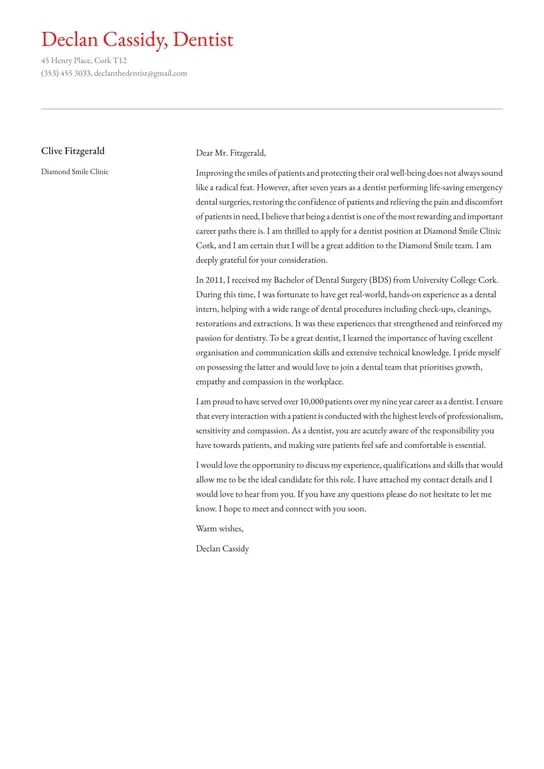
Understanding the Importance of a Dentistry Cover Letter
In the competitive field of dentistry, a well-crafted cover letter can be the key that unlocks your dream job. It serves as your first introduction to a potential employer, providing you with an opportunity to showcase your personality, enthusiasm, and qualifications beyond what’s listed on your resume. A compelling cover letter is not merely a formality, but a vital tool in setting you apart from other applicants and making a lasting impression. It allows you to personalize your application and demonstrate why you are the perfect fit for their specific practice or role. By highlighting your unique skills, experiences, and motivations, you can significantly increase your chances of landing an interview and ultimately, securing the position.
Why a Cover Letter Matters in Dentistry
A cover letter is essential in dentistry because it allows you to connect with the hiring manager on a more personal level. Unlike a resume, which is a concise summary of your professional history, a cover letter gives you the space to articulate your passion for dentistry and explain why you are drawn to a specific practice. It provides an opportunity to demonstrate your understanding of the practice’s values, culture, and patient care philosophy. Moreover, a well-written cover letter can help you address any potential gaps in your resume or explain career transitions, putting your best foot forward and showcasing your adaptability and dedication to the field. It showcases your communication skills, a crucial element in building rapport with patients and colleagues.
Highlighting Your Skills and Experience

Your cover letter is the ideal place to emphasize the skills and experiences that make you a strong candidate. Be sure to tailor your letter to the specific requirements of the job description. Instead of simply listing your skills, provide concrete examples of how you’ve applied them in previous roles. For instance, if the job posting mentions a need for experience with a particular software or procedure, mention your proficiency and include specific instances where you successfully utilized those skills. Use action verbs to describe your accomplishments and quantify your achievements whenever possible. This gives the hiring manager a clear understanding of your capabilities and the value you can bring to their practice. Remember to align your skills with the needs of the employer.
Key Components of a Dentistry Cover Letter
A well-structured dentistry cover letter typically includes several key components that work together to create a compelling narrative. Each section serves a specific purpose and contributes to the overall effectiveness of your application. By carefully crafting each part, you can ensure that your cover letter effectively communicates your qualifications, enthusiasm, and suitability for the position. It’s important to address each aspect thoughtfully and with a clear understanding of its role in persuading the employer that you are the right fit. The following outlines the essential elements required.
Contact Information and Salutation
Begin your cover letter by including your full name, address, phone number, and email address at the top. This ensures that the hiring manager can easily contact you. Address the letter to a specific person if possible; research the practice and identify the hiring manager or the dentist in charge. If you can’t find a name, use a professional salutation such as ‘Dear Hiring Manager’. Avoid generic greetings like ‘To Whom It May Concern,’ as they show a lack of attention to detail. Precision and professionalism set the tone for the entire letter from the beginning and demonstrate that you have put time and effort into the application.
The Opening Paragraph

The opening paragraph is your first chance to capture the reader’s attention. Start by clearly stating the position you are applying for and how you learned about the opportunity. Then, briefly express your enthusiasm for the role and the practice. Consider mentioning something specific that attracted you to the practice, such as its reputation, values, or commitment to patient care. This demonstrates your interest and that you’ve done your research. Keep the opening concise, engaging, and focused on making a strong first impression that encourages the reader to continue reading the rest of your letter. The opening paragraph should set the stage for a compelling argument for why you are the ideal candidate.
Expressing Your Enthusiasm and Interest
In this opening, it’s important to convey your genuine interest in the position and the practice. Show that you have researched the practice and understand its mission, values, and the services it provides. Instead of simply stating ‘I am interested,’ be specific about what appeals to you. For example, you might mention the practice’s patient-centric approach, its focus on a particular area of dentistry, or its use of advanced technologies. Your enthusiasm should be palpable and make the reader excited to learn more about you. Expressing this enthusiasm early helps create a positive connection and makes your application more memorable. This personal touch makes the letter stand out.
Showcasing Your Relevant Skills
The body of your cover letter is where you highlight your relevant skills and experience, demonstrating your qualifications for the position. Tailor this section to the specific requirements outlined in the job description. Provide concrete examples of your accomplishments and how you have applied your skills in previous roles. Use action verbs to describe your experience. Back up your claims with quantifiable results whenever possible, such as the number of patients seen, procedures completed, or improvements in patient satisfaction. Demonstrate how your skills align with the needs of the practice. Include specific examples, using the STAR method (Situation, Task, Action, Result), to provide detailed context and validate your experience.
Clinical Skills

Showcase your clinical skills by mentioning the specific procedures you are proficient in and any specializations you may have. Highlight your experience with various dental tools and technologies, such as digital imaging, CAD/CAM systems, or laser dentistry. Mention any certifications or specialized training you have received. If possible, include examples of cases where you demonstrated your clinical expertise and achieved positive patient outcomes. Emphasize your attention to detail, your ability to work efficiently, and your commitment to providing high-quality patient care. This area should highlight your clinical aptitude and capabilities within the practice.
Technical Proficiency
Detail your technical proficiency by listing any software, equipment, or systems you are experienced with. This can include practice management software, electronic health records (EHR) systems, and other specialized tools used in the dental practice. Mention your experience with digital radiography, intraoral scanners, and other technologies. Explain how you used these technologies to enhance patient care or improve efficiency. Include any training or certifications related to the technologies used. Your technical know-how assures the prospective employer of your ability to integrate smoothly into the office workflow.
Communication and Interpersonal Skills
Demonstrate your communication and interpersonal skills, which are crucial in dentistry. Highlight your ability to communicate effectively with patients, explain complex procedures, and build trust and rapport. Mention any experience you have in addressing patient concerns or resolving conflicts. Include examples of how you have successfully worked with a team of other dental professionals. Highlight your empathy, patience, and your ability to make patients feel comfortable and at ease. Communication, empathy, and the ability to build patient trust are highly valued. This helps assure the hiring manager you have these essential skills.
Quantifying Your Achievements

Whenever possible, quantify your achievements to provide concrete evidence of your skills and abilities. Use numbers and data to demonstrate the impact you have made in previous roles. Instead of saying ‘Improved patient satisfaction,’ state ‘Increased patient satisfaction scores by 15% through implementing a new patient communication protocol.’ Show the value you’ve provided by quantifying your achievements. Numbers give the hiring manager hard facts and demonstrate the tangible results of your skills and dedication. This makes your letter more persuasive and shows your accomplishments.
The Closing Paragraph
In your closing paragraph, summarize your key qualifications and reiterate your interest in the position. Thank the hiring manager for their time and consideration. Express your eagerness for the opportunity to discuss your qualifications further in an interview. Maintain a professional tone and leave a positive lasting impression. Make it clear that you are confident and enthusiastic about the opportunity. End with a strong closing statement that leaves the reader with a positive and lasting impression. Your closing paragraph wraps up the entire letter with a persuasive summary.
Call to Action
Include a clear call to action in your closing paragraph. Let the hiring manager know that you are available for an interview and how they can reach you. You can say, “I am available for an interview at your earliest convenience and can be reached at [phone number] or [email address].” State your eagerness to discuss the opportunity further and provide your contact information. This signals your proactiveness and commitment to the application process. This final push gives the hiring manager everything they need to contact you.
Formatting and Design

The formatting and design of your cover letter are crucial to making a positive impression. A well-formatted letter is easy to read, visually appealing, and reflects your professionalism. Pay attention to these details to ensure that your cover letter is polished and presents you in the best possible light. The design elements can significantly enhance your chances of success in the application process and showcase your attention to detail.
Font and Readability
Choose a professional and easy-to-read font, such as Times New Roman, Arial, or Calibri. Keep the font size between 10 and 12 points. Use clear headings, subheadings, and bullet points to break up large blocks of text and make your letter more scannable. Ensure consistent spacing and margins throughout the document. A clean and organized layout makes it easier for the hiring manager to read and understand the information. A well-formatted letter is a reflection of your attention to detail and professionalism, crucial in a healthcare setting.
Proofreading and Editing
Thoroughly proofread and edit your cover letter before submitting it. Check for any grammatical errors, typos, or inconsistencies in your writing. Ask a friend, family member, or career counselor to review your letter. A polished, error-free cover letter shows that you pay attention to detail and that you value precision, essential qualities in the field of dentistry. Carefully proofreading demonstrates your attention to detail. Errors in your cover letter can lead to a negative first impression and undermine your credibility as a professional candidate. The more you review, the less likely mistakes will slip through.
Tailoring Your Cover Letter

Customizing your cover letter for each job application is an important step in the job-seeking process. Generic cover letters often fail to impress hiring managers, while personalized letters can significantly increase your chances of success. Customize your cover letter to match the specific requirements of each job and demonstrate that you understand the practice’s needs. Tailoring shows your genuine interest and your ability to align with the needs of the prospective employer. This dedication makes your application more memorable.
Researching the Practice
Before writing your cover letter, research the dental practice to which you are applying. Visit the practice’s website, review its social media profiles, and read any online reviews. Understand the practice’s mission, values, and the services it provides. This information will enable you to tailor your letter to the practice’s specific needs and demonstrate your genuine interest. Tailoring your letter indicates your commitment to the application and will assist you in writing more effective and personalized content. Research allows you to write with confidence, showing that you care about the company.
Addressing Specific Requirements
Carefully review the job description and identify the key skills, experience, and qualifications that the employer is seeking. Customize your cover letter to address these requirements directly. Highlight the skills and experiences that align with the job description. Provide examples of how you have applied these skills in previous roles. If the job posting mentions specific technologies, software, or procedures, mention your proficiency. Address the employer’s requirements in your cover letter with precision. Demonstrating that you understand the needs of the position and are ready to meet them increases the likelihood of your being offered an interview and/or employment.
Cover Letter Examples for Dentistry

Reviewing examples of cover letters for different roles in dentistry can provide valuable insights and inspiration. Consider the following examples of cover letters for various dental positions. Use these to create your own cover letters, adapting them to your individual skills, experiences, and the specific requirements of each job you apply for. These examples show the best ways to represent each role and will help you get hired. Adapting the examples provided gives you a distinct advantage.
Example 1 General Dentistry
This cover letter example would focus on the skills and experience of a general dentist. It will likely highlight experience with various dental procedures, patient communication, and practice management. The letter will demonstrate how the general dentist meets the needs of the office. It will showcase any specialized training or certifications the dentist holds. It is essential to clearly and accurately convey skills and experience to a potential employer. A general dentistry cover letter should always communicate this clearly. A cover letter for general dentistry positions is vital to securing a job.
Example 2 Dental Hygienist
A dental hygienist cover letter should emphasize skills related to patient care, dental cleaning, and preventive care. Highlight experience with periodontal charting, scaling and root planing, and educating patients about oral hygiene. The letter should demonstrate your knowledge of infection control procedures and your ability to build rapport with patients. Stress any special techniques you have used, such as laser treatment or the use of dental software, for a stronger resume. The cover letter should demonstrate the hygienist’s skills and knowledge. It’s essential to tailor the cover letter to the specific needs and values of the dental practice.
Example 3 Dental Assistant
A cover letter for a dental assistant should highlight skills such as assisting with dental procedures, taking X-rays, and managing patient records. Include experience with sterilization protocols, assisting with various dental treatments, and any other skills. Showcase your ability to work as part of a team and communicate effectively with patients and dentists. Describe skills with dental software or experience assisting with specialized procedures. It is crucial to ensure the dental assistant’s skills are correctly communicated in the cover letter. This would allow the employer to see the value the dental assistant would bring to the practice.
Common Mistakes to Avoid
When writing a cover letter for a dentistry position, it’s crucial to avoid common mistakes that can hurt your chances of getting hired. Being aware of these pitfalls will help you create a polished and effective cover letter that impresses potential employers. Make sure you avoid these mistakes.
Generic Content
Avoid using a generic cover letter that could be sent to any dental practice. Tailor your letter to each specific job and practice. Make sure the letter reflects that you have researched the practice and understand its values. Generic letters demonstrate a lack of effort and can make it appear that you are not genuinely interested in the position. A personalized approach is far more effective in showing your enthusiasm and suitability. Making it more individualized makes it more likely to get you hired.
Typos and Grammatical Errors
Proofread your cover letter carefully to eliminate any typos or grammatical errors. Errors can make you look unprofessional and careless, and they can create a negative impression. Always review the letter multiple times to ensure it is free of mistakes. Use spell-check and grammar-check tools, but also ask a friend or family member to proofread. The more you proofread, the more likely it is that it will be free of mistakes. A well-written letter with no errors will show the hiring manager that you are serious about the application.
Overstating Qualifications
Avoid overstating your qualifications or making claims that you cannot support. Be honest about your skills and experiences. Exaggerating or providing misleading information can damage your credibility and could lead to your application being rejected. Stick to the facts and focus on demonstrating your genuine abilities. Being accurate shows integrity and builds trust with potential employers. This is crucial and can impact the overall success of your application.
Final Thoughts
A well-crafted cover letter is an essential tool in your job search. By understanding the importance of a cover letter, including all necessary components, and avoiding common mistakes, you can increase your chances of landing an interview and securing your dream job in dentistry. Remember to tailor your cover letter to each specific job and practice, demonstrating your unique skills and qualifications. Your cover letter is your opportunity to make a strong first impression and showcase your enthusiasm for the position. Your cover letter must be customized to the specific job to set you apart from others. Putting in the effort required to write a great cover letter will greatly increase your chances of getting the job.