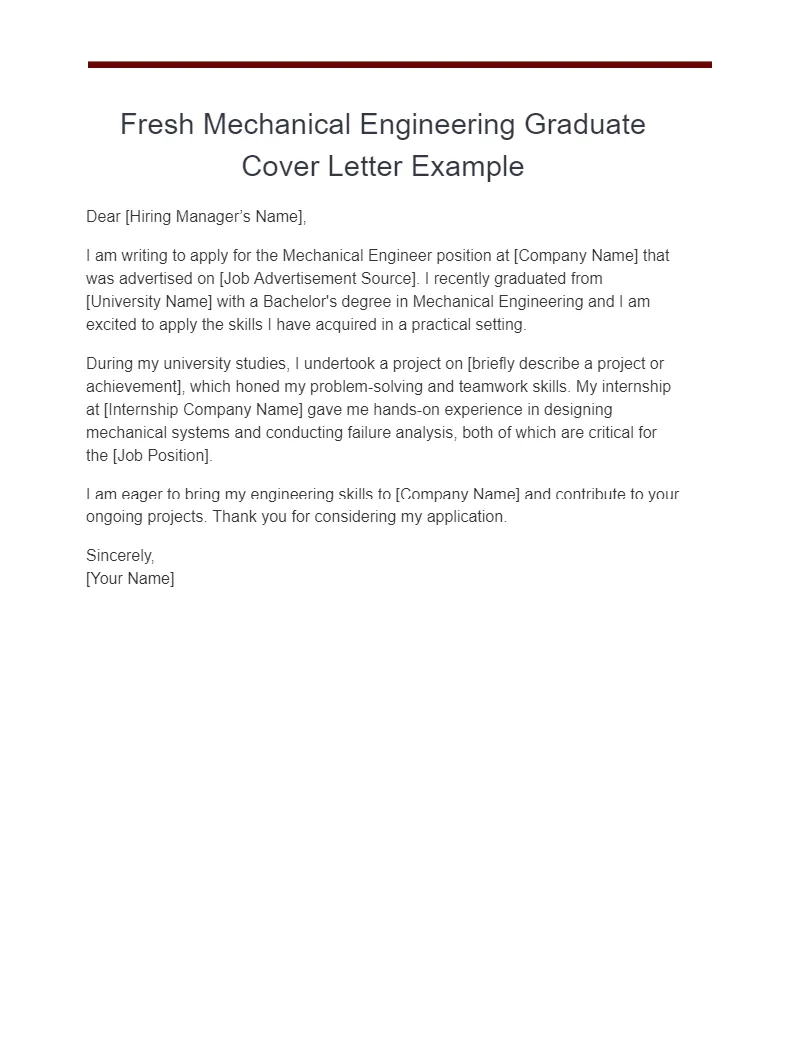
Cover Letter for Engineer Graduates
As a fresh engineering graduate, your cover letter is your first impression. It’s your chance to showcase your potential and make a strong case for why you’re the right fit. Unlike your resume, which provides a factual overview, your cover letter allows you to tell a story. It’s where you can connect your skills, experiences, and passion with the specific needs of the employer. A well-crafted cover letter can significantly increase your chances of landing an interview. A generic letter will likely end up in the rejection pile, so it is worth spending some time preparing a unique and personal letter for each application. Remember that the primary purpose of the cover letter is to get you an interview, so make it concise, compelling, and targeted.
Highlighting Your Engineering Skills
The core of your cover letter should focus on the skills you’ve developed during your engineering studies. Start by identifying the key skills the job description highlights. Then, select the skills from your repertoire that align with those requirements. This is where you bridge the gap between your education and the employer’s needs. Make sure to showcase a blend of hard and soft skills to present a well-rounded profile. Use action verbs to describe your achievements, and wherever possible, provide specific examples of how you’ve applied these skills. This could be from projects, internships, or even coursework. Demonstrate not just what you know, but how you’ve used your knowledge to solve problems and achieve results. This approach makes your letter more persuasive and memorable.
Technical Skills to Showcase

For an engineering graduate, technical skills are the foundation. List the relevant technical skills from your education and projects. Mention any software, tools, or programming languages you are proficient in. If the job description specifies certain technologies, make sure you include those prominently. Consider including skills like CAD software (e.g., AutoCAD, SolidWorks), simulation tools (e.g., ANSYS, MATLAB), programming languages (e.g., Python, C++), and other relevant technical expertise. Quantify your proficiency by mentioning projects where you’ve applied these skills, and briefly describe your role and outcomes. This provides tangible evidence of your capabilities and helps the employer quickly assess your suitability for the role. Technical skills are essential, but make sure you do not fall into the trap of listing skills without examples.
Soft Skills Employers Want
While technical skills are crucial, soft skills can set you apart. Employers value communication, teamwork, problem-solving, and leadership abilities. Provide examples of how you’ve demonstrated these skills in previous projects, group assignments, or extracurricular activities. Communication skills are vital for conveying complex ideas clearly and concisely. Teamwork skills are important for collaboration and achieving shared goals. Problem-solving skills show your ability to analyze situations and find effective solutions. Leadership skills demonstrate your capacity to motivate and guide others. When you describe your soft skills, provide context, detailing how you used these skills and the results you achieved. For example, you might mention a project where you successfully led a team to meet a challenging deadline.
Quantifying Achievements in Your Cover Letter
Instead of simply stating what you did, use numbers to illustrate your impact. Quantifiable achievements provide concrete evidence of your capabilities. For example, instead of saying “Improved efficiency,” state “Improved project efficiency by 15%.” This approach makes your accomplishments more convincing and memorable. Include specific data points, metrics, or statistics whenever possible. Consider using percentages, dollar amounts, time saved, or any other relevant figures. Always ensure that the numbers are accurate and reflect your true contributions. The more specific and detailed you are, the more credible your claims will be. This not only demonstrates your skills but also shows that you pay attention to details and can track results.
Using Numbers to Impress

Numbers make your accomplishments more impactful. Quantify your achievements in terms of time saved, costs reduced, or improvements made. If you designed a system, mention the percentage increase in efficiency or the cost savings it provided. If you worked on a project, highlight how your contributions led to a successful outcome. Provide context, mentioning the initial situation and what you did to bring about a positive change. Think about any data you can include to support your claims. If you improved team performance, specify the percentage increase in productivity or the reduction in errors. Numbers validate your achievements and make your claims more credible. The goal is to provide a clear picture of your impact, showing potential employers exactly what you are capable of achieving.
Examples of Quantifiable Achievements
Here are a few examples of how to quantify your achievements in an engineering cover letter: ‘Reduced project costs by 10% through value engineering.’ ‘Improved testing accuracy by 15% by implementing a new methodology.’ ‘Led a team of five engineers to complete a project two weeks ahead of schedule.’ ‘Developed a new algorithm that improved system performance by 20%.’ ‘Managed a budget of $50,000 for the construction of a prototype.’ These examples demonstrate how to showcase your impact using specific, measurable data. Tailor these examples to your experiences and the requirements of the job you are applying for. Be sure to emphasize your contributions and the positive outcomes that resulted from your actions. These types of details make your letter more compelling and leave a lasting impression on the hiring manager.
Tailoring Your Cover Letter to the Job
A generic cover letter won’t get you noticed. You must tailor each cover letter to the specific job and company. This shows that you are genuinely interested in the role and have taken the time to understand the requirements. Start by carefully reading the job description and identifying the key skills, qualifications, and experiences the employer is seeking. Then, adjust your cover letter to highlight the relevant aspects of your background. Do not send a general cover letter, hoping it will fit multiple roles. Demonstrate that you understand the company’s needs and how you can contribute to their success. This shows your initiative and attention to detail, traits highly valued in engineering.
Researching the Company and Role

Before writing your cover letter, research the company and the specific role. Visit the company’s website, read about their mission, values, and recent projects. Look for information about the team you might be joining, and understand the company’s culture. Understanding the company’s objectives will help you align your cover letter with their goals. Tailor your letter to resonate with their values and demonstrate how your skills and experiences align with their needs. By showing you have taken the time to understand the company, you demonstrate your interest and initiative. This is also a chance to understand the role’s specific demands, allowing you to better highlight the skills that make you the best fit.
Matching Your Skills to Requirements
Carefully compare the job description with your skills and experiences. Identify the skills and qualifications the employer is looking for, and then determine how your background aligns with these requirements. In your cover letter, explicitly state how your skills and experiences make you a strong candidate for the role. Provide concrete examples of projects, coursework, or internships where you have successfully applied these skills. Use keywords from the job description to demonstrate your understanding of the position’s needs. Make sure your letter is not just a list of skills; provide evidence to support your claims. When the employer sees how your skills meet their requirements, it’ll be clear why you’re the right fit.
Formatting and Design Best Practices
Your cover letter should be easy to read and visually appealing. Proper formatting and design can greatly improve its readability. Use a clean, professional font and maintain consistent formatting throughout the document. Ensure the layout is clear, with adequate spacing between sections. Keep your cover letter concise; aim for one page, and be mindful of the information you include. A well-formatted cover letter makes a positive impression, demonstrating attention to detail and professionalism. A well-formatted and visually appealing cover letter grabs the reader’s attention, making your content stand out and more memorable.
Choosing the Right Font

Select a professional and easy-to-read font, such as Times New Roman, Arial, or Calibri. Avoid using overly creative or ornate fonts that can distract from the content. A font size between 10 and 12 points is generally ideal for readability. Make sure the font size and style are consistent throughout the document. Ensure that the font size is appropriate for all devices the reader may use to view your letter. Your goal is to create a visually appealing and easy-to-read document that conveys professionalism and attention to detail. Choose a font that supports your message and reflects your brand.
Formatting for Readability
Use a clear and organized layout to enhance readability. Use headings, subheadings, and bullet points to break up large blocks of text. Maintain consistent spacing between paragraphs and sections. Use a professional-looking template, but ensure that your content is tailored to the specific job. Ensure the layout is easy to follow, with clear headings that guide the reader through your key points. Make use of white space to prevent the document from appearing cluttered. Make sure the document looks clean and professional. This approach will make your cover letter more accessible and make it easier for hiring managers to quickly grasp your qualifications.
Proofreading and Editing Your Letter
Before submitting your cover letter, proofread and edit it meticulously. Errors can detract from your credibility and may lead to your application being rejected. Review your letter for grammar, spelling, and punctuation errors. Pay attention to sentence structure and ensure your writing style is clear and concise. If possible, have someone else review your letter as well. Another pair of eyes can catch errors you might have missed. Proofreading and editing are critical steps in ensuring your cover letter effectively represents your skills and experience.
Checking for Errors

Carefully check your cover letter for any grammatical errors, spelling mistakes, or punctuation issues. Common errors include typos, incorrect verb tenses, and punctuation errors. Review each sentence to ensure it is clear, concise, and well-structured. Verify the accuracy of all dates, names, and titles. Use spell-check and grammar-check tools, but also read the letter yourself, as these tools might miss subtle mistakes. Ensuring your cover letter is error-free showcases your attention to detail and professionalism.
Getting Feedback
Ask a career counselor, professor, or trusted friend to review your cover letter. They can provide valuable feedback on the content, format, and overall effectiveness of your letter. Ask for their opinions on whether your skills and experiences are clearly presented and if your letter effectively conveys your enthusiasm for the job. Their feedback can help you identify areas for improvement and refine your message. Another perspective can help you identify any areas that need clarification or reinforcement. Revise your letter based on the feedback and tailor it to the job. Getting feedback is an essential step in ensuring your cover letter is the best representation of your skills and qualifications.