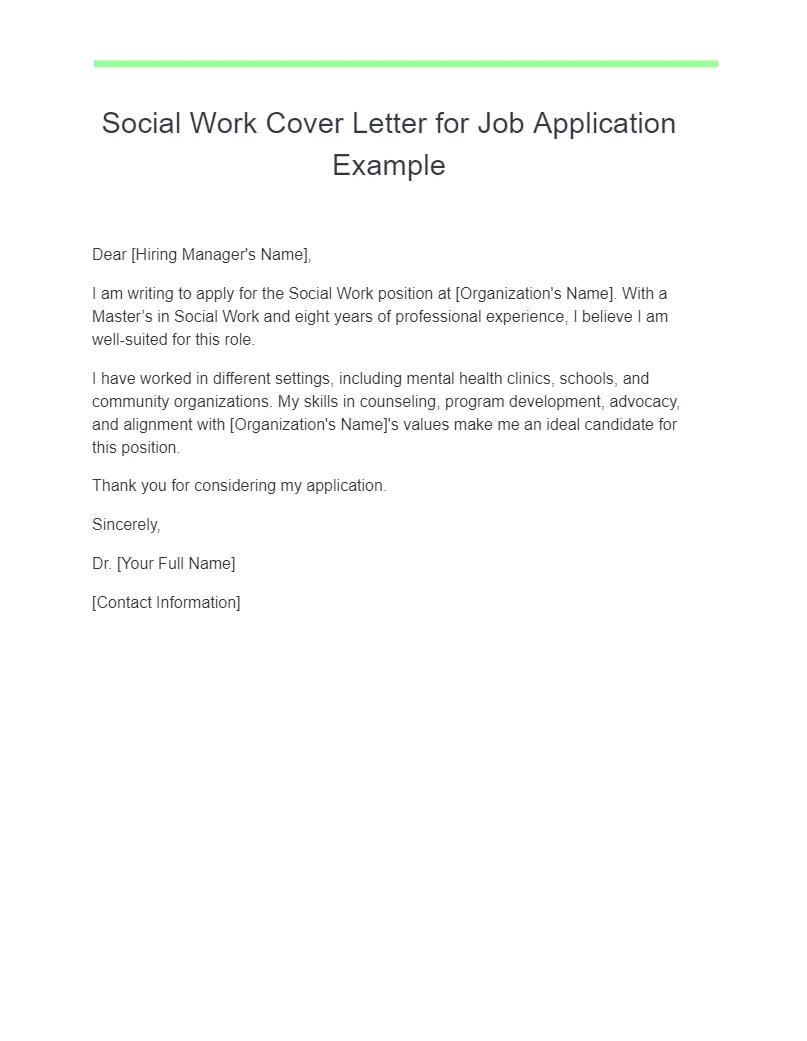
Why Cover Letters Matter for Social Work
In the competitive field of social work, a well-crafted cover letter is often your first introduction to a potential employer. It provides an opportunity to showcase your passion for the profession, highlight your relevant skills and experience, and demonstrate your understanding of the specific role and organization. Unlike a resume, which is a concise summary of your qualifications, a cover letter allows you to tell a story, explaining why you are the ideal candidate and how your values align with the organization’s mission. It’s a chance to connect with the hiring manager on a personal level and make a lasting impression. A strong cover letter can significantly increase your chances of getting an interview, setting you apart from other applicants and ultimately helping you land your dream job. Therefore, take the time to craft a cover letter that effectively communicates your unique strengths and qualifications and makes a compelling case for why you should be hired.
Highlighting Your Skills in Social Work Cover Letters
Social work demands a diverse set of skills, and your cover letter is the perfect place to emphasize those most relevant to the position you’re seeking. Think about the specific requirements listed in the job description and how your skills align with them. Highlight your interpersonal skills, such as empathy, active listening, and communication. Social workers must effectively communicate with diverse populations, including clients, colleagues, and other professionals. Demonstrate your ability to build rapport, de-escalate conflict, and facilitate difficult conversations. Also, mention your analytical and problem-solving skills, the ability to assess complex situations, develop effective intervention strategies, and evaluate outcomes. Include any experience with case management, crisis intervention, or advocacy, as these are common areas of focus in social work roles. Provide concrete examples of how you have utilized these skills in previous roles or experiences, showcasing your impact and results. Consider incorporating quantifiable achievements to demonstrate your effectiveness, such as the number of clients served or the success rate of your interventions.
Emphasizing Relevant Experience in Your Cover Letter

Your cover letter should clearly outline your relevant experience, showing how your past roles have prepared you for the specific social work position. Rather than simply listing your job duties, focus on the accomplishments and contributions you made in each role. Use the STAR method (Situation, Task, Action, Result) to describe specific situations, the tasks you were responsible for, the actions you took, and the positive outcomes you achieved. For example, instead of saying “Provided case management services,” you might write, “Managed a caseload of 25 clients, providing individual counseling, resource referrals, and advocacy, resulting in a 20% improvement in client self-sufficiency.” Tailor your experience to the specific requirements of the job. If the position emphasizes working with children, highlight your experience in child welfare or related settings. If the role requires experience with a particular population or issue, emphasize your work with that group. Show how your experiences have equipped you with the knowledge, skills, and judgment necessary to succeed in the role. Clearly articulate how you’ve applied your skills in practice, demonstrating your ability to make a tangible difference in the lives of others.
Tailoring Your Cover Letter to the Job Description
One of the most crucial steps in writing a compelling cover letter is tailoring it to each specific job application. Generic cover letters are easily identified and often discarded. Carefully review the job description and identify the key requirements, skills, and values the employer is seeking. Use the job description as a guide, aligning your cover letter with the specific needs and priorities of the organization. Demonstrate your understanding of the organization’s mission, values, and the populations they serve. Research the organization and highlight how your values align with theirs. Customize your cover letter to address the specific requirements of the role, emphasizing the most relevant skills and experiences. Use the same keywords and phrases from the job description, but make sure your use of them feels natural and authentic. In addition to skills and experience, address how you envision yourself contributing to the organization’s success. Show a genuine interest in the specific opportunity and organization. This level of personalization will demonstrate your commitment and make a strong impression on the hiring manager.
Cover Letter Examples Social Work [Case Manager]
A case manager cover letter should emphasize your organizational skills, your ability to manage a caseload, and your experience with assessment, planning, and resource allocation. Provide specific examples of your ability to assess client needs, develop service plans, and coordinate services. Highlight your experience with documentation, data collection, and reporting. Show your knowledge of relevant social work principles and ethical standards. Consider including the following in your cover letter:
- Your experience managing a caseload and the number of clients you’ve served.
- Your ability to assess client needs and develop individualized service plans.
- Your experience with resource allocation and connecting clients with community resources.
- Your knowledge of relevant regulations, policies, and ethical guidelines.
- Any experience with specific populations or issues, such as mental health or substance abuse.
Cover Letter Examples Social Work [Clinical Setting]

For clinical social work positions, your cover letter should highlight your clinical skills, experience in providing therapy, and knowledge of evidence-based practices. Showcase your experience working with individuals, families, or groups. Emphasize your ability to conduct assessments, develop treatment plans, and provide therapeutic interventions. Show your understanding of confidentiality and ethical guidelines. Consider including the following in your cover letter:
- Your experience in providing individual, family, or group therapy.
- Your knowledge of specific therapeutic modalities, such as CBT or trauma-informed care.
- Your experience with assessment, diagnosis, and treatment planning.
- Your understanding of ethical and legal issues in clinical practice.
- Any certifications or licenses, such as LCSW or LICSW.
Cover Letter Examples Social Work [Child Welfare]
Cover letters for child welfare positions should emphasize your experience working with children and families in crisis situations. Highlight your knowledge of child protective services, foster care, and adoption processes. Showcase your ability to assess child safety, investigate allegations of abuse or neglect, and make recommendations for child placement. Demonstrate your ability to work with diverse families and communities. Consider including the following in your cover letter:
- Your experience working with children and families in crisis.
- Your knowledge of child protective services, foster care, and adoption.
- Your experience with child abuse and neglect investigations.
- Your ability to assess child safety and make placement recommendations.
- Your understanding of cultural sensitivity and working with diverse families.
Cover Letter Examples Social Work [Community Outreach]
Community outreach cover letters should emphasize your ability to build relationships, engage with community members, and promote social change. Highlight your experience with program development, outreach events, and community organizing. Showcase your ability to communicate effectively with diverse audiences and promote your organization’s mission. Demonstrate your passion for serving the community and making a difference. Consider including the following in your cover letter:
- Your experience with program development and community outreach.
- Your ability to build relationships and engage with community members.
- Your experience with outreach events and community organizing.
- Your ability to communicate effectively with diverse audiences.
- Your passion for social justice and making a positive impact on the community.
Formatting Your Social Work Cover Letter

The format of your cover letter is essential for making a positive first impression. Use a professional and easy-to-read font, such as Times New Roman, Arial, or Calibri, with a font size between 10 and 12 points. Use a clear and concise layout, with consistent margins and spacing. Start with your contact information, the date, and the hiring manager’s contact information. Address the letter to a specific person whenever possible. Use a professional salutation, such as “Dear Mr./Ms. [Last Name].” The body of your cover letter should be concise and well-structured, typically consisting of three to four paragraphs. Proofread your cover letter carefully for any grammatical errors, spelling mistakes, or typos. Ensure the letter is free of jargon and easy to understand, and tailor your formatting to match the organization’s brand and style. A well-formatted cover letter shows attention to detail and professionalism, which are essential qualities for a social worker.
Proofreading and Editing Your Cover Letter
Before submitting your cover letter, take the time to proofread and edit it thoroughly. Errors in grammar, spelling, and punctuation can detract from your qualifications and give the impression that you are not detail-oriented. Read your cover letter aloud to catch any awkward phrasing or sentence structure. Ask a friend, mentor, or career counselor to review your cover letter and provide feedback. They can offer a fresh perspective and identify any areas that need improvement. Pay close attention to the tone of your cover letter and ensure it is professional, enthusiastic, and reflects your personality. Make sure your cover letter is tailored to the specific job and highlights the skills and experiences most relevant to the position. Revise and refine your cover letter until you are completely satisfied with the content and presentation, and remember, a polished and error-free cover letter will significantly increase your chances of making a positive impression and getting an interview.
Best Practices for Social Work Cover Letters
In addition to the advice mentioned above, there are several best practices to keep in mind when writing a social work cover letter. Always research the organization and tailor your letter to their specific mission, values, and the populations they serve. Highlight your relevant skills and experiences, using specific examples to demonstrate your achievements and impact. Quantify your accomplishments whenever possible, such as the number of clients you’ve served or the improvements you’ve made in their lives. Show enthusiasm and passion for the social work profession and the specific opportunity. Express your understanding of the role and how you can contribute to the organization’s success. End with a call to action, such as expressing your interest in an interview and providing your contact information. Proofread carefully for any errors, and have others review your cover letter before submitting it. Following these best practices will help you create a cover letter that grabs the attention of hiring managers and increases your chances of landing your dream social work job. Good luck!