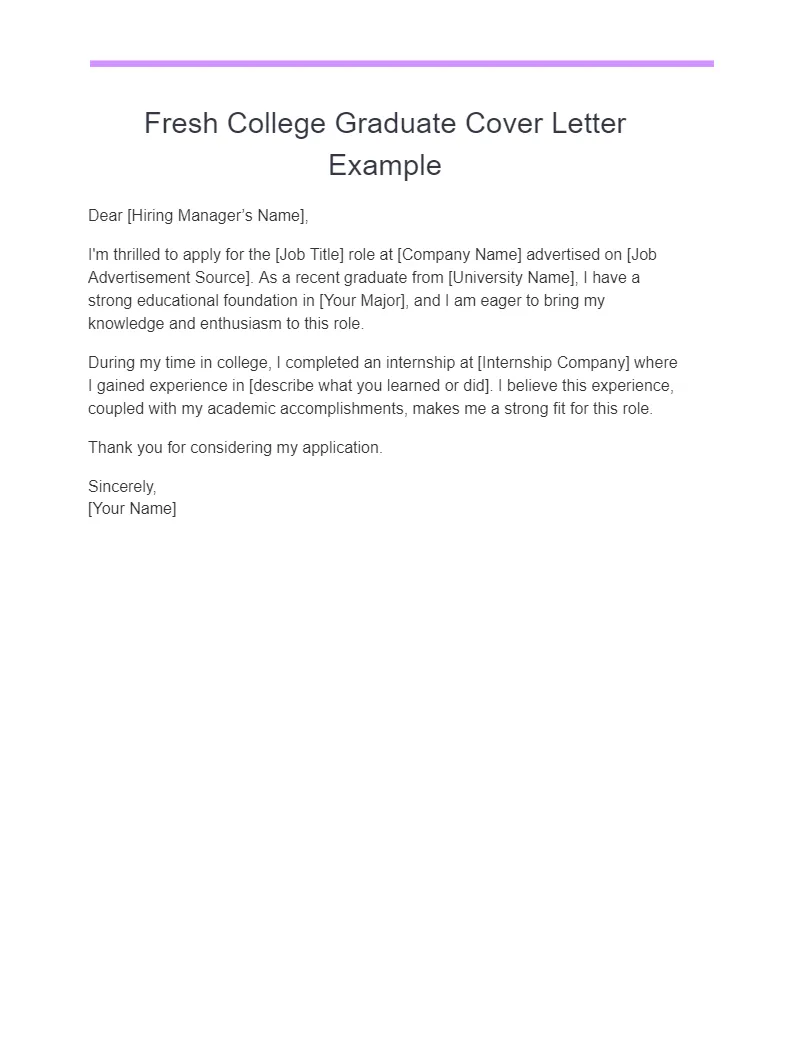
Cover Letter Example for Fresh Graduates
As a recent graduate, crafting a compelling cover letter is crucial for making a strong first impression on potential employers. This document serves as your introduction, offering a glimpse into your skills, experiences, and personality. Unlike a resume, which provides a factual overview of your background, a cover letter allows you to narrate your story, highlighting how your qualifications align with the specific job requirements. It’s your opportunity to showcase your enthusiasm, demonstrate your understanding of the company, and explain why you are the ideal candidate. A well-written cover letter can significantly increase your chances of securing an interview, setting the stage for a successful job search. This guide provides examples and tips tailored to the unique challenges and opportunities faced by fresh graduates, helping you create a cover letter that stands out.
Highlight Your Education and Skills
Your educational background is a cornerstone of your cover letter. Instead of simply listing your degree, go deeper by highlighting relevant coursework, academic achievements, and any specialized training you’ve received. For example, if you’re applying for a marketing position, mention specific marketing courses you excelled in, or projects where you gained hands-on experience with marketing tools and strategies. Furthermore, identify key skills that align with the job description. These can be technical skills (like proficiency in specific software) or soft skills (like communication, teamwork, and problem-solving). Provide concise examples of how you’ve used these skills in your academic or extracurricular activities. The goal is to show, not just tell, how your skills and education make you a strong fit for the role. Your cover letter should reflect the essential skills listed in the job description, demonstrating that you have what it takes to succeed.
Emphasize Relevant Coursework and Projects

Fresh graduates often lack extensive professional experience, making it essential to leverage academic projects and coursework to demonstrate your capabilities. Detail any projects that are directly related to the job you’re applying for. Describe your role in the project, the challenges you faced, and the results you achieved. Quantify your achievements whenever possible. Instead of saying, “Worked on a group project,” try something like, “Led a team of five students to develop a marketing plan for a local business, resulting in a 15% increase in social media engagement.” This level of detail proves your initiative and ability to apply your knowledge practically. By highlighting relevant coursework and projects, you can showcase your practical skills and demonstrate your understanding of the industry. Tailor these examples to match the job requirements, showing how your academic experiences have prepared you for the role.
Showcase Your Accomplishments
Even without extensive work experience, you likely have accomplishments from your academic, extracurricular, or volunteer activities. Identify any achievements that highlight your skills, leadership qualities, and commitment. Did you receive an academic award, lead a student organization, or volunteer for a relevant cause? These experiences can significantly strengthen your cover letter. Provide specific examples of your accomplishments. For instance, if you were the treasurer of a student club, mention how you managed the budget, organized fundraising events, or increased membership. Use the STAR method (Situation, Task, Action, Result) to structure your examples, making them clear and impactful. Clearly illustrate the situation you were in, the task you undertook, the actions you took, and the results you achieved. Highlighting your accomplishments not only demonstrates your capabilities but also showcases your proactive and results-oriented approach.
Use Action Verbs to Describe Your Contributions
Using strong action verbs in your cover letter makes your descriptions more dynamic and engaging. Start your sentences with verbs that showcase your accomplishments and skills. Instead of using generic phrases like “Responsible for,” opt for more powerful verbs such as “Managed,” “Developed,” “Implemented,” “Created,” or “Led.” For example, instead of “Was involved in the marketing campaign,” write “Spearheaded the social media marketing campaign, resulting in a 20% increase in followers.” This not only clarifies your role but also emphasizes your contributions and the impact you made. Action verbs make your cover letter more compelling, allowing the reader to quickly understand what you achieved and how you did it. Using a variety of action verbs throughout the letter prevents it from becoming monotonous, keeping the reader engaged and interested in learning more about your experience.
Tailor Your Cover Letter to Each Job

A generic cover letter rarely makes a strong impression. To increase your chances of success, customize each cover letter to the specific job and company. Carefully review the job description and identify the key requirements and desired skills. Then, highlight your qualifications and experiences that directly align with these requirements. Customize your letter by addressing the specific needs of the employer and showcasing how your skills and experiences can benefit the company. Avoid using a one-size-fits-all approach. Instead, personalize your letter by mentioning the company’s name, the specific role you are applying for, and the reasons why you are interested in that particular position. Demonstrating this level of thoughtfulness and effort will make your application stand out from the rest, showing employers that you are genuinely interested in the opportunity and have taken the time to understand their needs.
Research the Company and the Role
Thorough research is essential for writing a compelling cover letter. Before you start writing, research the company, its mission, values, and recent activities. This information will help you tailor your letter to the company’s specific needs and demonstrate your genuine interest. Explore the company’s website, social media profiles, and any recent news or press releases. Understand the role’s responsibilities and requirements. Identify what skills, experiences, and qualifications the employer is seeking. By demonstrating your understanding of the company and the role, you show that you have taken the initiative to learn about the opportunity. Mentioning specific company projects, initiatives, or values in your cover letter can further demonstrate your interest and that you are a good fit for their culture. This will make your application more memorable and more likely to be considered.
Address the Hiring Manager Directly
Whenever possible, address your cover letter to a specific person, such as the hiring manager or the recruiter. This shows that you have taken the time to identify the correct contact and that you are serious about the opportunity. Research the company’s website or LinkedIn to find the name of the hiring manager. If you cannot find a specific name, you can use a general salutation like “Dear Hiring Manager.” While not as personal, it is still better than using a generic greeting such as “To Whom It May Concern.” Addressing the letter to a specific person makes your application feel more personal and demonstrates that you are dedicated to the role. Make sure to spell the name correctly, and always double-check your address before sending the cover letter. A personalized greeting immediately grabs the reader’s attention and makes your application more engaging, potentially leading to a stronger connection from the outset.
Focus on What You Can Offer

Shift the focus from what you want to gain from the job to what you can offer the company. Highlight your skills, experiences, and qualifications, and explain how they align with the needs of the employer. Frame your cover letter as a value proposition, detailing how you can contribute to the company’s success. Be specific about your abilities and the impact you can make. Mention projects, initiatives, or goals that you could contribute to if you were selected for the position. Instead of simply stating you are a quick learner, provide an example of a time when you quickly mastered a new skill. Show the hiring manager that you are confident in your ability to deliver results and make a positive impact on their team. Emphasizing your potential contributions makes your cover letter more convincing, proving that you’re a great investment for the company.
Demonstrate Enthusiasm and Interest
Expressing genuine enthusiasm and interest in the company and the role is crucial. Your cover letter should convey your excitement about the opportunity and your desire to contribute to the company’s goals. Explain why you are interested in this specific position and why you believe the company is a good fit for you. Mention specific aspects of the company’s culture, values, or projects that resonate with you. Show that you have researched the company and that you are genuinely interested in working there. End your cover letter with a confident closing, reiterating your interest and expressing your eagerness for an interview. A strong and enthusiastic tone can capture the hiring manager’s attention and leave a positive impression, indicating that you are not only qualified but also excited about the prospect of joining their team.
Proofread and Edit Carefully
Errors in a cover letter can immediately disqualify an applicant. Before submitting your cover letter, proofread it carefully for any grammatical errors, spelling mistakes, or typos. Ensure that your sentences are clear, concise, and well-structured. Read your cover letter aloud to catch any awkward phrasing or inconsistencies. It’s also beneficial to have a friend, family member, or career advisor review your cover letter. A fresh pair of eyes can often catch mistakes that you might have missed. Pay attention to the formatting of your cover letter, ensuring it is easy to read and visually appealing. A polished cover letter shows attention to detail and a commitment to professionalism. A well-written and error-free cover letter greatly increases your chances of making a strong impression and being invited for an interview. Ensure your cover letter represents you at your very best, highlighting your skills and enthusiasm for the job.