Crafting a Compelling Cover Letter for Administrative Assistant Roles
In the competitive landscape of job applications, an exceptional cover letter is crucial for administrative assistants. It’s your first opportunity to make a strong impression and showcase your skills, experience, and enthusiasm for a particular role. This guide provides a comprehensive cover letter example, designed specifically for administrative assistant positions, along with valuable advice and actionable strategies. A well-written cover letter not only highlights your qualifications but also demonstrates your understanding of the role and your dedication to the company. The best cover letters help you stand out from the competition and get you invited for an interview. Let’s get started with how you can tailor your cover letter to maximize your success.
Understanding the Purpose of a Cover Letter
The primary purpose of a cover letter is to introduce yourself and provide context to your resume. It allows you to elaborate on your skills, experience, and career goals in a way that a resume alone cannot. A great cover letter does more than simply restate what’s in your resume; it tells a story about your professional journey and explains why you’re an ideal fit for the job. It also gives you the opportunity to highlight specific achievements and to express your enthusiasm for the company and the role. Consider your cover letter as a personal sales pitch, emphasizing your value and persuading the hiring manager to call you for an interview.
Highlighting Your Skills and Experience

Your cover letter is an excellent place to highlight skills and experiences most relevant to the administrative assistant role. Focus on the qualifications listed in the job description. Provide specific examples of how you have used your skills and achieved results in previous roles. For example, if the job requires proficiency in Microsoft Office, give specific examples of how you have used these tools to improve office efficiency. If the role emphasizes organizational skills, offer concrete examples of how you’ve successfully managed projects or streamlined office procedures. Tailor your letter to match the needs outlined in the job description to emphasize the experiences that align with the requirements. Remember to highlight both your hard skills (e.g., software proficiency, data entry) and your soft skills (e.g., communication, time management, problem-solving).
Why a Cover Letter is Essential
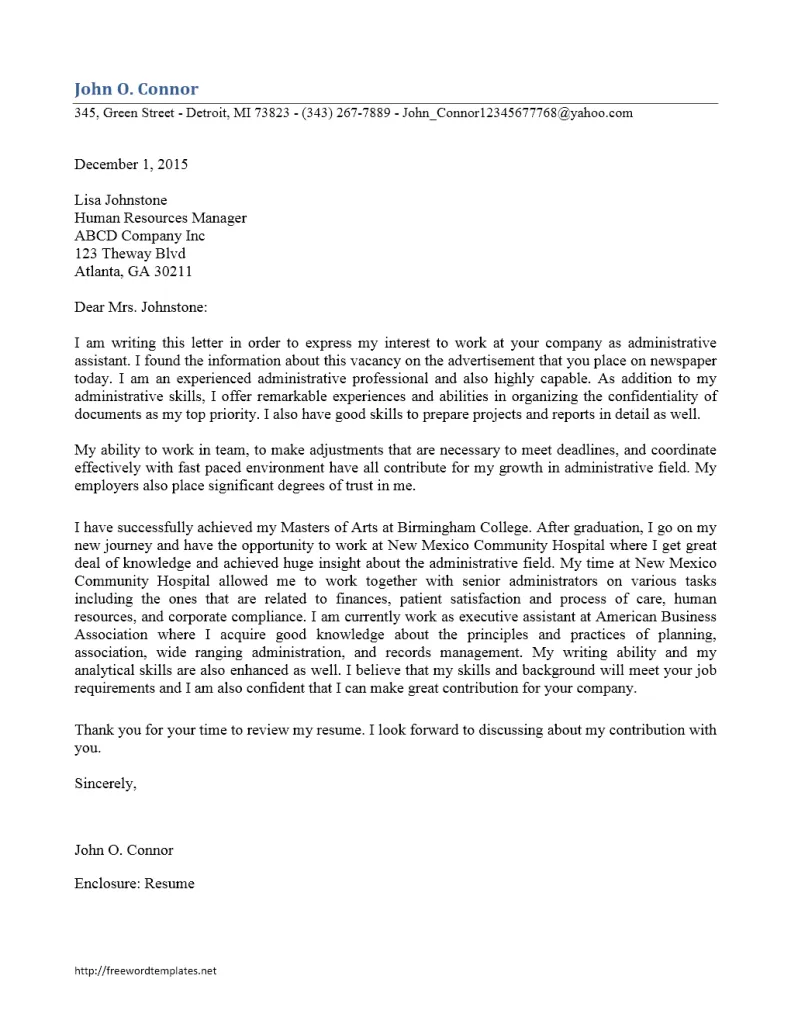
In a competitive job market, a cover letter can be a deciding factor. It provides an opportunity to stand out from other applicants by showcasing your personality, your enthusiasm, and your unique qualifications. Even if not explicitly required, submitting a cover letter demonstrates attention to detail and initiative. A well-written cover letter shows you are serious about the opportunity and have taken the time to research the company and the role. You can use your cover letter to address potential gaps in your resume and to explain your career transitions clearly and concisely. Consider it your opportunity to make a compelling case for why you deserve an interview. By customizing your cover letter for each job, you show the employer you are genuinely interested in the role and not just sending out a generic application. See image below.
Key Components of an Administrative Assistant Cover Letter
A well-structured cover letter is easily understood by hiring managers, highlighting your qualifications effectively. Adhering to a standard format ensures your cover letter conveys professionalism and clarity. The components of an effective cover letter increase readability and showcase your skills. Customizing each section to match the job description and company requirements is also important. The more relevant and personalized your cover letter is, the better your chances of getting an interview.
Header Information

The header of your cover letter should include your contact information and the date. Accurate and professional contact details are essential. This section ensures that the hiring manager can easily reach you. Information is typically aligned to the left or right, maintaining consistency. The header sets the tone for the letter, so make sure to keep it up to date for each application. This demonstrates that you have written a recent and tailored application.
Applicant Contact Information
Include your full name, phone number, email address, and optionally, your LinkedIn profile URL. Ensure your email address is professional (e.g., firstname.lastname@email.com). Always double-check your phone number for accuracy. Consistent font and formatting maintains a professional appearance. Your contact information is the first thing the hiring manager sees. Make sure it is clear, concise, and without errors. Update all of your information and check the email address regularly. See image below.
Recipient Contact Information
If possible, address your cover letter to a specific person (e.g., the hiring manager). Research the company website or use LinkedIn to find the name and title of the person responsible for hiring. If you cannot find a specific name, use a general greeting such as ‘Dear Hiring Manager.’ This adds a personal touch. Ensure the recipient’s name and title are accurate. If you’re unsure, use a general salutation. Addressing the letter to a specific person demonstrates attention to detail and initiative.
Professional Greeting

Start your cover letter with a professional greeting. If you know the hiring manager’s name, use ‘Dear Mr./Ms./Mx. Last Name.’ If you don’t know the name, use ‘Dear Hiring Manager’ or ‘Dear [Company Name] Hiring Team’. Avoid informal greetings. A professional greeting sets the tone for the rest of your letter. Correctly using the salutation shows respect and attention to detail. Always spell the person’s name correctly. This makes a positive first impression.
Body Paragraphs
The body paragraphs are where you showcase your skills, experience, and enthusiasm for the position. Structure your letter with an introduction, a few paragraphs highlighting relevant skills, and a closing paragraph. Each paragraph should be concise and impactful. Make sure the body is well-organized with clear transitions. This section allows you to convince the hiring manager that you are the best candidate for the job. Use clear, concise language and avoid jargon. Always proofread carefully. The body of your letter should be engaging.
First Paragraph Introduction
Start your first paragraph by stating the position you’re applying for and how you learned about the opportunity. Include a brief statement about why you’re interested in the role and the company. This paragraph should capture the reader’s attention. Mention the name of the company and the position clearly. Show your enthusiasm for the job and the company. The introduction should be direct and engaging. Highlight something that attracts you to the role or the organization. Show that you have done your research and are interested in the position. See image below.
Second Paragraph Showcasing Skills

In the second paragraph, highlight your relevant skills and experiences that match the job requirements. Use specific examples to demonstrate your abilities. For example, if the job requires strong organizational skills, give an example of how you have managed projects or improved office processes. Show how your skills align with the specific needs of the role. Support your claims with quantifiable results whenever possible. The hiring manager wants to see how you can add value in the administrative assistant role.
Third Paragraph Quantifying Achievements
Use your third paragraph to quantify your achievements and demonstrate the impact you’ve had in previous roles. Instead of just listing your responsibilities, provide specific results. For example, mention how you improved efficiency, reduced costs, or increased productivity. Use numbers and statistics to make your accomplishments more compelling. Providing quantifiable achievements allows the hiring manager to see the value you can bring to their organization. Make sure your achievements are relevant to the job requirements.
Closing Paragraph and Call to Action
End your cover letter with a strong closing paragraph that summarizes your interest in the position and reiterates your enthusiasm for the company. Include a call to action, such as requesting an interview or expressing your availability for a discussion. Thank the hiring manager for their time and consideration. The closing paragraph should be concise, leaving the reader with a positive impression. Express your enthusiasm for the opportunity and reiterate your key qualifications. Make it easy for the hiring manager to take the next step.
Formal Closing and Signature

Use a formal closing, such as ‘Sincerely,’ ‘Best regards,’ or ‘Yours sincerely,’ followed by your typed name. If you are submitting a digital cover letter, you can include your electronic signature. The formal closing should be consistent with the tone of your letter. Ensure your signature is clear and professional. Double-check the spelling and formatting. This reinforces the professional nature of your application.
Formatting and Design Considerations
The formatting and design of your cover letter will significantly affect its readability and presentation. A well-formatted cover letter is easy to read and reflects professionalism. These formatting elements will make your letter stand out.
Font Selection and Readability
Choose a professional font that’s easy to read, such as Times New Roman, Arial, Calibri, or Helvetica. Use a font size between 10 and 12 points. Use consistent font usage. The font should be clear and legible, avoiding overly decorative fonts. Readability is key, so choose a font that is suited for professional correspondence. A clean, readable font makes a positive impression and ensures your content is easy to consume.
Length and Structure of Your Cover Letter

Keep your cover letter concise and to the point. Aim for a maximum of one page. Structure your letter with clear paragraphs and headings to enhance readability. The best cover letters are focused and specific, highlighting the most relevant information. Use white space effectively to break up text and make your letter visually appealing. Ensure a logical flow from the introduction to the conclusion. A well-structured cover letter demonstrates your ability to organize information effectively.
Proofreading and Editing
Always proofread your cover letter carefully for any typos, grammatical errors, or formatting inconsistencies. Use spell-check and grammar-check tools, but also manually review your letter. Ask someone else to review your cover letter for a fresh perspective. Errors can undermine your credibility, so attention to detail is essential. Proofreading ensures your letter reflects professionalism. Correct any mistakes and revise awkward phrasing.
Common Mistakes to Avoid
Avoiding these common mistakes can significantly improve the effectiveness of your cover letter. These mistakes range from generic content to poor formatting. By understanding the pitfalls, you can ensure your cover letter stands out for the right reasons.
Generic or Uninspired Content
Avoid using generic cover letter templates that aren’t tailored to the specific job or the company. Make sure your letter is personalized and demonstrates your genuine interest in the role and the organization. Employers easily spot generic cover letters. Your letter should reflect your unique qualifications and enthusiasm. Generic content shows a lack of effort. Tailor your letter to the specific job description and show that you understand the company’s mission and values.
Typos and Grammatical Errors
Always proofread your cover letter carefully for typos, grammatical errors, and punctuation mistakes. These errors can damage your credibility and make you appear unprofessional. Use spell-check and grammar-check tools, but also manually review your letter. Double-check names, titles, and company details. Typos and grammatical errors are easily avoidable and can make a negative impression. Proofreading is crucial for ensuring your cover letter reflects professionalism. Ask a friend or family member to proofread for you.
Failing to Tailor Your Letter
Tailor your cover letter to each job application. Research the company and the role. Customize the content to align with the job requirements. Generic cover letters are less likely to make a positive impression. Tailor your letter to each specific job, showing how your skills and experience match the requirements. Show your genuine interest and explain why you are interested in that specific position.
Cover Letter Example for Administrative Assistant
Below is an example of an administrative assistant cover letter. This example provides a basic template. Adapt this example to your needs and tailor it to the job description. Personalize the content to reflect your unique skills, experiences, and the company’s requirements.
Example Cover Letter
[Your Name] [Your Address] [Your Phone Number] [Your Email Address] [Date] [Hiring Manager Name (if known), or Hiring Team] [Company Name] [Company Address] Dear [Mr./Ms./Mx. Last Name or Hiring Manager], I am writing to express my interest in the Administrative Assistant position at [Company Name], as advertised on [Platform where you saw the job posting]. With my proven organizational skills, attention to detail, and excellent communication abilities, I am confident that I can contribute significantly to your team. In my previous role at [Previous Company], I was responsible for managing calendars, scheduling meetings, and handling correspondence. I have a knack for keeping things running smoothly and efficiently. I have experience with [specific software/tools], and I consistently exceeded expectations in managing administrative tasks and supporting executives. I am particularly drawn to [Company Name] because of [mention something specific that interests you about the company]. I am eager to apply my skills and experience to support your team and contribute to your ongoing success. I am a highly organized and detail-oriented individual with a strong work ethic, and I am eager to learn and grow. Thank you for your time and consideration. I have attached my resume for your review and welcome the opportunity to discuss my qualifications further in an interview. Sincerely, [Your Typed Name]
Adapt the Example to Your Needs
The example provides a strong base, but it’s vital to adapt it to your situation and the job requirements. Customize the content to reflect your unique skills, experiences, and the company’s needs. Make sure the content aligns with the job requirements. Incorporate the keywords from the job description. Quantify your achievements with specific numbers and data. Tailoring your cover letter to each job is essential.
Tips for Customization
To make your cover letter more effective, research the company and its values. Highlight relevant skills and experiences. Use the keywords from the job description. Quantify your accomplishments. Personalize the letter by addressing the hiring manager by name. Proofread your cover letter carefully. By customizing your cover letter, you demonstrate your initiative and your interest in the position. Always tailor your cover letter to the job description.