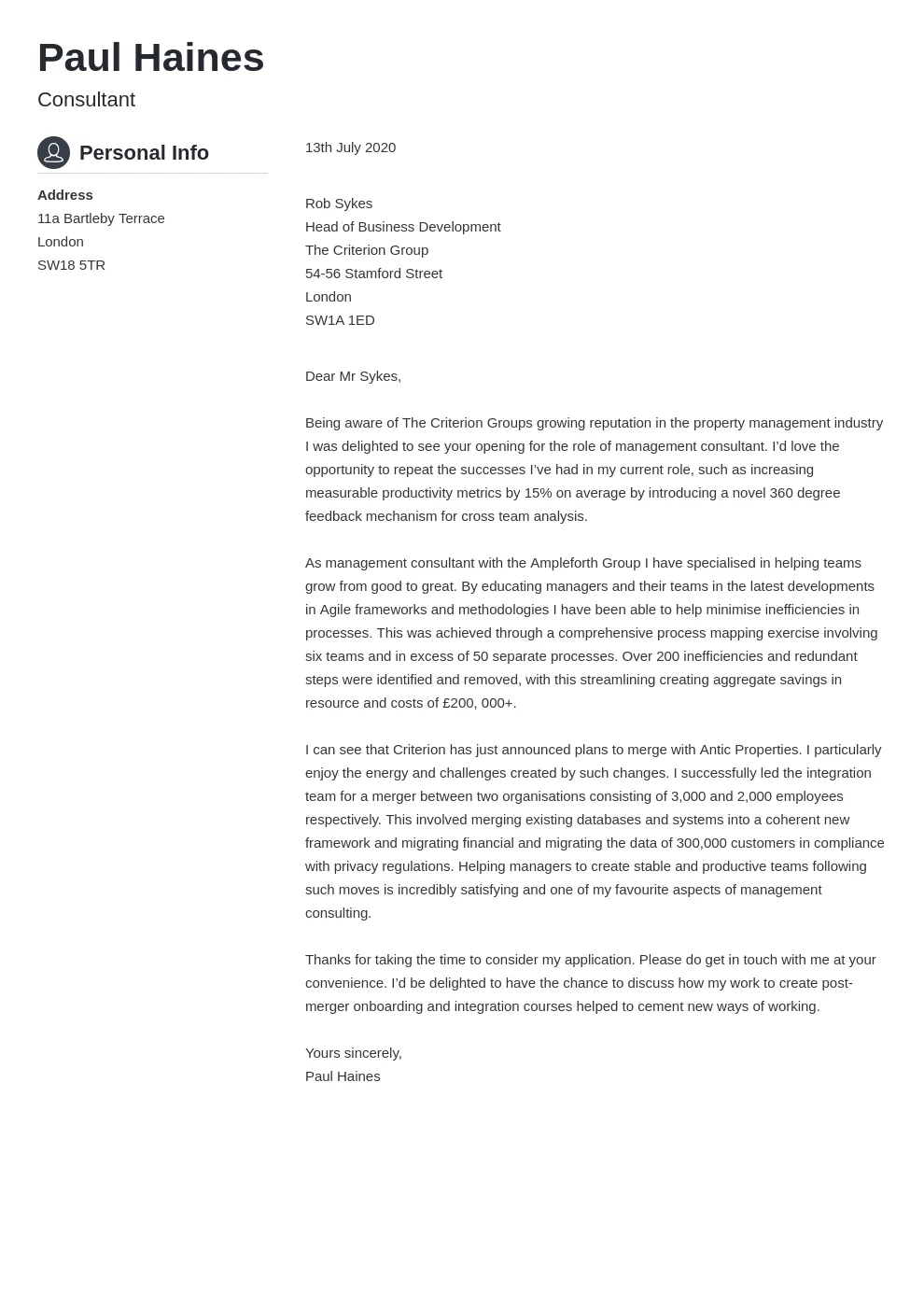
Crafting Your Consulting Job Cover Letter
A consulting job cover letter is your initial opportunity to make a strong impression on potential employers. It’s more than just a formality; it’s a strategic document designed to showcase your qualifications and convince the hiring manager that you’re the right fit for the role. A well-crafted cover letter complements your resume by providing context and depth to your experiences, skills, and accomplishments. It’s your chance to articulate your career goals, explain why you’re drawn to consulting, and demonstrate your understanding of the industry. The goal is to make the hiring manager want to learn more about you, leading to an interview and ultimately, a job offer.
Understanding the Consulting Job Application Process
The consulting job application process is often competitive and rigorous. Understanding the process is crucial for tailoring your cover letter and resume effectively. Typically, the process involves submitting your application materials (cover letter and resume), followed by an initial screening by HR or a recruiter. If you pass this stage, you might be invited to a phone interview or a preliminary interview with a consultant. The final stages often include multiple rounds of interviews, case studies, and assessments to evaluate your problem-solving abilities, communication skills, and cultural fit. Knowing these stages helps you anticipate what employers are looking for at each step and customize your cover letter to address their specific needs.
Researching the Company and Role

Before you start writing your cover letter, conduct thorough research on the consulting firm and the specific role you’re applying for. Visit the company’s website to understand their values, mission, and recent projects. Identify the industries they serve and the types of clients they work with. Look for insights into their company culture and any specific requirements mentioned in the job description. Tailor your cover letter to demonstrate that you understand the company’s business, the challenges it faces, and how your skills and experiences align with its goals. Mentioning specific projects or initiatives by the firm can also show that you’ve taken the time to learn about them and are genuinely interested in the role. This research is essential for making your application stand out.
Tailoring Your Cover Letter
Generic cover letters rarely impress hiring managers in the consulting industry. Tailoring your cover letter is vital to capture their attention and demonstrate your suitability for the role. Begin by carefully reviewing the job description and identifying the key requirements, skills, and experiences the company seeks. Then, use your cover letter to address these requirements directly, providing specific examples from your past to illustrate how you meet or exceed expectations. Customize your tone and language to reflect the firm’s culture, and avoid using boilerplate phrases or generic statements. Demonstrate a genuine interest in the role and the company. Highlighting specific projects or the value you could bring to their team will make your application more impactful.
Highlighting Relevant Skills and Experience
Consulting roles demand a unique blend of hard and soft skills. Your cover letter should highlight the skills and experiences that are most relevant to the position. Some key skills to emphasize include problem-solving, analytical thinking, communication, leadership, project management, and industry-specific knowledge. Provide concrete examples of how you’ve used these skills to achieve results in past roles or projects. Quantify your achievements whenever possible (see below) to showcase the impact you’ve made. Tailor your focus to match the specific requirements of the job description. If the job requires experience in a specific industry or area, make sure to draw attention to your relevant background. Make it clear why your skills and experience make you the best candidate.
Quantifying Achievements and Results

Consulting firms value results-driven individuals. Always quantify your achievements in your cover letter to demonstrate the impact you’ve made in previous roles. Instead of saying you ‘improved efficiency,’ provide specifics like ‘increased operational efficiency by 15%.’ Use metrics, data, and numbers to showcase your accomplishments. Quantify your impact on revenue, cost savings, project completion rates, or client satisfaction. For example, mention that you ’led a team that reduced project delivery time by 20%, resulting in significant cost savings.’ This makes your cover letter more credible and demonstrates your ability to deliver tangible results. Be concise and focus on the most relevant achievements that align with the requirements of the job.
Showcasing Your Understanding of Consulting
Consulting firms want to see that you understand the nature of their work. Show this understanding in your cover letter. Briefly explain your understanding of the consulting process, including the importance of client relationships, problem-solving methodologies, and delivering actionable recommendations. Demonstrate your awareness of industry trends, the challenges businesses face, and how consultants help clients overcome these challenges. You can also discuss specific consulting projects you’ve undertaken, or discuss how you would approach a client problem. This displays not only your experience but your commitment to consulting as a profession. The more you can show a deep understanding of what a consulting job involves the better.
Demonstrating Your Problem-Solving Abilities
Problem-solving is at the heart of consulting. In your cover letter, clearly demonstrate your problem-solving abilities. Describe instances where you successfully identified and analyzed complex problems, developed innovative solutions, and implemented them effectively. Use the STAR method (Situation, Task, Action, Result) to structure your examples. For example, describe a specific project (situation), the challenges you faced (task), the steps you took to address them (action), and the positive outcomes you achieved (result). Highlight your ability to think critically, analyze data, and make sound decisions. This will give the hiring manager confidence that you can handle the intellectual demands of the job.
Formatting and Structure for Success

The formatting and structure of your cover letter are crucial for making a positive first impression. A well-formatted cover letter is easy to read and showcases your professionalism. Use a clear and concise font, such as Arial or Times New Roman, and ensure your cover letter has a professional layout. Keep your cover letter to one page. Start with your contact information, the date, and the hiring manager’s name and title. Divide your letter into distinct sections, including a compelling opening, a body that highlights your skills and experiences, and a confident closing. Use bullet points and short paragraphs to improve readability. Ensure your letter has adequate white space. Proper formatting makes the letter more approachable and demonstrates attention to detail.
Writing a Compelling Opening
The opening paragraph of your cover letter is your opportunity to grab the reader’s attention. Start strong by expressing your enthusiasm for the position and the company. State the position you’re applying for clearly. Mention where you saw the job posting and why you’re interested in the role. Briefly state your key qualifications and how they align with the job requirements. You can also mention a connection you have with the company, such as a referral, or an impressive project the firm has undertaken. The first few sentences should be engaging and encourage the reader to continue to review the rest of your cover letter, leading them into the body of your application.
Structuring the Body of Your Cover Letter
The body of your cover letter should expand on the key skills and experiences you mentioned in your opening. Use this section to provide specific examples that illustrate your abilities and accomplishments. Structure the body in a way that clearly aligns with the job requirements outlined in the job description. Dedicate a paragraph to each key skill or experience and support your claims with concrete examples. Use action verbs to describe your accomplishments. Quantify your results whenever possible. The body should demonstrate why you are a strong fit for the role. Make sure your writing is direct and easy to follow, with clear transitions between paragraphs.
Concluding with Confidence and a Call to Action

The closing paragraph of your cover letter is your opportunity to leave a lasting impression. Reiterate your enthusiasm for the role and the company. Summarize your key qualifications and express your confidence that you’d be a successful consultant. Include a clear call to action, such as ‘I am eager to discuss how my skills and experience can contribute to your team. I look forward to the opportunity to speak with you.’ Provide your contact information and thank the hiring manager for their time and consideration. End the letter professionally with ‘Sincerely’ or ‘Best regards,’ followed by your name and signature.
Proofreading and Editing Your Cover Letter
Before submitting your cover letter, carefully proofread and edit it to ensure it’s free of errors. Spelling and grammatical mistakes can detract from your qualifications and professionalism. Read the letter aloud to catch any awkward phrasing or unclear sentences. Ask a friend, mentor, or career advisor to review your cover letter and provide feedback. Focus on clarity, conciseness, and accuracy. Double-check all names, titles, and dates. Proofreading is essential for ensuring that your cover letter makes the best possible impression. A polished cover letter demonstrates your attention to detail, something that is greatly valued in the consulting profession.
Key Phrases to Include
Include key phrases and keywords in your cover letter that align with the job description. These keywords help demonstrate your understanding of the role and the company’s priorities. Review the job description for key skills, technologies, and industry terms. Weave these terms naturally throughout your cover letter. For example, if the job description mentions ‘project management’ or ‘data analysis,’ be sure to use these terms when describing your relevant experience. The key is to incorporate these words in a way that feels natural and authentic to showcase your relevant skills and experiences. Using the right phrases and keywords can dramatically improve your chances of being selected for an interview.
Avoiding Common Mistakes

Avoid common mistakes that can damage your chances of success. Do not submit a generic cover letter; tailor each application to the specific job and company. Don’t just repeat information from your resume. Provide context, examples, and expand on your experiences. Avoid using jargon or overly complex language. Keep it simple, direct, and easy to understand. Don’t include irrelevant information or personal details that aren’t relevant to the job. Also, make sure to be positive and enthusiastic. Finally, always double-check that your application is free of errors.
Examples of Effective Cover Letters
Studying examples of effective consulting cover letters can provide valuable insights. Look for cover letters that are well-structured, clear, and compelling. Pay attention to how the candidates highlight their skills and experiences, quantify their achievements, and demonstrate their understanding of consulting. Analyze the language and tone used in successful cover letters. Seek examples that show a strong understanding of the company’s values and the role’s requirements. Tailor your cover letter to match the style and tone of these successful applications, while ensuring you maintain your unique voice.