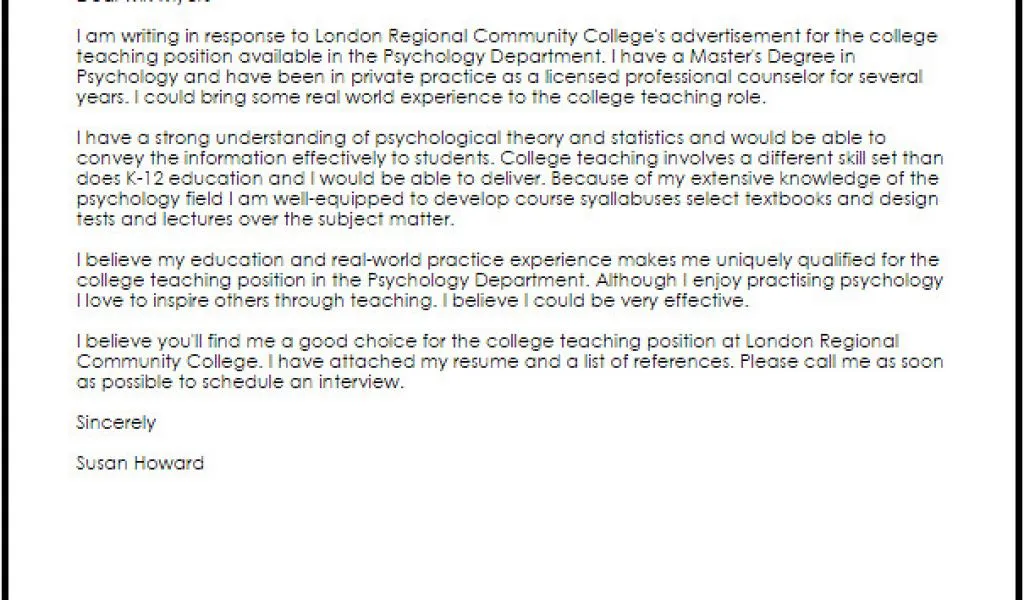
Crafting a Compelling College Teaching Cover Letter
A college teaching cover letter is your first introduction to a potential employer, acting as a critical tool to showcase your qualifications, experience, and passion for education. It’s more than just a formality; it’s an opportunity to present a narrative that complements your resume, highlighting why you are the ideal candidate for the position. A well-crafted cover letter demonstrates your understanding of the role, the institution, and your ability to contribute to the academic environment. Taking the time to develop a strong cover letter can significantly increase your chances of securing an interview and ultimately, landing your dream job.
Understanding the Purpose of a Cover Letter
Why a Cover Letter Matters

A cover letter serves several important purposes. First, it provides context to your resume, allowing you to elaborate on your experiences and skills in a way that a resume cannot. Second, it allows you to demonstrate your personality, enthusiasm, and writing abilities, which are all essential qualities in a teaching position. Third, it gives you the chance to connect your qualifications to the specific requirements of the job and the values of the institution. Finally, a cover letter shows that you are serious about the position and have taken the time to understand the opportunity.
Key Components of a Successful Cover Letter
Contact Information and Salutation
Begin with your contact information at the top, including your name, address, phone number, and email address. Following this, address the letter to the hiring manager, if possible. Research the department or institution website to find the correct person’s name, which shows initiative. Use a professional salutation such as ‘Dear Dr. [Last Name]’ or ‘Dear Professor [Last Name]’. If the name is unavailable, use a general salutation like ‘Dear Hiring Committee’.
Opening Paragraph Making a Strong First Impression
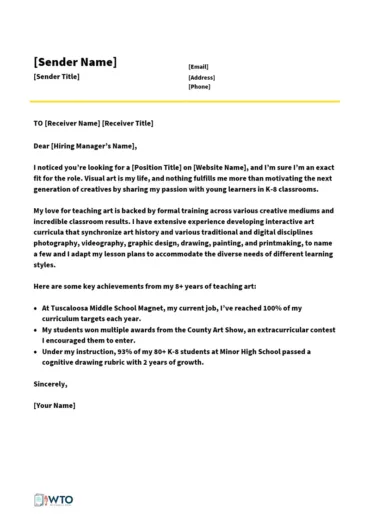
The opening paragraph is your chance to grab the reader’s attention. State the position you are applying for and where you saw the advertisement. Briefly mention your most relevant qualifications and why you are excited about the opportunity. Avoid generic opening lines. Instead, convey genuine enthusiasm and demonstrate your understanding of the institution’s mission or values. Make it clear from the start why you are a strong fit for the role and the institution.
Highlighting Your Qualifications and Experience
Showcasing Relevant Skills and Expertise
This is the core of your cover letter, where you demonstrate your skills and expertise. Focus on the skills and experiences that align with the job description’s requirements. Provide specific examples of how you have applied these skills in the past. Use action verbs to describe your accomplishments and the impact of your work. Clearly articulate how your skills benefit the institution, highlighting your teaching philosophy and how it aligns with the department’s goals.
Quantifying Achievements and Contributions

Whenever possible, quantify your achievements. Use numbers to illustrate your successes. For example, ‘Increased student engagement by 15%’ or ‘Developed a new curriculum that improved student grades by 10%’. Quantifiable results demonstrate the impact of your work and provide concrete evidence of your abilities. This makes your claims more credible and helps the hiring committee understand the value you bring to the institution.
Addressing Specific Requirements and Preferences
Tailoring Your Letter to the Institution
Each cover letter should be tailored to the specific institution and position. Research the college or university, its mission, values, and recent achievements. Demonstrate your understanding of the institution by mentioning specific programs, initiatives, or research areas that resonate with you. This shows that you are genuinely interested in the opportunity and have taken the time to learn about the institution beyond the job posting. Tailoring your letter demonstrates your commitment and increases your chances of standing out.
Demonstrating Your Understanding of the Position

Carefully analyze the job description and address all the requirements. Explain how your qualifications and experiences match the specific needs of the role. Highlight any unique skills or experiences that set you apart from other candidates. If the position requires specific software proficiency or teaching methodologies, make sure to mention them. Emphasize your ability to contribute to the department’s teaching, research, or service goals.
Expressing Enthusiasm and Interest
Show your genuine enthusiasm for the position and the institution. Express your excitement about the opportunity to contribute to the academic community. Mention specific aspects of the role that appeal to you. Demonstrate your passion for teaching and your commitment to student success. Conveying enthusiasm helps the hiring committee see you as a motivated and engaged candidate who will be a valuable asset to the department.
Closing Paragraph and Call to Action
In the closing paragraph, reiterate your interest in the position and thank the hiring committee for their time and consideration. Express your availability for an interview and provide your contact information again. Use a professional closing such as ‘Sincerely,’ or ‘Best regards,’. Always proofread your letter one final time before sending it to ensure there are no errors or typos. A strong closing leaves a lasting positive impression and encourages the hiring committee to take the next step.
Formatting and Presentation

Your cover letter should be easy to read and visually appealing. Use a professional font, such as Times New Roman, Arial, or Calibri, and maintain a consistent font size (11 or 12 points). Use standard margins (1 inch on all sides) and double-space between paragraphs. Keep the letter to one page. Use clear headings and subheadings to break up the text and make it easier for the reader to scan. Ensure your letter has a professional layout, free from any distracting formatting elements.
Proofreading and Editing
Proofread your cover letter multiple times, checking for any grammatical errors, typos, or inconsistencies. Read it aloud to catch any awkward phrasing. Have a friend or colleague review it as well, as a fresh pair of eyes can often spot mistakes you might miss. Pay close attention to the tone of your letter, ensuring it is professional and enthusiastic. A polished and error-free cover letter demonstrates your attention to detail and professionalism.
Tips for Different Types of Teaching Positions
Lecturer Positions
For lecturer positions, highlight your teaching experience and the ability to develop and deliver engaging lectures and assessments. Emphasize your experience with different teaching methodologies, your ability to work with diverse student populations, and your knowledge of current pedagogical best practices. If applicable, showcase any curriculum development experience or any skills in incorporating technology into the classroom.
Assistant Professor Positions
When applying for assistant professor positions, emphasize your research experience, publications, and the potential to contribute to the institution’s research agenda. Detail your research interests and how they align with the department’s focus areas. Demonstrate your ability to secure grant funding, and your plans to establish a research program. Highlight your teaching experience and any efforts to mentor students in research. Show how your work has already contributed to your field, or how it promises to do so.
Associate Professor and Professor Positions
For associate professor or professor positions, highlight your significant contributions to teaching, research, and service. Showcase your leadership experience and your ability to mentor junior faculty and students. Provide evidence of your successful grant funding, impactful publications, and established research program. Detail your experience with curriculum development and departmental leadership. Demonstrate your ability to collaborate with colleagues and contribute to the overall success of the department.
Common Mistakes to Avoid
Generic Cover Letters
Avoid using a generic cover letter that is not tailored to the specific position or institution. Generic letters often lack the specific details that demonstrate your genuine interest and understanding of the opportunity. Customize your letter to show the hiring committee that you have taken the time to research the institution and understand the requirements of the role. This demonstrates your commitment and attention to detail and significantly improves your chances of success. A generic cover letter often appears impersonal and may be immediately discarded.
Typos and Grammatical Errors
Typos and grammatical errors can damage your credibility and make a negative impression. Always proofread your cover letter carefully before submitting it. Use spell-check and grammar-check tools, but also have a friend or colleague review it. A clean and error-free cover letter demonstrates your professionalism and attention to detail. Errors indicate a lack of care and can make the hiring committee question your ability to produce professional work.
Focusing Solely on Yourself
While it’s important to highlight your qualifications and experience, avoid making your cover letter solely about you. Instead, focus on how your skills and experiences align with the needs of the institution and how you can contribute to its success. Show that you understand the institution’s goals and values and how you can help achieve them. Demonstrate your enthusiasm for the opportunity and the ability to contribute to the department’s mission. A balanced cover letter that focuses on both your abilities and the institution’s needs is far more effective.
Example Cover Letter Snippets
Opening Paragraph Examples
Example 1 ‘I am writing to express my enthusiastic interest in the [Position Name] position at [Institution Name], as advertised on [Platform]. With over [Number] years of experience in [Field], coupled with a strong commitment to student success and a passion for [Specific Area], I am confident I possess the skills and dedication necessary to excel in this role and contribute to the vibrant academic community at [Institution Name].’
Example 2 ‘Having closely followed the innovative research conducted by the [Department Name] at [Institution Name], I am eager to apply for the [Position Name] position. My expertise in [Specific Area] and my demonstrated ability to develop engaging curricula, coupled with my strong commitment to student mentorship, align perfectly with the values and goals of your department. I am excited about the opportunity to contribute to your team and help shape the future of [Field].’
Highlighting Skills and Experience Examples
Example 1 ‘In my previous role at [Previous Institution], I developed and implemented a new curriculum in [Course Name] that resulted in a 15% increase in student engagement and a 10% improvement in student grades. I am proficient in [Specific Software/Methodologies] and have successfully integrated technology into my teaching practice to enhance student learning outcomes.’
Example 2 ‘My research on [Specific Research Area] has led to publications in [Journals/Conferences] and has resulted in [Specific Achievements]. I have a proven track record of securing grant funding, including [Grant Name], and I am passionate about mentoring students and helping them achieve their academic goals. My experience with [Specific Teaching Methods] aligns perfectly with the learning goals of your institution.’
Closing Paragraph Examples
Example 1 ‘Thank you for considering my application. I am eager to learn more about this exciting opportunity and discuss how my skills and experience align with the needs of [Institution Name]. I am available for an interview at your earliest convenience and can be reached at [Phone Number] or [Email Address]. Sincerely, [Your Name]’
Example 2 ‘I am highly enthusiastic about the prospect of joining the faculty at [Institution Name] and contributing to the success of the [Department Name]. I have attached my resume for your review and welcome the opportunity to discuss my qualifications further. Thank you for your time and consideration. Best regards, [Your Name]’