What is a Cover Letter?
A cover letter is a crucial document that accompanies your resume when applying for a job, acting as your initial introduction to a potential employer. It’s a formal letter that highlights your skills, experience, and enthusiasm for a specific position. Unlike a resume, which provides a factual summary of your qualifications, a cover letter allows you to elaborate on your experiences, express your personality, and demonstrate why you are the ideal candidate for the role. A well-crafted cover letter can significantly increase your chances of getting an interview by capturing the hiring manager’s attention and showcasing your unique value proposition. It allows you to make a strong first impression and persuade the employer to consider your application further.
Why is a Cover Letter Important?
In the competitive field of civil engineering, a cover letter serves as a vital tool for making a strong impression and differentiating yourself from other applicants. It allows you to go beyond the bullet points of your resume and provide context to your qualifications, demonstrating how your skills and experiences align with the specific requirements of the job. A well-written cover letter showcases your communication skills, attention to detail, and genuine interest in the position and the company. It provides an opportunity to address any potential gaps in your resume, explain career transitions, and express your passion for civil engineering. Many employers consider a cover letter a mandatory part of the application process, viewing it as a reflection of your professionalism and commitment. It’s your chance to convince them you are the right fit.
Key Components of a Civil Engineer Cover Letter

A compelling cover letter for a civil engineer typically includes several key components that work together to present a complete picture of your qualifications and suitability for the role. These components include your contact information and a professional header, a compelling greeting and introduction, a section highlighting your relevant skills and experiences, another section focusing on quantifiable achievements, a demonstration of your passion for civil engineering, and a clear call to action. Each of these components plays a specific role in crafting a persuasive narrative. It’s important to tailor each element of your cover letter to the specific job requirements and the company’s culture to maximize its impact and increase your chances of securing an interview.
Contact Information and Header
At the top of your cover letter, include your contact information, which should include your name, address, phone number, and professional email address. Ensure your email address is professional and appropriate. Below your contact information, include the date and the employer’s contact information, which typically includes the hiring manager’s name, title, company name, and address. Correct formatting and accuracy are important for creating a professional first impression. Always double-check this information to ensure it’s up-to-date and accurate to avoid any potential communication issues. This initial section helps the employer easily reach you and demonstrates your attention to detail.
Greeting and Introduction
Begin your cover letter with a professional greeting, such as “Dear Mr./Ms./Mx. [Last Name],” whenever possible. Research the hiring manager’s name to personalize your letter. If the name is unavailable, opt for a general greeting like “Dear Hiring Manager.” The introduction is where you immediately capture the reader’s attention, clearly stating the position you are applying for and where you found the job posting. Briefly highlight your most relevant qualifications and express your enthusiasm for the opportunity. Consider including a brief statement about why you are interested in the company or the specific role, setting the tone for the rest of the letter and demonstrating your genuine interest. A strong introduction is the first step toward making a positive impression.
Highlighting Relevant Skills and Experience

In the body of your cover letter, provide detailed information about your skills and experience that align with the job requirements. Review the job description carefully and identify the key skills and qualifications the employer is seeking. Then, highlight specific examples from your work history, projects, or academic experiences that demonstrate your proficiency in these areas. Use action verbs to describe your accomplishments and focus on what you have achieved, rather than just listing your responsibilities. Tailor the content to the specific job, emphasizing experiences that showcase your relevant expertise, such as project management, structural analysis, design, construction, or any specialized software skills. This section is about showing the employer why you’re a perfect fit.
Quantifiable Achievements
To make your cover letter even more impactful, quantify your achievements whenever possible. Use numbers, percentages, and specific data to demonstrate the results you’ve achieved in your previous roles. For instance, instead of saying “Improved project efficiency,” say “Improved project efficiency by 15% through the implementation of a new scheduling system.” This helps employers understand the value you can bring to their organization. Highlight any instances where you’ve saved time, reduced costs, improved safety, or successfully completed projects ahead of schedule. Quantifiable results provide concrete evidence of your capabilities and make a strong impression on the hiring manager. Show, don’t just tell; use concrete examples to prove your worth.
Showcasing Your Passion for Civil Engineering
Demonstrate your genuine passion for civil engineering by expressing your enthusiasm for the field and the specific role you are applying for. Discuss your interest in the company’s mission, values, or projects, and explain why you are excited about the opportunity to contribute. Show your understanding of the challenges and rewards of civil engineering. Mention any industry trends or technologies that you find interesting. Share any relevant experiences, such as participation in professional organizations, relevant coursework, or personal projects that reflect your dedication to the field. Showing passion makes you a more compelling candidate. It signals a commitment beyond simply fulfilling the job requirements.
Tailoring Your Cover Letter to the Job

One of the most important aspects of writing a compelling cover letter is tailoring it to the specific job and company you’re applying to. Avoid using a generic cover letter template. Carefully review the job description and identify the key requirements, skills, and qualifications the employer is seeking. Then, customize your letter to address these specific needs. Highlight the experiences and skills most relevant to the position, using the same keywords and terminology that are used in the job description. Research the company and its projects to demonstrate your interest. Mention specific reasons why you want to work for them. Tailoring your cover letter shows that you’ve taken the time to understand the job and the company’s needs, making you a more appealing candidate.
Addressing Specific Requirements
In addition to tailoring your cover letter to the specific job, address any specific requirements or qualifications mentioned in the job description. For instance, if the job requires proficiency in a specific software program, make sure to highlight your experience with that program and any relevant projects where you used it. If the job posting mentions a particular certification or license, ensure that you mention your relevant certifications and licensure. Similarly, if the job emphasizes teamwork, communication, or leadership skills, provide examples of how you’ve demonstrated these skills in your previous roles. By directly addressing these requirements, you demonstrate that you have carefully read the job description and are a well-matched candidate.
Using Keywords from the Job Description
To further optimize your cover letter, incorporate relevant keywords from the job description throughout the text. Employers often use applicant tracking systems (ATS) to screen applications, and these systems scan for keywords that match the job requirements. By including these keywords in your cover letter, you increase the chances of your application being noticed. However, avoid keyword stuffing, which can make your letter sound unnatural and detract from its overall impact. Instead, strategically weave keywords into your descriptions of skills and experience, focusing on relevance and readability. Integrate keywords naturally into the sentences so that they enhance the clarity and highlight your qualifications.
Formatting and Professionalism

The formatting of your cover letter plays a significant role in making a positive impression on the employer. Use a professional font such as Times New Roman, Arial, or Calibri, and maintain a consistent font size (11 or 12 points). Ensure your letter is well-structured, with clear paragraphs, concise sentences, and appropriate spacing. Use bullet points to highlight key accomplishments or skills. Avoid excessive use of bolding or underlining. Ensure your letter is easy to read and visually appealing. Maintain a professional tone throughout the letter, avoiding slang or informal language. Pay attention to your grammar, spelling, and punctuation. Proofread your letter carefully for any errors before submitting your application. A polished and well-formatted letter demonstrates your attention to detail and professionalism.
Proofreading and Editing
Proofreading and editing are essential steps in ensuring that your cover letter is free of errors and presents you in the best possible light. Carefully review your letter for any grammatical errors, spelling mistakes, punctuation issues, and typos. It helps to read your letter aloud to catch any awkward phrasing or sentences that do not flow smoothly. Consider having a friend, family member, or career advisor review your letter as a fresh pair of eyes can often spot errors that you might miss. Ensure that the tone is professional and the content is clear and concise. Editing helps you to refine your writing. These processes help you to present yourself as a polished candidate who pays attention to detail.
Call to Action and Closing
Conclude your cover letter with a clear call to action and a professional closing. Express your enthusiasm for the opportunity and reiterate your interest in the position. State your availability for an interview and how the employer can contact you. Thank the hiring manager for their time and consideration. Use a professional closing such as “Sincerely,” “Best regards,” or “Yours sincerely.” Double-check your contact information to ensure it is correct. A strong closing reinforces your interest and increases the likelihood of a positive response. This section is a reminder to the hiring manager of your request for an interview.
Reviewing and Refining Your Letter

Before submitting your cover letter, take the time to review and refine it thoroughly. Ensure your letter is tailored to the specific job and company, highlighting the most relevant skills and experiences. Confirm that your achievements are quantified. Make sure that the tone is professional and the formatting is consistent. Proofread your letter carefully for any errors in grammar, spelling, and punctuation. Consider seeking feedback from career advisors. By reviewing and refining your letter, you can ensure that it makes a strong impression and effectively conveys your qualifications and passion for civil engineering. Your goal should be to create a compelling document that sets you apart from other candidates.
Example Cover Letter for Civil Engineer
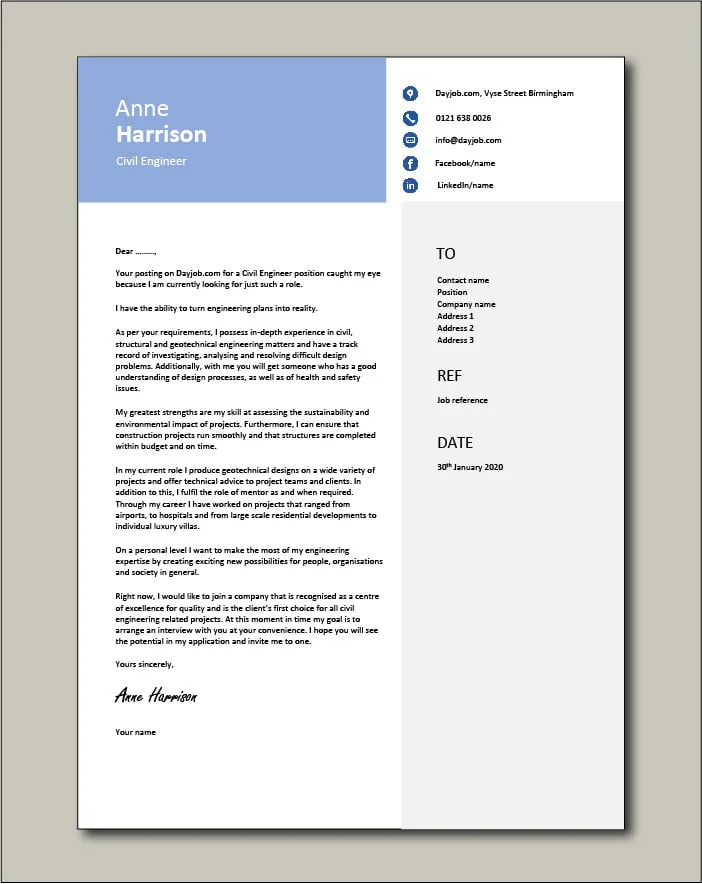
Here’s a sample cover letter, keeping in mind the points we discussed in this guide. Remember that every cover letter should be personalized to fit the specific job and the company. [Your Name] [Your Address] [Your Phone Number] [Your Email Address] [Date] [Hiring Manager Name] [Hiring Manager Title] [Company Name] [Company Address] Dear [Hiring Manager Name], I am writing to express my enthusiastic interest in the Civil Engineer position at [Company Name], as advertised on [Platform]. With [Number] years of experience in civil engineering, I am confident that my skills and experience make me an excellent fit for this role. In my previous role at [Previous Company], I successfully managed [Number] projects. I was responsible for [responsibilities]. I am proficient in [Software]. I am excited about the opportunity to contribute to [Company Name]’s projects. Thank you for your time and consideration. Sincerely, [Your Name]
Common Mistakes to Avoid
While composing your cover letter, be aware of common mistakes that can undermine your application. Avoid using a generic cover letter that is not tailored to the specific job. Don’t make excessive use of jargon or technical terms that the hiring manager may not understand. Do not include irrelevant information or repeat everything that is on your resume. Avoid spelling and grammatical errors. Don’t write a cover letter that is too long or unfocused. Do not make negative statements about previous employers or roles. The most important thing is to be truthful. Take the time to thoroughly review and refine your letter. Avoiding these common mistakes will enhance your chances of making a positive impression on the employer and being considered for the position.