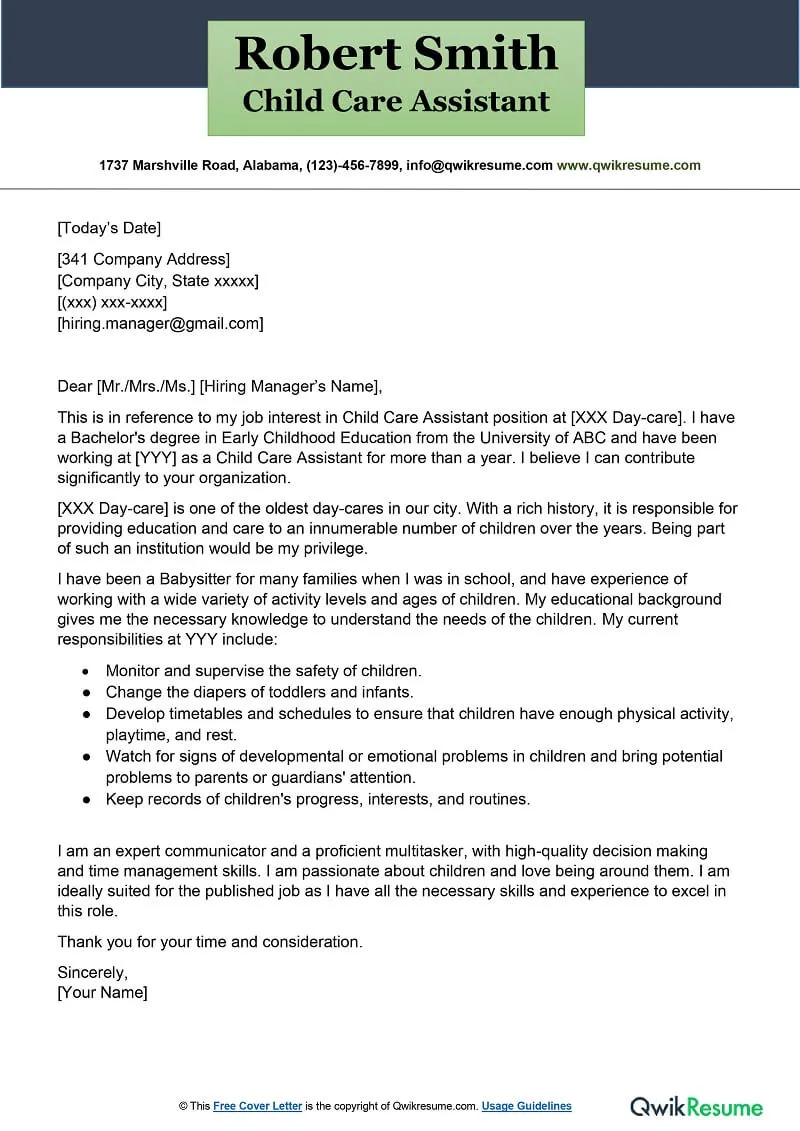
Understanding the Importance of a Childcare Assistant Cover Letter
A well-crafted cover letter is your first introduction to a potential employer and serves as a crucial tool in securing a childcare assistant position. It’s more than just a formality; it provides you with the opportunity to showcase your personality, skills, and enthusiasm for working with children. Unlike a resume, which presents a summary of your qualifications, a cover letter allows you to elaborate on your experiences, explain your career goals, and demonstrate how your abilities align with the specific requirements of the job. Therefore, investing time and effort into creating a compelling cover letter is essential for making a positive first impression and standing out from other applicants. A strong cover letter increases your chances of getting an interview and ultimately landing the job.
Key Components of a Childcare Assistant Cover Letter
A successful cover letter includes several key components that work together to create a strong narrative. These components should be organized logically, allowing the hiring manager to quickly grasp your qualifications and understand why you’re the ideal candidate. The structure typically begins with your contact information, followed by a professional salutation. The body of the letter should highlight your relevant experience, showcase your skills and qualifications, and express your passion for childcare. It’s also important to customize the letter for each specific job application, adapting it to the employer’s needs and values. Finally, a clear closing with a call to action, along with your contact information, should conclude the letter.
Contact Information and Salutation

Begin your cover letter by providing your contact information, including your full name, phone number, email address, and optionally, your LinkedIn profile URL. This allows the employer to easily reach you if they wish to schedule an interview. Following your contact information, include the date and the employer’s contact information if available. Address the hiring manager directly, using their name if known; otherwise, use a professional salutation such as ‘Dear Hiring Manager.’ This personalized approach shows that you’ve taken the time to research the organization and demonstrates respect and attention to detail. Avoid generic salutations like ‘To Whom It May Concern’.
Highlighting Relevant Experience
In the body of your cover letter, dedicate a section to highlighting your relevant experience. Briefly describe your past childcare roles, such as babysitting, volunteering at a daycare, or working as a camp counselor. For each experience, specify your responsibilities, the age groups of the children you worked with, and any special achievements or skills you developed. Quantify your accomplishments whenever possible. For instance, instead of stating ‘Assisted with daily activities,’ you could write ‘Planned and implemented age-appropriate activities for a group of 10 children, resulting in a 20% increase in engagement.’ By providing concrete examples and measurable results, you demonstrate the value you can bring to the position.
Showcasing Skills and Qualifications
This is your opportunity to showcase the skills and qualifications that make you a great candidate. Identify the key skills the employer is looking for in the job description, and then provide examples of how you have demonstrated these skills in your previous roles. Common skills for childcare assistants include patience, creativity, communication, problem-solving, and the ability to create a safe and nurturing environment. You can also highlight any relevant certifications, such as first aid, CPR, or any early childhood education courses you’ve taken. Tailor your skills to the specific requirements mentioned in the job posting to make a stronger connection with the employer.
Demonstrating Passion and Enthusiasm

Employers seek childcare assistants who are genuinely passionate about working with children. Express your enthusiasm by sharing why you enjoy childcare and what motivates you to pursue this career path. Discuss your approach to working with children, highlighting your ability to create a positive and engaging environment. You can mention any specific values that are important to you, such as fostering creativity, promoting learning, or ensuring the children’s well-being. Your passion will set you apart from other candidates and show the employer that you are truly invested in the role and the children you will care for. Use enthusiastic language and personal anecdotes to bring your passion to life.
Customizing Your Cover Letter
One of the most critical steps in writing a winning cover letter is customization. Avoid sending a generic cover letter to every job. Instead, tailor your letter to each specific role and employer. Research the childcare center, daycare, or school to understand their mission, values, and specific needs. Review the job description carefully, noting the skills and qualifications they are seeking. In your cover letter, address these requirements directly, providing examples of how your experience aligns with their needs. Show that you’ve taken the time to understand the organization and are genuinely interested in the position. This personalization will increase your chances of getting an interview. Also, check for any contact information or social media handles that you can use to learn more about the company.
Formatting and Presentation Tips
The format of your cover letter is crucial to ensure it is easily readable and professional-looking. Use a clean and clear font, such as Times New Roman, Arial, or Calibri, in a size between 11 and 12 points. Maintain consistent formatting throughout the document, including margins, spacing, and bullet points if used. Keep the letter concise, ideally no more than one page. Use clear headings and subheadings to break up the text and make it easy for the reader to scan. Proofread the document carefully to eliminate any grammatical errors, spelling mistakes, or typos. A well-formatted cover letter reflects your attention to detail and professionalism. Remember that the goal is to present yourself in the best possible light.
Choosing the Right Tone

The tone of your cover letter should be professional, enthusiastic, and appropriate for the childcare industry. Use positive language and focus on your strengths and accomplishments. While expressing your passion, maintain a professional demeanor, avoiding overly casual or informal language. Show respect for the employer and the organization, and express your genuine interest in the position. The tone should reflect your personality while remaining professional and appropriate for a job application. Ensure that your personality shines through your writing while maintaining respect for the potential employer.
Proofreading and Editing
Before submitting your cover letter, proofread it carefully for any errors. Errors can undermine your credibility and create a negative impression. Check for spelling mistakes, grammatical errors, punctuation errors, and typos. Read the letter aloud to catch any awkward phrasing or sentences that don’t flow well. It’s also beneficial to have someone else review your cover letter. Another pair of eyes can often catch mistakes that you might miss. Make sure all information is accurate, especially the contact information. A polished, error-free cover letter demonstrates your attention to detail and professionalism.
Writing the Closing and Call to Action
The closing of your cover letter should leave a lasting positive impression and encourage the employer to take the next step. Express your gratitude for their time and consideration. Then, include a call to action, indicating your desire for an interview and providing your availability. For example, you could write: ‘Thank you for your time and consideration. I am eager to learn more about this opportunity and would welcome the chance to discuss my qualifications in an interview. I am available for an interview at your earliest convenience.’ Provide your contact information once again, just in case the employer doesn’t scroll up. Ensure your closing is professional and leaves a positive impression.
Thank You and Contact Information

Always end your cover letter with a thank you to the hiring manager for their time and consideration. This shows your respect and appreciation for their efforts. Include your contact information again, including your phone number and email address, to make it easy for the employer to reach you. It’s always a good idea to reiterate your enthusiasm for the position and your interest in an interview. A professional closing such as ‘Sincerely,’ ‘Best regards,’ or ‘Yours sincerely’ is appropriate. Ensure all of your contact details are correct.
Following Up After Submission
After submitting your cover letter and resume, it’s a good practice to follow up with the employer. Wait for about a week to ten days after submitting your application before sending a brief follow-up email. In the email, reiterate your interest in the position and ask if they have received your application and if they require any further information. Keep the email concise and professional, and thank them again for their consideration. Following up demonstrates your initiative and continued interest in the role. This action can help you stand out and may even increase your chances of being considered for an interview.